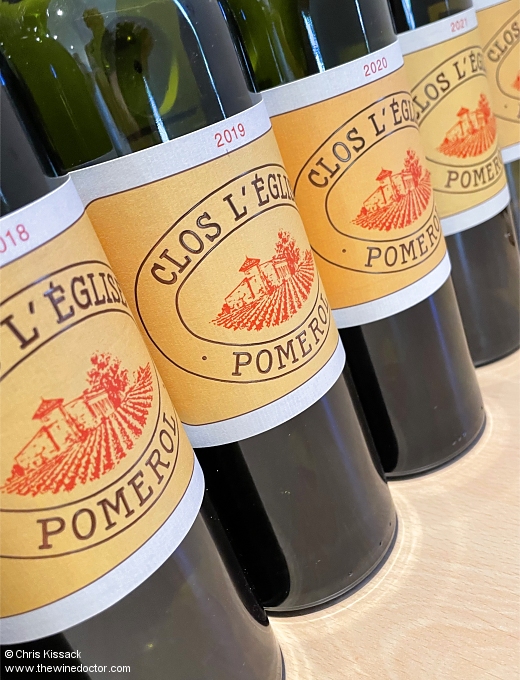
Clos L’Église: Tasting & Drinking
Not being familiar with the wines prior to the arrival of Hélène Garcin-Lévêque I can make no comment on the efforts of the Moreau frères, or indeed of the Rouchut family. I should also point out that, during my early years of exploring Bordeaux and Pomerol, this was not a domaine I was able to follow closely, and as a consequence I tasted only a handful of contemporary vintages. Happily, in more recent times I have expanded my knowledge and tasting experience of the domaine, and have tasted pretty much every vintage since the Garcin-Lévêque family arrived in 1997. This is partly down to my repeated requests to visit the estate (not always answered!), but also consequent upon a vertical tasting hosted by Hélène back in 2018.
Having tasted every vintage since 1997, I was struck by the honest character of the wines. There is no obvious step-change in quality or style during the two decades, despite the efforts of the proprietors; instead the wines seem to remain most true to the style of their respective vintages. This is especially so in the more challenging seasons, such as 1997, 2002 and 2007, when the less certain ripeness of the fruit seems to have allowed the character of the Cabernet Franc to shine through most of all. These are the vintages with lightly greener, minty, bay leaf and green peppercorn characteristics. In contrast, those vintages which were strongest for the Bordeaux region, or for Pomerol in particular, such as 1998, 2000, 2001, 2005, 2009, 2010 and 2015, shine most brightly, with perhaps one or two exceptions. And looking to more recent vintages, the 2016, 2018, 2019, 2020, 2022 and 2023 vintages all have merit.
I have also been taken by the fine quality on offer here, especially in maturity, even in some of the aforementioned lesser vintages. The 1997 vintage was one of the more challenging of the 1990s, and at this time the owners were still fresh-faced and inexperienced. Nevertheless, tasted at just over twenty years of age, this vintage showed delightful maturity and while not the greatest wine you will ever encounter it made for perfect drinking, providing you are a fan of the more savoury characteristics of aged Bordeaux, including some of those fresh, greener Cabernet Franc methoxypyrazine complexities. The 2002 and 2007 vintages are perhaps less convincing, but maybe they just need another five or ten years in the cellar. If you are in the market for a mature bottle, though, I would have to direct you towards one of the more successful vintages listed above.
With the passing of the years I have come to recognise that, if you are hankering for you next glass of Pomerol, Clos L’Église can be a good choice, its wines tending to evolve in a charming fashion with an appealing freshness, more so than some of the other wines from the Garcin-Lévêque stable. If you were to line up the wines of Clos L’Église, Poesia, Château Barde-Haut, it would undoubtedly be the glass of Pomerol I would reach for first. Clos L’Église is an estate which I now try to follow as closely as possible, with the expectation of better and better wines in the future. (9/12/09, updated 20/8/14, 4/3/18, 14/8/26)