Poesia
Ranking: Grand Cru (St Emilion Classification)
Appellation: St Emilion
Owner: Patrice & Hélène Garcin-Lévêque
Ten-second primer: An overlooked property which went by the name Haut-Villet, the acquisition by Patrice & Hélène Garcin-Lévêque was this estate’s salvation. A source of firm, limestone-shaped St Emilion since their first vintage in 2014. Winemaking overseen by Patrice & Hélène Garcin-Lévêque.
This profile includes: Three pages of history and detail (links above), and tasting notes back to 2014.
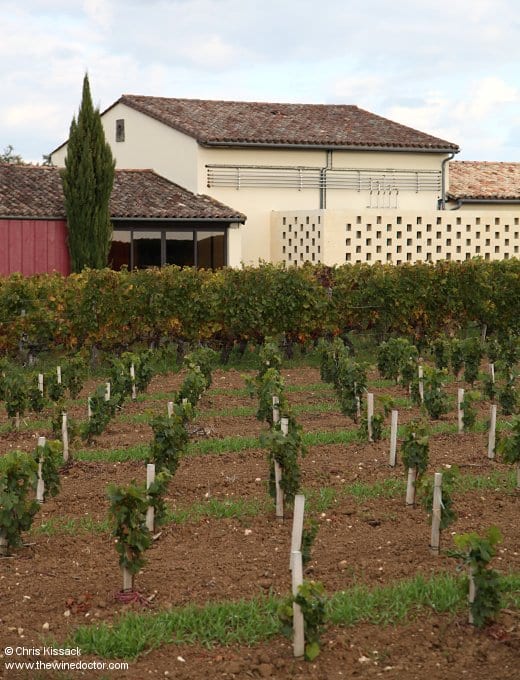
On the road heading east out of the St Emilion appellation, beyond even Château Valandraud, as you approach the vineyards of Castillon, there once sat a rather unprepossessing estate. There was a hotchpotch of understated, low-slung buildings (one of which is pictured below), the ruined tower of a long-disused mill (pictured on the next page), and almost 10 hectares of vines. For may years a great sign covering a large part of one wall declared the estate’s identity as Château Haut-Villet.
In 2013, however, all this came to an end. A new owner arrived, bringing a new sense of dynamism to the vineyards and cellars. The name was changed, to match a property the newcomers already owned in Argentina, and what was Haut-Villet became Poesia. It seemed clear from the outset that much was due to change here, not just the name on the label, but in the cellars too, as well as the style of what went into the bottle.
In the decade and more that has passed since the property changed hands this prediction has been proved correct; the domaine has since been transformed. The cellars have been rebuilt, in a manner sensitive to the pre-existing design (even if there is a rather dramatic glass-walled cuverie on one side of the property), and the wines, which accurately represent their limestone origins, are to be commended.
The individuals who are to be credited with undertaking this modern-day renaissance are Hélène and Patrice Garcin-Lévêque, previously better known for their tenure of Château Barde-Haut and Clos L’Église. Before we come to their arrival in this tale, however, I first present a little context, with a potted history for the estate.
History
The hills and slopes around St Emilion have a viticultural history which stretches back as far as the Gallo-Roman period. Ancient viticulteurs would plant vines (as well as fruit trees) in trenches hewn from the region’s limestone rock, and even today the remains of these trenches can still be seen, to the west of the town around Château Franc Mayne, Château Bellevue and behind Château Ausone. Here to the east of the town, around Poesia, we have another corner of the appellation with an equally ancient history. There are no limestone trenches here (at least, none that I know of) but there have been enough archaeological finds made in these vineyards to indicate that Gallo-Roman agriculteurs once tended this land.