Home > Producer Profiles > Bordeaux Profiles > Chateau Latour à Pomerol

Chateau Latour à Pomerol

It seems only natural after writing a profile of Petrus, one perhaps long overdue, that I should turn my attention to Latour à Pomerol, for there are one or two notable parallels between the two estates (and many stark differences too, I admit). Both properties were for many years in the ownership of Madame Loubat, and both have since then found their way into the ownership of JP Moueix. That, however, is perhaps where the comparisons must end.

Latour à Pomerol: A History

Perhaps one feature that distinguishes Latour à Pomerol from Petrus, and indeed most other properties of Pomerol, is the peculiarly morcellated nature of the vineyards, with plots scattered here and there throughout the appellation. This in part reflects the history of the estate, which in the most distant past is fairly sketchy, the mists only beginning to clear during the 19th century. At this time there was a family of vignerons in Pomerol named Chambaud, and it was their vineyards that would form the basis, although not the largest part it would seem, for what we know today as Latour à Pomerol. The sole heiress to the Chambaud estate married Louis Garitey in 1875, and the estate stayed in the ownership of the couple until Garitey's death in 1914, when it was divided between their three daughters. One of these was the aforementioned Madame Loubat, who went on to acquire other properties, including an estate called Haut-Canton-Guillot, next to Trotanoy, and the Clos des Grandes-Vignes next to the church in Pomerol. It was these two estates, although primarily the Grandes-Vignes plot, together with the smaller inherited vineyard, that formed the lion's share of what would be Latour à Pomerol. Its first appearance in written documents was in the 1890 edition of Cocks & Feret, fifteen years after their marriage, when it was ranked amongst some of the best estates of the appellation.

The estate remained in the hands of Loubat until her death in 1961 when, as was the case with Petrus, it was inherited by her niece Lily Lacoste. And as with Petrus, the estate benefited from the developing business relationship between the Loubat-Lacoste and Moueix families, as the latter took on responsibility for tending the vines as well as making and marketing the wines the following year. Nevertheless Lacoste maintained ownership of the estate until 2002, when she donated it in entirety to the charitable Fondation de Foyers de Charité de Châteauneuf de Galaure. By now well into her nineties this was perhaps a questionable decision, and her nephew Guy Pétrus-Lignac is on record as being suspicious about these events, perhaps more so when it was revealed that many bottles of Petrus had been mysteriously liberated from Lacoste's cellar. Was someone abusing Lacoste's trust? This was the beginning of the Petrus scandal, an as yet inadequately resolved dispute which I have covered in more detail in my Petrus profile. There is little more to say on the matter here, although it is worthy of note that of the three standing accused of taking advantage of the elderly Lacoste one is François Burel, the general secretary of the Fondation de Foyers de Charité de Châteauneuf de Galaure. Whatever the eventual result of this debacle, for the moment the charity still holds tenure here, and JP Moueix Etablissements continue in the same manner as they did before Lacoste's demise.

Latour à Pomerol: Vineyards and Wines

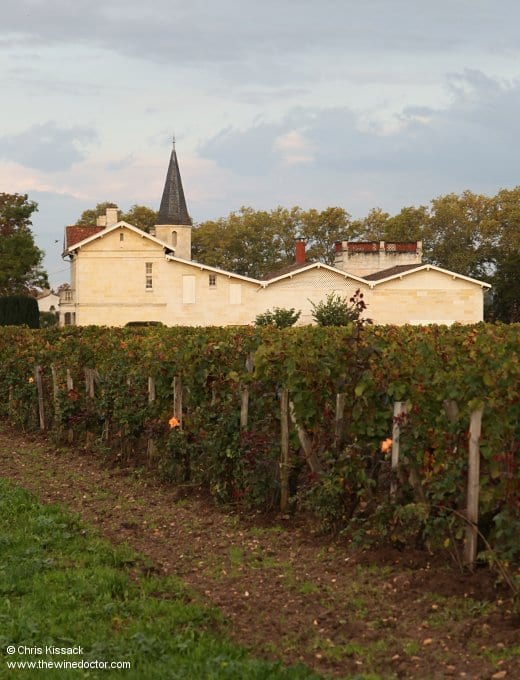
Latour à PomerolAs mentioned above the vines are divided between a number of plots in the Pomerol appellation, the principal being the Grandes-Vignes plot, which surrounds the Pomerol church, and which covers 5 hectares. The remaining plots are further to the west, near the road between Pomerol and Périgueux. The vines cover 8 hectares all told, mostly on soils of sandy clay and gravel, with sand particularly dominant in the vineyards towards the west of the appellation. The vines have an average age of 35 years, and are 90% Merlot and 10% Cabernet Franc. The fruit is harvested by hand, as should be expected, and then fermented in temperature-controlled concrete vats. After malolactic fermentation it then goes into barrique, 50% new each vintage, for 18 months, before it is bottled with filtration. The total output is in the order of 3000 cases, all of which is the grand vin, Latour à Pomerol. There is no second wine.

As for the wines, they are on the whole up to the high standard that we should expect from the Moueix family, at least in the half-a-handful of vintages I have tasted. Other critics certainly have positive comments to make, including Clive Coates who writes in Grands Vins (University of California Press, 1995) of a "full wine with a concentration which comes from the dominance in old vines", a feature attributable to the vineyard avoiding terminal damage in the frost of 1956. Looking to my tastings, the 2008 was very good indeed, reflecting the appeal of this vintage, especially the Pomerol appellation, when tasted en primeur. For me it was one of the top-ten 'best buys' of 2008. The 2007 was weaker, but this is the nature of the beast; few proprietors made anything of great interest in this difficult year. Prior to that an inspection of my tasting experience exposes a yawning chasm, with only a couple of vintages on which I can report. The 1988 was a very good wine which did well in a line-up from that vintage, and although I was less impressed with the 1994 it was still a wine showing considerable potential which I would like to revisit. (21/8/09)

Contact details:
Address: 54, quai du Priourat, 33502 Libourne
Telephone: +33 (0) 5 57 51 78 96
Fax: +33 (0) 5 57 51 79 79
Internet: www.moueix.com

Chateau Latour à Pomerol - Tasting Notes

Click to locate stockists.

2009

Chateau Latour à Pomerol (Pomerol) 2009: A Mouiex wine. This very dark wine has a great nose of cherry fruit, although it does have a hint of that macerated cherry-skin character too. Bold and creamy on entry, there is a little hint of alcohol at first although it disappears as quickly as it appeared, leaving a very fruit-forward and fleshy wine, underneath which there is ripe tannin and good acidity. Very attractive although it does not have the precision of the greater wines. Still very fine potential though. From my 2009 Bordeaux primeur assessment. 17-18+/20 (March 2010)

2008

Chateau Latour à Pomerol (Pomerol) 2008: Good dark plummy fruit, lovely and fresh, with a red fruit character. The texture is silky, stylish, and centres around a cool core of tannins. Well polished, with fresh acidity, and a good balance. With a little more weight I am sure this would be an excellent wine. From my 2008 Bordeaux primeur assessment. 17.5-18.5+/20 (April 2009)

2007

Chateau Latour à Pomerol (Pomerol) 2007: Dark sweet fruit on the nose here, a slightly meaty style, this is impressive. On the palate it possesses a lovely depth, a fine weight, and some beautifully coated tannins. There is a lot of substance here, but also an approachable and balanced composition, with fine acidity. A gentle finish, but overall this is a very attractive wine, and a real step up within the Moueix firmament in this vintage. From my 2007 Bordeaux en primeur assessment. 16-17+/20 (April 2008)

1994

Chateau Latour à Pomerol (Pomerol) 1994: Dark, not quite opaque at the core, and showing a wide rim of pallor. Very dense, minerally and claretty on the nose, which opens out to give something more smoky and chewy. It is slightly spicy on the palate, with a little fruitcake note, but with plenty of structure and tannin. A sweet, almost exotic midpalate, the texture carrying through onto the finish. Serious wine which needs five years plus in the cellar. From a Bordeaux 1994 tasting. 15+/20 (July 2004)

1988

Chateau Latour à Pomerol (Pomerol) 1988: A dark and youthful hue. What a lovely nose this wine has, full of classically mature fruit, with notes of gravel, mineral and stone. There is power evident on the nose too, with notes of iron and a pure blackcurrant edge. The palate gives the same impression, one of pure fruit plus power, good tannic structure, yet paradoxically it has a sense of restraint. Good balance too. This wine has such potential. From a 1988 Bordeaux tasting. 18.5+/20 (March 2004)