Home > Producer Profiles > Bordeaux Profiles > Chateau Latour-Martillac

Chateau Latour-Martillac

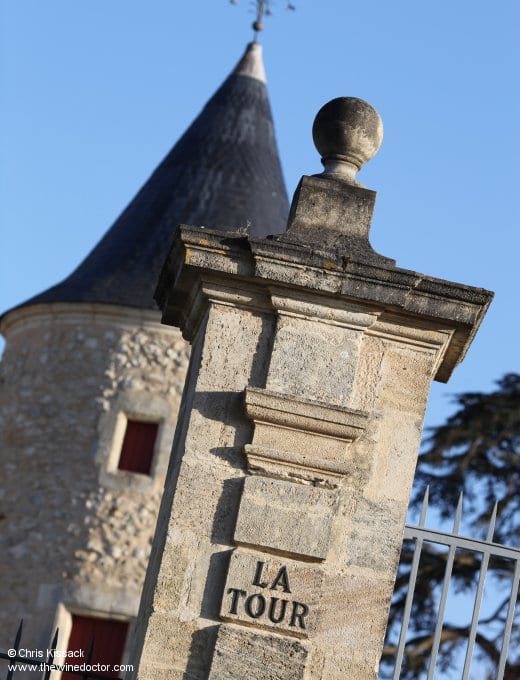
Latour-MartillacAs is the case with the more famous Latour of Pauillac, here the name is derived from an ancient tower. Unlike Latour, however, which lost its original tower several centuries ago and now must make do with an admittedly impressive dovecot, here the tower, which dates from the 12th Century, is still most tangible. It is said to have once been a circular staircase, part of a fortress long since demolished, but now the tower stands in isolation, in the courtyard at the front of the property. Behind it lie the buildings of modern-day viticulture, the chai and cellars and, of course, the chateau.

The earliest records concerning Latour-Martillac as a vineyard, however, date only to the 19th Century. At this time it seems that the property was part of the Montesquieu estate, which also included the nearby Chateau la Brède, where the famous philosopher Charles-Louis de Secondat (better known simply as Montesquieu) was born and bred. Although it was during this time that Latour-Martillac developed a separate identity, the wines were not widely known or of any great repute. This did not change when the estate came under the dominion of Charropin, a native of Bordeaux who accrued his wealth in the practice of law, and it was not until the Kressmanns, a family of German descent, arrived on the scene that things were to change in this particular Graves vineyard. Edward Kressmann landed in Bordeaux in the 1860s and quickly set up in the wine trade, and by 1871 he was distributing the wines of Latour-Martillac. The family's involvement with the domaine increased over the years, first taking on responsibility for the viticulture, before finally purchasing it outright in 1929. They have owned it ever since.

From the earliest days of their involvement the Kressmanns have been shaping the future of Latour-Martillac, starting with Edward who planted white varieties in 1884 and in 1892 launched their Graves Monopole Dry, widely endorsed by the diva Adelina Patti and one of their most successful wines, selling well throughout much of the early 20th Century. A glance at the vineyard statistics of the time show that of 12 hectares most were planted with white varieties, the red vines having only a minor role, so it is no surprise that a white wine would be the estate's bread and butter. Latour-Martillac took on a reputation of sorts, and the wine was drunk at the coronation of George VI in 1937 following the abdication of his brother, Edward VIII, in order to marry the divorcee Wallis Simpson. By this time the estate was under the direction of Alfred Kressmann, Edward's son, who in turn bequeathed the property to his own son, Jean. Jean had been in charge since 1940, only inheriting the the estate proper in 1955. One of his first actions was to expand with the purchase of land adjacent to the property which was planted with vines, bringing the vineyard area to 30 hectares, and further purchases have been made in more recent years. Today the estate is under the management of the next generation of the Kressmann family, the brothers Tristan and Loïc. It was these two young whirlwinds that have brought quality at Latour-Martillac up to where it is today, achieved through securing the advice of Denis Dubourdieu in 1986 and then Michel Rolland in 1989, as well as refurbishing the chai in that same year.

Latour-MartillacToday the vineyard covers 42 hectares, of which 33 hectares are planted to red varieties, having usurped white's predominance, which now occupies 9 hectares. The terroir underfoot is the typical gravel of the region, of Pyrrenean origin. The red vines, which have an average age of 30 years, are 60% Cabernet Sauvignon, 35% Merlot and 5% Petit Verdot whereas the white are 55% Semillon, 40% Sauvignon Blanc and 5% Muscadelle, with an average age of 40 years. The vines are pruned in the usual Bordeaux double Guyot manner and use two rootstocks well suited to the region, 101-14 and 3309. The harvest is manual, and the grapes transported to the chai in small plastic crates to minimise damage and subsequent oxidation, and the fruit undergoes selection on a sorting table before fermentation. The red grape varieties are destemmed, crushed and fermented in temperature-controlled stainless steel vats at around 28-30°C, and after a three week maceration go into oak, up to 40% new, for as long as 20 months. It is then fined with egg whites before bottling. The white wines, by contrast, undergo a gentle pressing before temperature-controlled fermentation and then going into oak, again up to 40% new, where it rests on the lees for up to 15 months. The end result is the grand vin, Chateau Latour-Martillac (10000 cases of red, 2000 cases of white per annum) and there is a second wine, largely the product of young vines, marketed as Lagrave-Martillac.

With recent investment and also enthusiasm the wines of Latour-Martillac are reported to have shown marked improvements during recent years. My tasting experience is insufficient to pass such broad judgement. Certainly the white of the 2004 vintage was a good wine although not first division. The red was a little less impressive, and one can only hope it will flesh out with time. Nevertheless I look forward to tasting more from this estate in the near future. (21/9/07)

Contact details:
Address: 33650 Martillac
Telephone: +33 (0) 5 57 97 71 11
Fax: +33 (0) 5 57 97 71 17
Internet: www.latour-martillac.com

Chateau Latour-Martillac - Tasting Notes

Click to locate stockists.

2008

Chateau Latour-Martillac Blanc (Pessac-Léognan) 2008: This is another wine which is showing a lot of Sauvignon character on the nose, with the aromas of green and yellow capsicum, overlaid with a little lemon cream. The palate is attractive, pithy, with some grip. A rather diffuse midpalate though. There are good components here, but less harmony than in some other wines. Short finish. From my 2008 Bordeaux primeur assessment. 15-16+/20 (April 2009)

2007

Chateau Latour-Martillac Blanc (Pessac-Léognan) 2007: A very lightly honeyed nose, with notes of smoky oak. Less punchy and impressive than some of the other wines here, although there is good midpalate substance and a good presence of flesh. It has grip and structure too. Certainly a good wine. From a tasting of 2007 Pessac-Léognan at two years of age. 16+/20 (October 2009)

Chateau Latour-Martillac (Pessac-Léognan) 2007: Dense fruit here, slightly meaty and feral in character. It has a more stony character at the start of the palate, then becoming more lean and slightly herbal through the middle. Red fruit flavours dominate, especially red cherry and cranberry. Overall a leaner and rather ungiving style with prominent grip. Seems unbalanced and maybe overworked. From a tasting of 2007 Pessac-Léognan at two years of age. 13.5/20 (October 2009)

2006

Chateau Latour-Martillac Blanc (Pessac-Léognan) 2006: This has an immediately appealing nose, with restrained capsicum notes and slightly oatmealy oak. It is fresh but full, attractive and slightly fat on the palate. Underneath though there is a lot of acidity, providing much better definition than I found last time, more vigour and verve. This has an attractively rich, citrus fruit finish and overall I think it has great potential. A much higher score today. From a tasting of 2006 Pessac-Léognan at two years of age. 17.5+/20 (October 2008)

Chateau Latour-Martillac Blanc (Pessac-Léognan) 2006: A bright and aromatic wine, quite vibrant in its presence. Fresh, with good flavour, a good and firm seam of acidity. Nice weight and grip, with a moderate concentration. Not demonstrating a lot of precision or vigour tonight. From a tasting of 2006 White Graves. 15.5-16+/20 (April 2008)

2005

Chateau Latour-Martillac Blanc (Pessac-Léognan) 2005: This has a talcy, minerally, stony nose, although these are nuances mixed with a grassy softness. It does seem a little harder on the palate though, which has a forceful, rocky character with a firm acid backbone. Nevertheless I feel it has less flesh than the others, and is perhaps not so concentrated as some. Nevertheless it has a good flavour profile, and it has a rather harmonious feel to it. The definition is good, and it may well develop more interest with age. From my tasting of 2005 Bordeaux at two years of age. 16.5+/20 (October 2007)

Chateau Latour-Martillac (Pessac-Léognan) 2005: A vibrantly perfumed nose here, with a deliciously gamey, meaty quality to it, and a very direct and linear style of dark fruits. With elements of gravel and tobacco, this is certainly showing some good Graves characteristics. Slightly plump and polished style here, full of fruit and overall attractive. Good substance, with a polished marble mouthfeel although with a little more generosity than that suggests, and certainly a very good composition. Impressive wine. From my tasting of 2005 Bordeaux at four years of age. 17.5+/20 (November 2009)

Chateau Latour-Martillac (Pessac-Léognan) 2005: There is exuberant fruit on the nose, which is vigorous and dense, laden with fruit and concentrated, and spiced with a note of roasted herbs. The palate is rounded, a touch flashy perhaps, but surprisingly reserved in view of the character of the nose. There is a purity to it, and a lot of tannins which give a firm grip, along with a firm acid backbone. This is a big, structured, extracted wine which is just about holding together at present. It could be fine. From my tasting of 2005 Bordeaux at two years of age. 16.5-17+/20 (October 2007)

2004

Chateau Latour-Martillac Blanc (Pessac-Léognan) 2004: Rather muted on the nose, showing a little oak though, but with some greengagey-nettly aroma also showing. Rather brutally structured, a bit oaky, pithy and certainly very masculine in style. Firm acidity and naked fruit; there is no cushion to soften the impact here. But good cellar potential. From my 2004 Bordeaux assessment. 16+/20 (October 2006)

Chateau Latour-Martillac (Pessac-Léognan) 2004: There are lots of ripe fruits on the rather forward, open nose of this wine, perfumed in character, with a layer of oak. But the palate disappoints; it has a hollow centre, and lacks texture. Thin and perhaps over-extracted as there is an incongruous wall of tannin to match. A great shame, as the nose held some promise. From my 2004 Bordeaux assessment. 14/20 (October 2006)