Home > Producer Profiles > Bordeaux Profiles > Chateau Brown

Chateau Brown

There are innumerable chateaux in Bordeaux that bear testament to the presence of the English (and the Irish and Scottish) in Bordeaux, over many centuries. Perhaps the prime example is Chateau Talbot, the Talbot in question having been the Earl of Shrewsbury, a military commander of considerable significance during the latter stages of the Hundred Years' War. It was, after all, his downfall at the Battle of Castillon that led to the expulsion of the English. There are further examples from more recent times, such as Palmer, named for General Charles Palmer, who served under Wellington and discovered the estate when travelling through Bordeaux in 1814. And of course there are the Barton estates, Langoa and Léoville, both of which owe their names to Hugh Barton. Let us not forget, then, John Lewis Brown, whose name lives on not only in the Médoc, at Cantenac-Brown, but also down near Léognan, in the shape of Chateau Brown.

Chateau BrownLike many properties around the Graves region, the history at Chateau Brown stretches back over many centuries, and viticulture was dominant here long before it was in the Médoc, further north. There is evidence that vines were grown here as far back as the 12th Century. Nevertheless, it did not take on the name by which we know it today until it was purchased by John Lewis Brown, a wealthy Scottish trader who settled in Bordeaux near the end of the 18th Century. Records of classifications such as Lawton's (1815) and Franck's (1845) both reveal the existence of a Chateau Brown, but this is in the Médoc, and is in fact John Lewis Brown's other major asset, which went on to be the Cantenac-Brown and Boyd-Cantenac of today. There is little talk of the Brown of Graves, but despite this the property enjoyed an admirable reputation during the 19th Century, and the wines were highly regarded when stood up against their peers. Nevertheless, during the early 20th Century the estate fell into disrepair, and eventually it ceased to function as a vineyard. With the advancing suburban sprawl of Bordeaux, it is a wonder that the vineyard did not disappear altogether.

Chateau BrownIn 1939 the estate was purchased by André Bonnel, and it was not long after his acquisition, in the 1950s, that the viticulture stopped. Following a hiatus of twenty years or so, the vineyard was replanted, but it was too late for the property to take its place in the Graves Classification, which was unofficially drawn up in 1953, and made formal six years later in 1959. The estate passed from André to Jean-Claude Bonnel, and then was sold to Bernard Barthe, who poured effort and investment into the estate, as evinced by the gleaming chai, complete with new temperature-controlled stainless steel vats of varying sizes, and a state-of-the-art pneumatic press. But the true renaissance for Brown was yet to come, and it may be that the purchase of the estate by Jean-Christophe Mau, of the Bordeaux Mau dynasty descended from Yvon Mau, in conjunction with the Dutch Dirkzweger family, heralds that renaissance.

The Mau family were once in control of one of the largest Bordeaux négociant firms, the eponymously named Yvon Mau (Mau starting out cycling from one vineyard to the next on a penny farthing, buying wines as he did so). But at the opening of the 21st Century the family made the decision to sell the négociant arm of the business to Freixenet, the Spanish cava producer. With the revenue generated, the family looked to invest in a prestigious appellation, far away from the struggling bargain basement world of generic Bordeaux, where competition from the New World increases year on year. They settled on Brown, and in 2004 the deal was struck, the Mau and Dirkzweger families purchasing the estate, with Barthe retaining a 20% stake. Jean-Christophe Mau, the youngest member of the fifth generation of the Mau family, having left his original career as an accountant to return to the vinous fold, took on the role of director.

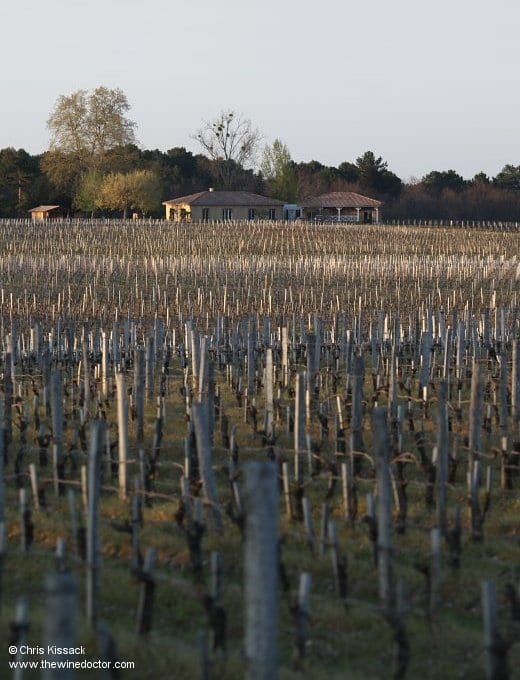
Chateau BrownIt should go without saying that the acquisition of Brown, marking a move from generics to top class Bordeaux, is fired by a determination to make truly great wine. If there is any evidence required for this, perhaps the engagement of Stéphane Derenoncourt as consultant is one indicator of Jean-Christophe's intentions. In the vineyard there has been some replanting, and some regrafting, the latter a laborious and expensive task, and not the simple alternative to the purchase of new vines which it might seem to be. The drainage has been improved, and there are plans for further activity on this front. The chai, having been recently refurbished, has not needed such intensive work, and here Mau and Derenoncourt can concentrate on producing the best wines possible from the vineyard at hand. There are 50 hectares all told, situated across the communes of Gradignan, Villenave-d'Ornon and Léognan on the very edge of Bordeaux. The vines themselves, which account for 25 hectares, sit on two gravel ridges, the more southerly rising to a height of 23m, the northern-most part of the vineyard disappearing behind it and the low house that sits at the far end of the visible vines. These are predominantly red varieties, 65% Cabernet Sauvignon, 30% Merlot and 5% Petit Verdot, with white varieties accounting for just 4.5 hectares, these being 70% Sauvignon Blanc and 30% Semillon, all planted at a density of 7200 vines/ha. The soil between the rows is ploughed to encourage the vines to push their roots deeper, a green harvest may be performed depending on the vintage, with leaf stripping later in the year. The harvest is manual, the fruit sorted and destemmed before pressing, macerated for up to five days, and fermented in the aforementioned steel, the varied size of vats allowing for vinification plot-by-plot. There is pumping over to submerge the cap. After up to 28 days in vat, the wine then goes into barrel, perhaps 40% new each vintage, for up to fourteen months. There are both red and white wines made, both labelled as Chateau Brown, either could be regarded as the grand vin in my opinion. Of the former there are about 5000 cases per annum, the latter something approaching 2000 cases, very much depending on the vintage.

Having little exposure to Chateau Brown until recently, I had no context against which I could benchmark the wines tasted at the chateau in late 2006, my first significant experience of the wines. Writing in Bordeaux, David Peppercorn recalls fondly the 1928, before seemingly rediscovering the property with the 1981 and 1985 vintages, on which he makes positive murmurings. I tasted a number of vintages, both red and white, that straddled the Barthe-Mau deal, wines likely therefore to give some indication of the results we might expect from the efforts of Jean-Christophe and Stéphane Derenoncourt. The signs are good, although obviously the superlative 2005 vintage, and the under-rated 2004 vintage, have given the team a helping hand at the beginning of their new venture. Remarkably, Mau has not yet increased the price of Brown on the Bordeaux place, despite the investment and obvious improvement that is apparent in the wines. Clearly, now is a good time to be buying Chateau Brown. (30/1/07)

Contact details:
Address: Chateau Brown, 33850 Léognan
Telephone: +33 (0) 5 56 87 08 10
Fax: +33 (0) 5 56 87 87 34
Internet: www.chateau-brown.com

Chateau Brown - Tasting Notes

Click to locate stockists.

2007

Chateau Brown Blanc (Pessac-Léognan) 2007: This has an attractive and very exuberant, aromatic style. Having tasted the components separately, it is the Semillon, which accounts for 35% of this blend, that has really impressed in this vintage. The blend itself is full, attractive, with lots of grip and substance. Even a touch creamy. Good structure and and fresh acidity underneath. Good. From my 2007 Bordeaux primeur assessment. 16-17+/20 (April 2008)

Chateau Brown (Pessac-Léognan) 2007: There is an attractive freshness to the character on the nose of this wine, which is 55% Cabernet Sauvignon, 40% Merlot and 5% Petit Verdot. A good frame of tannins, an appealing midpalate presence and overall an attractive style. Gentle substance. This compares very favourably with the rest of the big names of the appellation. From my 2007 Bordeaux primeur assessment. 14.5-15.5+/20 (April 2008)

2006

Below are a number of tasting notes on barrel samples tasted at the chateau with Christophe Mau in December 2006. I have not scored these embryonic wines.

Chateau Brown Semillon (barrel sample) 2006: A difficult vintage, especially for Semillon; the eventual yield was just 25 hl/ha, but this figure largely reflects the exclusion of a large quantity of rotten fruit. A cloudy sample, as currently undergoing batonnage. Aromatic, almost creamy if that is possible, fresh grapefruit and honey, wonderful purity of aroma. Very dry, minerally, crisp palate, with a little meringue note, and a little carbon dioxide spritz. Good quality for the vintage I think. The benefit of rigorous selection. No score. (December 2006)

Chateau Brown Sauvignon Blanc (barrel sample) 2006: Also cloudy, as for the above. Wow - what a nose; a highly aromatic blast of pure passionfruit. Quite lovely. On the palate, vibrant, pure, quite lifted, showing a finer texture and balance than the Semillon. Very primary but still quite impressive, especially in the context of the vintage. This and the Semillon are good; they should blend into a good wine. No score. (December 2006)

Chateau Brown Merlot (barrel sample) 2006: Harvested from September 28th. A pure, glossy appearance. Very typical, pure, plum and fruitcake nose. Still rather crisp and pétillant on the palate, having barely finished fermenting, and the taste doesn't suggest full malolactic yet either. Very pure though, but only moderately fleshed out. Rather bright finish, but with a lot of tannin coming in at this point. Good potential, no more. No score. (December 2006)

Chateau Brown Cabernet Sauvignon (barrel sample) 2006: Harvested October 11 - 18th, underwent 20% saignée. Another youthful appearance, and on the nose some characteristic smoky blackcurrant Cabernet fruit. Nicely balanced, lots of fresh acidity. well balanced tannins, a touch green but I think this reflects the malic acid rather then fruit ripeness. Good finish, but no length. Still a touch pétillant too. No score. (December 2006)

Chateau Brown Petit Verdot (barrel sample) 2006: Harvested October 3rd - 4th. Another dark, glossy hue. Fat, black fruit on the nose. Crisp, again pétillant on the palate, firm yet flashy, less tannic but with good acids. Good quality from this variety. It is difficult to see how these three varieties will blend together, but they have promise, within the context of a difficult vintage. No score. (December 2006)

2005

Chateau Brown Blanc 2005: The nose remains rich and pungent, although it has obviously developed during the eight months since I last tasted it at the chateau. There is still a huge pile of character here, at first difficult to place, until I realise it has that classic, in-your-face, musky Sauvignon Blanc aroma of cat's you-know-what, and yes there is even a little gooseberry bush here too. It has clearly moved on from the green, nettly face it was showing last year. But it is still a complex wine, with notes of greengage, wet vegetation, still a little nettle I suppose,  with citrus fruits and yellow capsicum. Obviously this is very Sauvignon-dominated at the moment, although I would think the Semillon, which makes up 35% of the blend, will show its face with time. The palate is rounded and fresh, with a little body and texture, all wrapped up in the incisive, fresh Sauvignon character which mirrors may of the features found on the nose. These carry through onto the finish, which is firm and grippy, with a biting structure. A really nice wine, showing plenty of potential, and which will benefit greatly from being left alone in the cellar for a year or two I think. For label images and more see my Wine of the Week write-up. 17.5+/20 (August 2007)

Chateau Brown Blanc 2005: SB 65%, S 35%. A definite step up here, this vintage displaying a vibrant, pungent nose, with plenty of green, nettly aromatics. Just a lovely style on the palate, rounded and creamy, firmly composed but showing more poise than the 2004, and a long, lovely array of flavour on the palate. Grip and style, and a well defined finish. Good length too. Excellent. 17.5/20 (December 2006)

Chateau Brown 2005: CS 60%, M 35%, PV 5%. The deep, ruby-purple hue of youth. Fabulous fruit here, crisp and crunchy yet dark and fully ripe blackcurrants, fine, lithe and poised, with some brooding tobacco notes. Nicely composed, creamy, quite primary, with a wonderful underpinning structure. Fine, ripe, charcoally tannins on the finish. Quite delicious. 17+/20 (December 2006)

2004

Chateau Brown Blanc 2004: SB 65%, S 35%. A paler gold this time, again minerally and nettly on the nose, with the suggestion of a creamy roundness. But there is also the suggestion of finesse here. Full style, a strong character, grippy-pithy in keeping with many other wines of the vintage that I have encountered. Firmly put together. A well structured, fresh wine with good acidity, but with overall a rather solid composition. I like it. 17/20 (December 2006)

Chateau Brown 2004: CS 55%, M 43%, PV 2%. A vibrant, fresh, red-blackcurrant fruit, with a little leafy-tobacco note. Fresh, balanced, youthful palate, this Mau/Derenoncourt wine is a marked contrast to the preceding vintage, although that might be said of many 2003/20 ()04 comparisons. A little lean through the midpalate, not that unusual in this vintage, but it has good quality and is a well poised wine. Very good. 16.5+/20 (December 2006)

2003

Chateau Brown Blanc 2003: SB 70%, S 30%. A clear, pale gold. Smoky, stony, minerally character on the nose, with a little smoke too. Rounded, quite creamy, ripely textured, with a stony firmness and again a teasing little ripple of meringue. It has low acidity, the unfortunate hallmark of the vintage, but nevertheless has a good, grippy backbone. Better than I expected, but still plainly a 2003. 14/20 (December 2006)

Chateau Brown 2003: CS 67%, M 30%, PV 3%. Dark, macerated cherry fruit on the nose, with a slightly pruny, raisiny feel to it. That's 2003 for you. Full, quite vibrant considering, but there is a predominant macerated, perhaps even stewed feel to it. Warm and firmly tannic finish typical of the vintage, and low acidity to complete the usual picture. Not my style. 14.5/20 (December 2006)

Home - Site index - Site updated May 09, 2008 - © The Winedoctor 2000 - 2008 - Wine Scores - RSS