Crémant de Loire
The committee, having devoted two sessions to examining the sparkling wines presented by Mr. Ackerman-Laurance, therefore unhesitatingly declares that “these wines can favorably rival true Champagne wines. They possess the same smoothness and lightness; they are perfectly white and clear; their mousse is a bright, sparkling white, and we believe that, when comparing wines from similar vintage years, it would be difficult to say which holds the advantage.”
– Bulletin of the Industrial Society of Angers, 1838
The story of Crémant de Loire is a short one; not so much a magnum opus, much more a novella, to be consumed in a single sitting. Rather like a bottle of Crémant de Loire itself, you might say.
Nevertheless, this short story deserves to be told, not least because Crémant de Loire is one of the Loire Valley’s – and indeed one of France’s – most significant appellations. In terms purely of volume, its annual production dwarfs that of other renowned Ligérian appellations, including famous names such as Chinon and Bourgueil, and even beats Sancerre (just!).
Looking beyond the Loire Valley, its production volume compares favourably with France’s other Crémants, including Crémant d’Alsace (the only other crémant produced in larger volumes), Crémant de Bourgogne (which produces similar volumes), Crémant de Bordeaux, Crémant de Limoux and Crémant du Jura (all of which it dwarfs). When considered in combination with the Loire Valley’s other sparkling wines – largely Saumur, Vouvray and Montlouis-sur-Loire, not to mention all the Vin Mousseux and Vin de France wines – it pushes the Loire Valley into second place in France for volume of sparkling wine produced, behind only Champagne.
It is not just about numbers though. Today the Crémant de Loire appellation fosters the creation of some of the region’s most remarkable sparkling wines, principally made using Chenin Blanc but with Chardonnay playing an important role in some cuvées (other varieties are permitted, naturally). And it provides this service to a diverse and widely dispersed array of producers, from small-scale domaines on the outskirts of the Muscadet vineyard and long-established family domaines all the way upriver in Touraine’s Cheverny appellation, to big-name sparkling wine houses and négociants located between the two in Anjou and Saumur. This makes it one of the Loire Valley’s rare multi-regional appellations (of which there are only two, the other being Rosé de Loire).
History
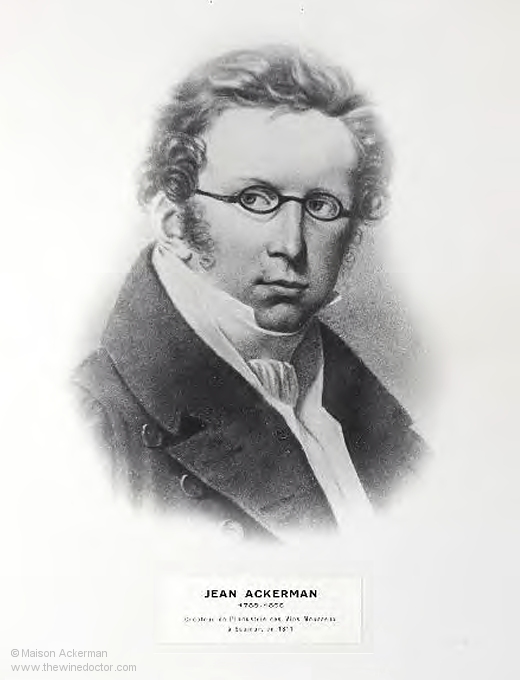
Although the appellation is a child of the 1970s, it grew from a long history of sparkling wine production, one which dates back to the 19th century. Today Jean-Baptiste Ackerman (1795 – 1866) is widely regarded as the father of Loire Valley sparkling wine; he came here from Champagne in the early 19th century and was responsible for introducing the Champagne method to Saumur and the surrounding regions. His conviction that this methodology would transfer to the Loire Valley was based partly on the quality of the wines made there using Chenin Blanc, partly on this variety’s suitability to the second fermentation in bottle, and of course partly on the region’s extensive network of limestone caves which were ideal for aging large volumes of bottles.