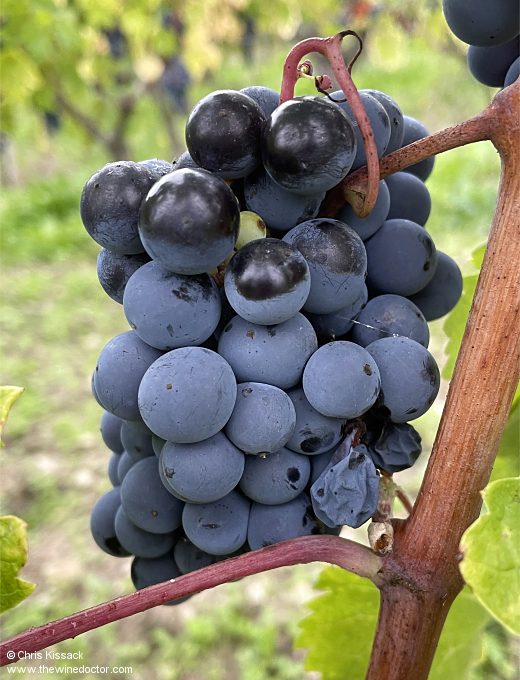
Loire Valley Wine Guide: Grolleau Noir
The Groslot descended from Mazières to Cinq-Mars-la-Pile, and it made the fortune of the region’s vignerons, who gave the variety its name, justified by the regular and sustained harvest it gave them. It was, in fact, better for them than a lottery ticket, with a random chance of winning a jackpot. They had in their hand a fortune, and they did not allow it to escape.
– Ampélographie: Traité Général de Viticulture, Alfred Bouchard
(Masson et Cie, tome 2, editors Viala & Vermorel, 1901)
In the cohort of red grape varieties which populate the vineyards of the Loire Valley all the big players are immigrants.
You might think the region’s leading red cultivar – undeniably Cabernet Franc – is inherently Ligérian, but it almost certainly originates from the Basque country. The only true point of discussion is when it came here, and whether it came directly, or via Bordeaux. Likewise, Gamay and Pinot Noir are Burgundian in origin, and as discussed in my guide to Pineau d’Aunis, the evidence strongly suggests this latter variety travelled here from France’s south-west. Côt and Cabernet Sauvignon are also late arrivals to the region, from Cahors and Bordeaux respectively.
This leaves those of us on the hunt for a genuine Loire Valley autochthone, a true-blooded, blue-blooded, red Ligérian variety which we can crown king of the cultivars, with just one option; Grolleau.
Yes, Grolleau. Or, more precisely, Grolleau Noir. Or Groslot, if you adopt one of the older alternative names, as used by the historian Alfred Bouchard in his recounting of the variety’s origin story at the top of the page.
It is of course easy to dismiss Grolleau – I am sad to say a number of otherwise erudite wine writers are on record as doing just this – but it has played an important role in the viticultural history of the Loire Valley, and this remains true even if today it is an increasingly minor player. Plantings are in free-fall and what fruit is harvested today is largely thrown into the region’s rosé blends, whether sparkling or still. It would be wrong to be too sniffy about it though; while it seems unlikely that a glassful of Grolleau would have inspired Churchill to continue fighting the good fight, or Elton John to put his lyrical pen to paper (Pol Roger and DRC are perhaps better equipped to take on these roles), in the right hands Grolleau makes for a deliciously crushable cuvée.
And, more significantly, Grolleau was the variety behind the most unbelievably delicious rosé I ever drank, one which still haunts my memory more than 15 years on.
This unsung hero deserves consideration. In this instalment of my guide to the grape varieties of the Loire Valley I therefore push Grolleau into the spotlight, with the latest information on its origins, its legends, its character in the vineyard, and of course its wines.
Origins
I am drawn first to what we know of the genetics of Grolleau, and whether it can point us in the direction of this variety’s origins.