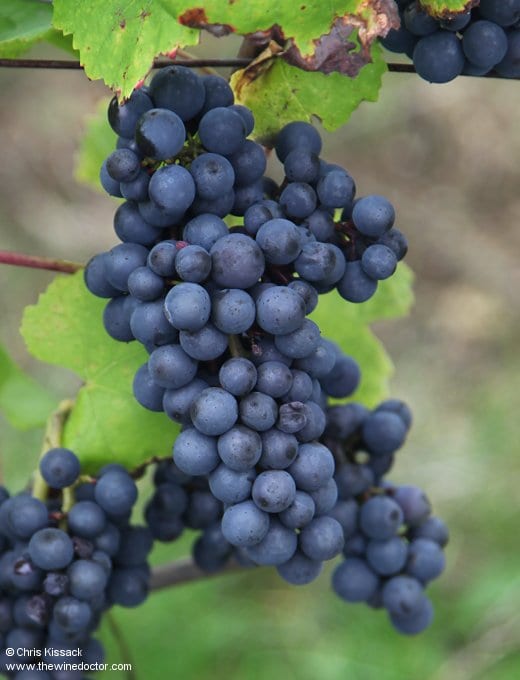
Loire Valley Wine Guide: Pinot Noir
It might seem a little strange to some that I should focus on Pinot Noir as a major Loire variety. After all, until very recently it was a variety whose reputation rested on its performance in just one region, Burgundy, although today it also does very well in California and New Zealand. Nobody has yet – to my knowledge – added the Loire Valley to that list of Pinot regions (and if I tried to do so no doubt there would be some stiff opposition).
In addition, the area planted to Pinot Noir in the Loire Valley is quite small compared to that planted to Cabernet Franc and Gamay. There are about 450 hectares in Sancerre (about 15% of the appellation’s 3,000 hectares) and something in the order of 160 hectares in Menetou-Salon (about 25% of the appellation’s 625 hectares), these being the two big players. Add the plantings in the Massif Central, around Tours where it has a role in a declining number of Touraine appellations (Pinot Noir has been forcibly sidelined in favour of Cabernet Franc, Côt and Gamay in recent years), in Cheverny, Valençay and so on, and you probably get a few hundred more hectares. Compare it to the region’s 15,000 hectares of Cabernet Franc and it is clear Pinot Noir is a bit player.
Having said that, what a bit player this is!
The quality available in the red wines of Sancerre today is nothing like the cool, lean and tart red Sancerres of old. These are, in my opinion, some of the most noble wines in the entire Loire Valley, and they are some of the most interesting to drink (I have been adding them to my cellar since first discovering this ‘new’ Sancerre Rouge close to 20 years ago). Since then I have watched the red wines of Sancerre (and other appellations) continue to improve, and as a consequence I have no doubt that Pinot Noir deserves a page of its own in this guide.
In this instalment of my guide I will look at Pinot Noir’s wines, especially those delicious first discoveries, and the moment when I realised my view of red Sancerre had to change. First though, some detail on the variety itself, its genetic diversity and origins, and how and where it can be found in the Loire Valley.
Pinot Blanc, Gris & Noir
Although this is something I have already alluded to in previous instalments of this guide, it is absolutely essential I revisit and reiterate it here; Pinot Noir is only one mutation of the Pinot vine, the other mutations having been named Pinot Blanc, Pinot Gris, Pinot Meunier and so on. In having such a rich clonal diversity Pinot is not alone; many varieties have multiple clones. When planting Cabernet Franc, for example, there are at least two dozen clones to choose from, each one varying somewhat with regard to berry size, tannin concentration, disease resistance and so on. Because one clone looks broadly the same as the next, however, it is not difficult to think of them all as the same variety. With Pinot, where the differences are much more striking, such as leaf morphology and berry colour (these can be white, pink or black, in other words blanc, gris or noir), it is hardly surprising that the viticulturalists of old regarded them as different varieties.