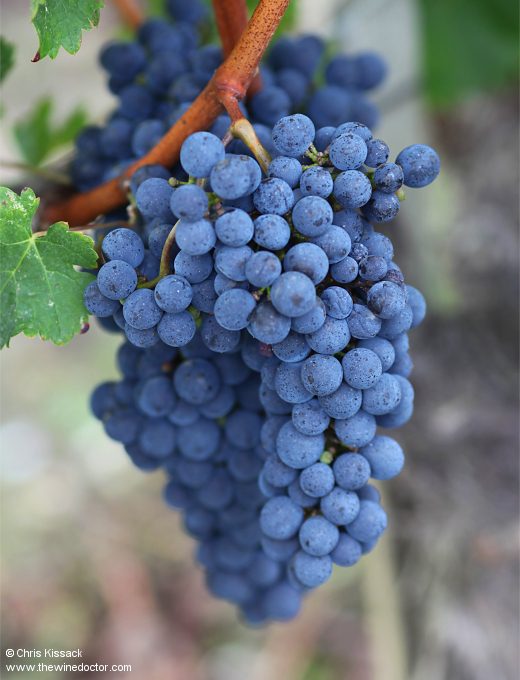
Loire Valley Wine Guide: Côt
…our wines from the Cher region owe their reputation to the grape variety we call Côt. The town of Esvres, where I live, crossed from east to west by the Indre, has according to the merchants themselves, over some twenty years, gained a reputation for the highest quality wines from the Cher, perhaps due to the nature of its soil, or perhaps the skill of its inhabitants. I therefore felt entitled to use the name this variety goes by here, even if, under the name Auxerrois, it is also the basis of the vineyards of the Lot, whose wines are purchased by the Bordelais to add body and color to their own wines.
I believe that the word Côt is a contraction of Cahors, the name it bears in a neighbouring department; but the spelling I have adopted accurately reflects our local pronunciation.
– Ampélographie, ou Traité des Cépages, Comte Odart
(Chez Bixio et Chez L’Auteur Maison Rustique, 1845)
Like the best spies and double agents, all ancient cultivars have an array of pseudonyms and alternative names which they hide behind. In the vast majority of cases these pseudonyms are largely of historical interest, the wine world having settled on one name.
Cabernet Franc is a good example; today it goes by this name worldwide, but only a century ago vignerons in Chinon and Bourgueil would have spoken of Breton, while those cultivating the variety in St Emilion and Pomerol were more familiar with the term Bouchet. But gradually these local names have faded from use, and today the modern name of Cabernet Franc is used by all.
Well, everybody except the proprietors and team at Château Lafleur, who insist on calling it Bouchet. But they are the exception which proves the rule.
There are, however, a small number of varieties which seem content to lead a double life, going by one name in one region, but another name elsewhere. California’s Zinfandel is a perfect example, its double life only revealed when genetic analyses demonstrated this variety and Italy’s Primitivo to be one and the same. More obscure (but keeping it Ligérian), Pinot Gris still goes by the names Pinot Beurrot and Malvoisie in two distant corners of the Loire Valley.
The Loire Valley’s most redoubtable double agent, however, is undeniably Côt, a name endorsed by the renowned 19th-century ampelographer Alexandre-Pierre Odart de Rilly (1778 – 1866), more commonly known as Comte Odart. It is a variety with a number of interesting alter egos, not least Pressac Noir, reflecting its propagation by an ancient proprietor of Château de Pressac in St Emilion. To Touraine vignerons and to those who drink their wines, however, this red variety will always be Côt.
You might know it better by one of its other pseudonyms; say hello to Malbec.
Origins
Unlike Grolleau and Pineau d’Aunis, genetic studies provide us with precise detail of Côt’s lineage, and therefore gives some (hopefully) reliable clues as to its birthplace (which, as you might suspect, is a long way from Touraine).
This reflects the fact that both of Côt’s parents have been identified, a remarkable feat considering that both have flirted with extinction.