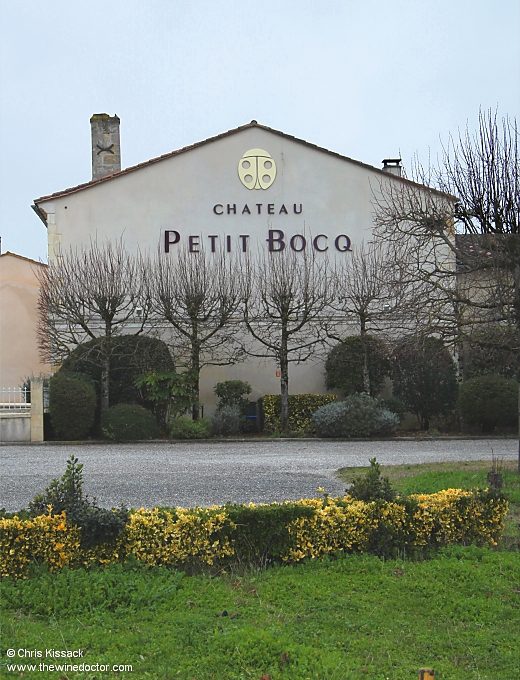
Château Petit Bocq
Ranking: Unclassified
Appellation: St Estèphe
Owner: The Lagneaux Family
Ten-second primer: Created as a micro-domaine by Francis Souquet, this property grew from a few rows of vines to nearly 20 hectares in the hands of the Lagneaux family. Today proprietor Adrien Lagneaux entrusts the management and winemaking to director Stéphane Pariaud.
This profile includes: Three pages of history and detail (links above), and tasting notes back to 1999.
The dream of having one’s own vineyard, and making wine with one’s own name on the label, is a draw that many find irresistible. The problem many who feel this urge must face, however, is that unless you inherit your vineyard, there is a significant financial barrier to overcome. Vines, even those in less exalted appellations, can be prohibitively expensive. It is why many newcomers to wine set up in the more peripheral parts of the wine world. In the Loire Valley, Montlouis-sur-Loire was once a popular starting point for many, as well as Cheverny and the more anonymous terroirs of Anjou. In Bordeaux, hopeful novices are much more likely to start up somewhere within the various Côtes de Bordeaux appellations or some sandy corner of St Emilion than they are in Pauillac or Pomerol. Unless they are very, very wealthy novices, that is.
It has not always been an insurmountable hurdle though. A few decades ago one such impassioned individual succeeded, transitioning from overlooked owner of an understated holiday home on the northern Médoc, to prominent proprietor of an estate in the prestigious St Estèphe appellation. The individual in question was a medical doctor, Gaëtan Lagneaux, and the property he built up was Château Petit Bocq. He was not its creator though, as it was made flesh two decades before his purchase. To understand the origins of the estate, we must look to the early seventies, and a man named Francis Souquet, an employee of Château Ducru-Beaucaillou.
Origins
Château Petit Bocq was the personal project of Francis Souquet, who worked as chef de culture at Ducru-Beaucaillou. In 1971 he gathered together a few rows of vines which were located in the southern reaches of the St Estèphe appellation, midway between the hamlets of Marbuzet, close to the Gironde, and Le Puy, situated much further inland, in Cissac-Médoc. The first vintage he produced here was 1972, using fruit from less than 2 hectares of vines. The blend was a little atypical, Merlot accounting for 80% of the total, reflecting what was planted in the vineyard, but the wine seemed to have enjoyed some success.