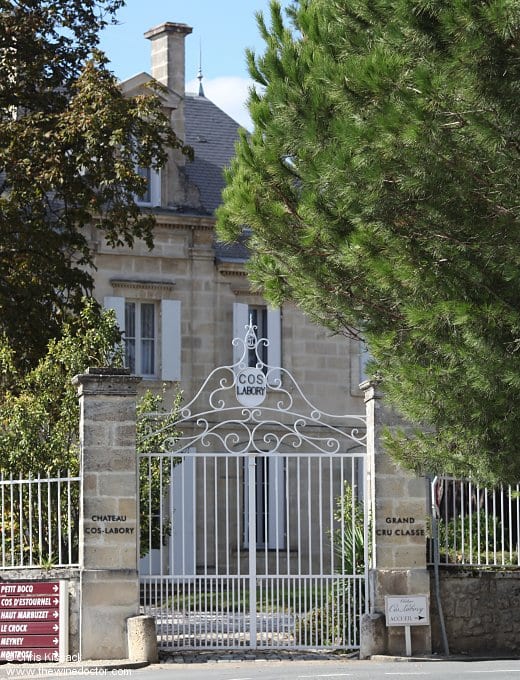
Château Cos Labory
Ranking: Fifth growth (1855 Classification)
Appellation: St Estèphe
Owner: Michel Reybier
Ten-second primer: Long recognised as an under-performing name in Bordeaux, in March 2023 proprietor sold to Michel Reybier, owner of neighbouring Cos d’Estournel. We can expect improved quality as a result. Wines now made by Dominique Arangoïts.
This profile includes: Three pages of history and detail (links above), and tasting notes back to 2004.
On a corner of the D2, almost on the boundary between the Pauillac and St Estèphe appellations, sits the golden sandstone edifice that is Cos d’Estournel. Decorated with a triumphal archway and festooned with ornate pagodas, it is a hotspot for visitors to the region, so much so that opposite the château there is a lengthy lay-by where drivers can park up before getting out to take the requisite photographs. On driving past it is rare not to see at least one happy photographer there, even in the depths of winter. On occasion a coach may pull up to regurgitate at the roadside its heavy load of tourists, sourced from one of the cruising river boats that stop off at the city of Bordeaux. They pour over the roadside, cameras at the ready. Shutters are clicked. And then they clamber back on board, to be trundled away to their next destination.
While these disciples of Bordeaux obsess over the magnificence of Cos d’Estournel, how many take a glance at the rather more traditional building just to its left, I wonder?
It does not present such a dramatic facade, and what appeal it does possess is mostly obscured by several large trees planted just a few metres from the front door; as a result, from the roadside, it is difficult to gain anything other than a view of the side of the château. Nevertheless, this is another of St Estèphe’s more significant estates, a sibling of Cos d’Estournel – the two have some shared history – and one of just five classed growth châteaux in the commune. In truth for many years the estate has lagged behind its neighbour not just on the basis of its rather dour architecture, but also on the quality of its wines. In 2023, however, there came a significant change in ownership – more details on which further down the page, of course – and as a result Château Cos Labory now deserves more of our attention.
Although ranked at almost opposite ends of the small spectrum of the 1855 classification, Château Cos Labory and Château Cos d’Estournel do have some common features, the most obvious being the name. As I have already explained in my profile of its more illustrious neighbour, Cos is most likely a derivative of caux, itself derived from colline de cailloux, meaning ‘stony slope’. In the Gascon tongue the end consonant is vocalised, accounting for how caux may have mutated into cos over the years. One particularly important Gascon in this story was Louis Gaspard d’Estournel (1762 – 1853), who was a key figure in the stories of these two properties. Following the easing of some of his financial difficulties he returned to Château Cos d’Estournel in 1821, and flush with new funds he acquired numerous nearby plots of land, including those today belonging to Château Cos Labory, in 1847.
But this point in Cos Labory’s history – which saw it stripped of its better parcels when they were absorbed into the vineyard of Château Cos d’Estournel – was by no means its beginning. To uncover its true origins, we must look back at least to the preceding century.