Home > Producer Profiles > Bordeaux Profiles > Chateau Prieuré-Lichine
Chateau Prieuré-Lichine
If there is one memory of Prieuré-Lichine that really sticks in my mind, it concerns the 1982 vintage. At first it was a vicarious experience, as a friend of mine heaped great praise on a bottle he had recently consumed. Never the first name on anyone's lips when discussing the commune of Margaux, I was a little surprised to hear such a high opinion of the chateau, of which I admit I knew little at the time. But then a few years later I had the good fortune to taste the vintage in question - sourced from my friend's cellar, as it happens - and could only agree that here indeed was a delicious bottle of wine. It was complete, harmonious and characterful. Thus enthused, I decided to discover a little more about this estate, which had the promise of not only good quality but also, thanks to its rather subdued presence on the market, good value too.
The history of Prieuré-Lichine dates back, rather unsurprisingly, to the existence of a Benedictine Priory that owned this land during the Middle Ages. As is the case with a number of other Bordeaux estates, such as Boyd-Cantenac and Haut-Brion, as well as many further afield, including numerous domaines in Burgundy and along the wine rivers of Germany, the origin of Prieuré-Lichine is an ecclesiastical one. The Benedictine monks first cultivated grapes for service at dinner and at religious ceremonies, just as their Teutonic cousins in Trier did at the Maximin Grünhaus estate. But as the centuries passed, the wine was also sold to laymen, providing a very useful source of income for the monks. No doubt this change in emphasis occurred slowly, over many years, although the practice was likely to have been well established by the 18th Century at the latest. It is at this time that documents of sale demonstrate the existence of Le Prieur de Cantenac, the forerunner of today's Prieuré-Lichine, selling for up to 1000 livres per tonneau (one tonneau is 900 litres), a price comparable with other estates today ranked as troisièmes crus, including Palmer. Prieuré-Lichine was clearly off to a good start.
As
the 18th Century drew to a close, France was in turmoil as the Revolution took a
firm hold. It was not just the noblemen that lost their possessions, but also
the church. The priory was acquired by the new state, divided and sold. This
process gave rise to a number of the Bordeaux properties that exist today, such
as Boyd-Cantenac and Pouget, whilst some vineyards were purchased by
neighbouring proprietors, such as General Palmer, who
thus expanded his estate considerably. The vineyards that interest us here,
however, were purchased by a man named Durand, who subsequently sold it to a
gentleman named Pagès, who bequeathed it to his widow, who saw the estate
classified as a quatrième cru in the
1855 classification.
There then followed a sequence of rather undistinguished proprietors, a Madame
Rosset, Messieurs Rulh and Rousseau, and a Victor Saint-Ubéry. The latter passed
the estate to his son-in-law Frédéric Bousset, who was in charge at the estate
in 1925. The consequences of such a rapid succession of owners, together with
the disasters of the day, namely vineyard diseases such as oidium and
phylloxera, and depression and war, are, with the benefit of hindsight, obvious.
The estate, known simply as Prieuré and later Prieuré-Cantenac, gradually
deteriorated, and when Alexis-Lichine came shopping for an estate to purchase it
was in a very dilapidated condition, and the vineyards had contracted to a mere
11 hectares of sorry-looking vines.
Alexis-Lichine and Prieuré-Lichine are effectively synonymous. During much of the 20th Century the former was the proprietor of the latter. Lichine was an accomplished author, and having penned his Guide to the Wines and Vineyards of France he was keen to get his hands dirty. Cantenac-Prieuré, as it was known, was for sale at a knockdown price, and following the advice of his many acquaintances in Bordeaux including Georges Delmas, then régisseur at Haut-Brion, in 1951 Lichine paid the asking price of £8000. He wasted no time, quickly expanding the estate, purchasing plots of vines from Issan and renting others. Over the years he acquired numerous plots from other Margaux estates, and within a decade or two the vineyard area was up to 58 hectares, taking in plots that once belonged to Palmer, Brane-Cantenac, Durfort-Vivens and Giscours, to cite just a few of his many transactions. He also expanded and repaired the chai, a significant investment considering the state it was in, and he lavished attention on the chateau, which includes sections dating back to the 14th Century, parts of the original priory that once stood here. The results of this effort and enthusiasm were good, my tasting of the 1982 vintage some small evidence of this. But it was inevitable that the Lichine era, in the shape of Alexis at least, would come to an end. In 1989 Alexis Lichine died, bequeathing the estate to his son, Sacha, who at first continued in the same vein as his father. In 1990 the chai saw a significant extension, and the vineyard area climbed higher, to 70 hectares. Another new addition that year was Michel Rolland, as Sacha then engaged the services of the famous consultant oenologist. Despite this apparent enthusiasm, however, the estate was sold in 1999 to the Ballande Group, a mining, agricultural and transport firm based in New Caledonia, for the sum of $28.5 million, and the estate remains in their hands today.
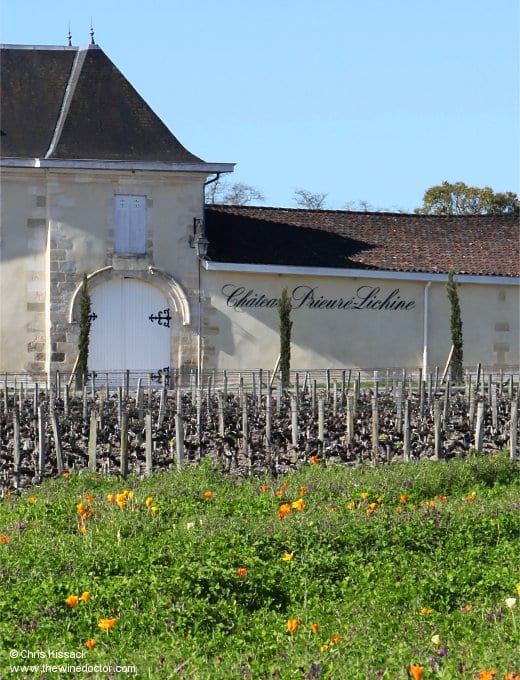
The Prieuré-Lichine vineyards are naturally, in view of Lichine's many acquisitions, very widely spread across the Margaux commune. Most lie to the north of Cantenac, on one of the gravel ridges that characterise the Médoc. The vines are 54% Cabernet Sauvignon, 40% Merlot, 5% Petit Verdot and 1% Cabernet Franc, and are planted at a density of 8500 vines/ha. They are harvested by hand, sorted and crushed before fermentation in temperature-controlled concrete vats with a maceration lasting between three and four weeks. The must is pumped over twice daily to submerge the cap. The wine is then transferred into oak for up to 16 months, with 55% of the oak replaced each vintage. It is racked every three months, before bottling. The grand vin is Chateau Prieuré-Lichine (20000 cases per annum) and there is a deuxième vin, introduced in 1973, called Chateau de Clairefont (about 7000 cases per annum). There is also a little vin blanc, named Blanc de Chateau Prieuré-Lichine, which has been a feature of the portfolio since 1990.
And so to the wines. For many years they had no presence on the Bordeaux place as they were sold exclusively through Bass Charrington, a firm with which Alexis Lichine had many close dealings; the firm purchased Lascombes from Lichine, who had been running the estate on behalf of a consortium of American backers. They were first sold openly in 1979, and since then quality has been in the ascendant, testament to Lichine's efforts. The wines are full and can be impressive, especially when they have been rested in the cellar for a sufficient period of time. I enjoyed the 1983 not quite as much as the 1982, but it was still a very good wine indeed. And more recent vintages suggest no drop off in quality at Prieuré-Lichine, with a fine 2004 - a good vintage for the commune I think - and a decent 2003. These are still wines worth seeking out, it seems. (4/5/07)
Contact details:
Address: Chateau Prieuré-Lichine, 34 avenue de la République, 33460 Cantenac
Telephone: +33 (0) 5 57 88 36 28
Fax +33 (0) 5 57 88 78 93
Chateau Prieuré-Lichine - Tasting Notes
Chateau Prieuré-Lichine (Margaux) 2007:
Dark and rather handsomely styled fruit on the nose, and an attractive, pure,
rounded, rather seamless character on the palate. The tannins are well covered
at first, but have a very firm nature, and provide a rather fierce grip at the
finish. Nevertheless there is a fresh, attractive crispness to the fruit, which
has a cranberry and blackcurrant leaf character, and overall this has a nice,
upright style. As is the case with a number of other wines, provided the fruit
and texture outlasts the tannins, this could be very good indeed. From my
2007 Bordeaux
en primeur assessment. 16.5+/20 (April 2008)
![]()
Chateau Prieuré-Lichine (Margaux) 2005:
Dark and rather handsomely styled fruit on the nose, and an attractive, pure,
rounded, rather seamless character on the palate. The tannins are well covered
at first, but have a very firm nature, and provide a rather fierce grip at the
finish. Nevertheless there is a fresh, attractive crispness to the fruit, which
has a cranberry and blackcurrant leaf character, and overall this has a nice,
upright style. As is the case with a number of other wines, provided the fruit
and texture outlasts the tannins, this could be very good indeed. From my
tasting of 2005 Bordeaux
at two years of age. 16.5+/20 (October 2007)
![]()
Chateau Prieuré-Lichine (Margaux) 2004: More typicité here, with a perfumed edge
to the spiced oak found on the nose. Full structure, ripe and integrated tannins
on the palate. Nicely textured, with good acidity. Perfume and an appealing
mineral quality to the fruit coming across very well. A success. Very good
indeed. From my assessment of
Bordeaux 2004. 16.5+/20
(October 2006)
![]()
Chateau Prieuré-Lichine (Margaux) 2003: Nice nose; rather muted, but showing
some primary black fruits, and with a cashew nut, oak-derived aroma. Good
texture of fruit on the palate, but with very firm tannins. Ripe, dark, slightly
nutty, but with more tannins than the fruit can cope with at present. From my
assessment of Bordeaux 2003.
15.5/20 (October 2005)
![]()
Chateau Prieuré-Lichine (Margaux) 1983: A mahogany red hue, like all the
wines in this flight. A ripe, raisined, macerated fruit
nose, with some slightly floral, rose-petal notes. There
is pleasant fruit on the palate, with very soft,
integrated tannins. Good texture, balancing acidity and a
soft creamy finish. Drinking very well. From a tasting of
1983 Bordeaux. 16.5/20 (November 2000)
![]()
Chateau Prieuré-Lichine (Margaux) 1982: A very dark, deep red wine with a pale
pink rim but good concentration of colour close to the meniscus. Masses of
sweet, ripe fruit on the nose, with a touch of toffee. There's plenty of
character here. Great power is immediately apparent on the palate, with mature,
classically styled stony-gravelly fruit. Most impressive is the silky texture,
and beautiful balance. What a pleasure to drink. From a tasting of
1982 Bordeaux. 18/20 (May 2004)
![]()
Home - Site index - Site updated May 13, 2008 - © The Winedoctor 2000 - 2008 - Wine Scores - RSS