Home > Wine Guides > Bordeaux Wine Guide > St Estèphe
St Estèphe
Bordeaux Wine Guide:
Introduction
History & Geography
Region 1: Graves
Region 2: Sauternes
Courtiers & Négociants
Region 3: Margaux
Region 4: St Julien
Region 5: Pauillac
Region 6: St Estèphe
Region 7: Médoc, Médoc
Osmosis & Extraction
Region 8: St Emilion
Region 9: Pomerol
Bordeaux - the Future?
Appendices:
Médoc 1855 Classification
Sauternes 1855 Classification
Graves Classification
St Emilion Classification
Cru Bourgeois Classification
Our arrival at St Estèphe marks the end of our journey through the four famous communes of the left bank of the Gironde. Travelling through Pauillac, we come to St Estèphe by crossing the Jalle de Breuil, one of the many drainage channels that have featured prominently in this journey north of Bordeaux. The terroir changes here, as although the best sites are located on the same gravel croupes as those found further to the south, underfoot there is a lot more clay, and thus the soils here are much more retentive of moisture than those in the communes of Pauillac, St Julien or Margaux. Further to the north, beyond St Estèphe and the Chenal de Calon, are the supposedly lesser vineyards of the Médoc, sometimes referred to as the Bas-Médoc in order to distinguish them from those of the Haut-Médoc. I will tell more of this distinction in the next chapter of this guide, where I deal with the vineyards of Médoc and Haut-Médoc, but here I restrict myself purely to St Estèphe, the wines of which have a distinctive character which may be directly correlated to the clay-rich soils. They tend towards greater richness and substance than those from a little further south, and the soils also confer a particular advantage in hot, dry years as the vines are less exposed to hydric stress than those vines grown in the more gravelly soils to the south, which are less retentive of water.
St Estèphe - The Appellation
St Estèphe accounts for about 1200 hectares, and thus is not significantly
different in vineyard area to either Pauillac, which
has about 1100 hectares, or
Margaux, which is a little larger with 1300 hectares. Nevertheless, St Estèphe
certainly has a very different profile. Unlike Pauillac and Margaux there is no
Premier Grand Cru Classé estate to lead the way, and indeed the number of classed growth
properties boasted by the commune is really very small. There are just five in
all, half of the number found in St Julien which is considerably smaller at 900
hectares, and less than a third of that possessed by Pauillac. Nevertheless,
although the quantity, at this level at least, may be low, the quality is
not. Of these five estates, at least two, if not three or four, turn out truly
superlative wines.
Leading the way in the St
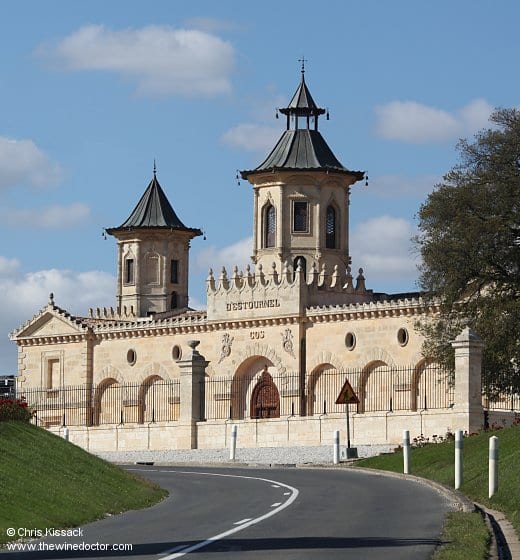
Estèphe appellation are Montrose and Cos d'Estournel, the latter frequently
abbreviated by those familiar with the estate to Cos. Although both are renowned for
the quality of their wines, this latter estate must surely also wine the award
for the most extravagant architecture in all Bordeaux. It is not that long since
my eyes first caught sight of the chateau in real life, and it is just as
striking in reality as it is in any picture. Sitting directly on the main road
through the town, the chateau has a distinctly Oriental feel - although I admit
I am no
architectural savant - with pagodas
perched on top of a chateau built using the creamy stone that is so typical for the
region. The building was erected under the
direction of Louis Gaspard d'Estournel, who was said to have been nicknamed the
Maharajah of St Estèphe, a moniker that reflected his taste for travel to
exotic climes, including India. Nevertheless the chateau, depicted on every
label, certainly seems to have its roots in a more eastern country.
Montrose, meanwhile, might at first consideration seem to have Scottish roots, but this does not appear to be so; the derivation of Montrose is uncertain, but it does not seem to be related to the beautiful Scottish coastal town of the same name. The best explanation of which I am aware is that mont-rose relates to the pink heather that once covered this small croupe of gravel. The vineyard here is a relatively recent creation, the gorse and heather having dominated the landscape as recently as the 18th Century. It was not until the early years of the 19th Century, when the estate was inherited by Etienne Théodore Dumoulin, that vines were planted. His attention was drawn to part of the estate, a plot of land to the south of the Calon vineyard and adjacent to the Gironde, entitled La Lande de l'Escargeon, the situation of which was such that it clearly had potential as a vineyard. Dumoulin did not hang about; having cleared the heather and scrub he established that the soil beneath was gravelly, and was indeed eminently suited to the vine. By 1815 planting was underway, and by 1820 he had expanded the vineyard and had also built Montrose's rather bijou chateau. Only a few decades later, Montrose was ranked alongside Cos in the 1855 classification of the Médoc.
St Estèphe - The Classifications
Notable Chateaux
Deuxièmes Crus, 1855
Ch. Cos d'Estournel
Ch. Montrose
Troisièmes Crus, 1855
Ch. Calon-Ségur
Quatrièmes Crus, 1855
Cinquièmes Crus, 1855
Ch. Cos-Labory
Cru Bourgeois
Ch. Beau-Site
Ch. Haut-Marbuzet
Ch. Lilian Ladouys
Ch. Meyney
Ch. Les Ormes de Pez
Ch. de Pez
Ch. Phélan-Ségur
For a full listing see my pages on the 1855 and Cru Bourgeois classifications
Although these two grand estates occupy prime position in the commune, having both been ranked as deuxième cru in the 1855 classification, these are by no means the only names of interest. One step further down the 1855 ladder is Calon-Ségur, once part of the great and expansive Ségur estate of the 17th and 18th Centuries, and although the wines have under-perfomed in many vintages of the 20th Century today it seems they are back on track, and they can indeed be excellent. Just one rung down is Lafon-Rochet, which has been a very reliable source of good quality wine ever since the property was reinvigorated by the arrival of the Tesseron family, who have also done much to bring Pontet-Canet in Pauillac back up to form. At the lowest level, Cos-Labory is one of those estates which could do better, but a number of vintages in the opening years of the 21st Century have been well received and this is certainly an estate worth watching. And with the vineyards nestled between those of Cos d'Estournel, Lafon-Rochet and, just across the Jalle du Breuil, those of Lafite-Rothschild, it would seem that there is much unexploited potential here.
One characteristic that sets St Estèphe apart from near-neighbours St Julien and Pauillac is at the Cru Bourgeois level; St Estèphe is rich in such properties, many of which are sources of very good wine, often at a very good price. I expect everyone has their own favourite, and for years Meyney would have been top of many lists, helped by a very commendable wine in the 1989 vintage. Today the wines are still good, but not quite so enthralling perhaps, and there are new competitors; Phélan-Ségur is certainly worth investigating, as is Ormes de Pez, Haut-Marbuzet should not be missed, and on occasion even Beau-Site can turn out a good wine. This can be a happy hunting ground for buyers looking for classically styled claret at a fair price.
- Next instalment: Médoc, Médoc
Home - Site index - Site updated May 15, 2008 - © The Winedoctor 2000 - 2008 - Wine Scores - RSS