Home > Producer Profiles > Bordeaux Profiles > Chateau Giscours

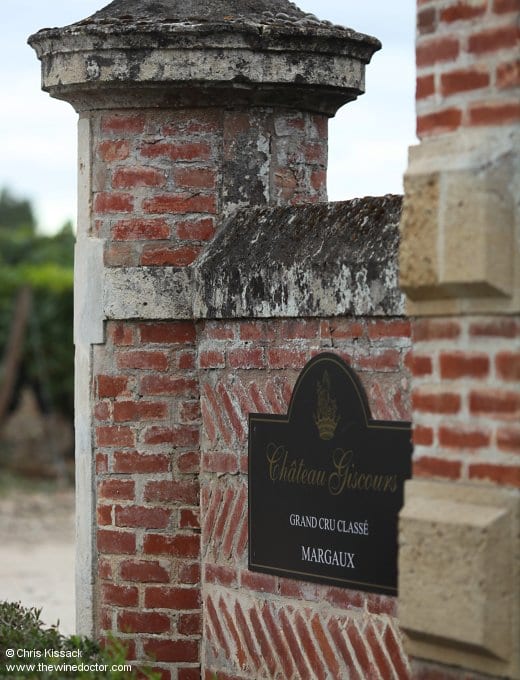
Chateau Giscours

Chateau Giscours and I had a faltering start. Giscours has the honour of being the first ever bottle of classed growth Bordeaux I purchased, although not admittedly the first I ever tasted (although it must be high up in the list). The exact vintage of the bottle I procured now escapes me, but it must have been from the early 1980s. What I do remember, upon opening it, is that I wasn't impressed; indeed, Chateau Giscours might have put me off claret for life. Looking at the extortionate pricing of the clarets from the 2005 vintage in the en primeur campaign, that might not have been such a bad thing.

The first trace of Chateau Giscours appears in the history books in 1330, when it was described as a fortified dungeon of all things. There is little else to describe the activities at Giscours at that time, but just over two centuries later, in 1552, documents concerning the sale of the estate show that it was then recognised as a vineyard. The property was sold at a price of 1000 pounds, passing from vendor Gabriel Giraud to new owner Pierre L'Homme. Another two centuries on, and the property is in the hands of the Saint Simon family, although not for too long. As with many other Bordeaux chateaux, the estate was confiscated with the Revolution in 1789, coming into the hands of the local citizens as National Property. There then followed a string of new owners, the most notable being Count de Pescatore who was responsible, in 1847, for the construction of the chateau which still stands at Giscours today. More than fifty years on from the Revolution, the new owner's motive was to impress Empress Eugénie, France's last Empress and wife of Prince Louis Napoleon, who was due to visit. Some things never really change.

Count de Pescatore was still in charge when the property was ranked as a third growth in the 1855 classification, but thereafter all did not go swimmingly at Giscours; yet again we have an example of a well run Bordeaux chateau falling into ruin, a consequence of under investment and a lack of interest, and such changes show through in the wines. Throughout the early 20th Century, Chateau Giscours was not a label to be sought out with any confidence. It was only the action of Nicolas Tari, who purchased Giscours after World War II, that saved the property from complete ruin and bankruptcy. Tari first restored the chateau and constructed an artificial lake, before turning his hand (or rather his finances) to sorting out the vineyards and re-equipping the cellar (as well as running his own polo team). Within a few decades, however, Tari found himself in financial trouble; Giscours was rescued this time by Eric Albada Jelgersma, a Dutch businessman. Tari subsequently found himself in hot water; an enquiry concluded, in 2000, that Tari had made personal use of his company's income. The punishment handed down included a fine not to be sniffed at, together with a two-year jail sentence, with eighteen months suspended, against which Tari unsurprisingly appealed.

Today Eric Albada Jelgersma owns the Giscours business activities (as I understand it, Tari still owns the bricks and mortar), and he owns the neighbouring Margaux property Chateau du Tertre outright. Albada Jelgersma's tenure has on the whole been a success, and in the last decade the wines of Giscours have demonstrated a palpable improvement in quality, and it seems that the wines of Giscours may one day emulate the popularity they have enjoyed in centuries past. The Albada Jelgersma era has not, however, been without controversy; in the late 20th Century Chateau Giscours was at the centre of one of the modern Bordeaux scandals, when it was revealed the wine making included some very dubious practices, all outlawed by the word of the appellation regulations.

The scandal came to light in 1998, the same year that Clinton found himself facing impeachment, which led some elements of the US press to compare the two events. "Forget Monica Lewinsky. It's France that has the real scandale of 1998 on its hands" read the Augusta Chronicle. Tongue-in-cheek reporting, naturally, but the error of judgement in the Giscours scandal should not be underplayed. An investigation of practices at the property revealed a set of invoices for the purchase of oak chips from Bordeaux barrel making firm Demptos. The trail led the investigating authorities further, as documents at Demptos revealed wood chip products had been sold to several other properties, all of cru bourgeois status. In the case of Giscours it became apparent that these had been used to impart an oak flavour to the second wine rather than the grand vin, but this did not excuse the irrefutably illegal practice. The cellar master, respected oenologist Jean-Michel Ferrandez, was charged and subsequently received a significant fine in 2000 (he was probably in court the same day as Tari), as did the other chateaux, and the coopers Demptos. The fallout for Bordeaux as a whole was remarkable by its absence, this being the region's most juicy affair since the Cruse scandal of the 1970s. Perhaps reassurances from Jacques Fanet, one time Assistant Director of the INAO, that "In Bordeaux, we put wine in wood, not wood in wine", did the trick. Or maybe it was that Ferrandez was promptly sacked. Or, just possibly, many wine drinkers are more worried about how the wine tastes and how much it costs, especially a second wine, rather than some technical aspect of its production.

The vineyards at Giscours are spread over four gravel outcrops in Margaux, with a poor quality, slightly sandy, pebbly soil. The estate nears 400 hectares in size, of which 85 hectares are designated vineyards, although at present there are just over 80 hectares planted up. The vines are planted at up to 10 000 vines/ha, a high density arrangement, and include a significant number of old vines; 25% are over 40 years of age. They are predominantly Cabernet Sauvignon (53%) and Merlot (42%), the remainder Cabernet Franc and Petit Verdot. In summer the vines see a leaf thinning and green harvest to push up the quality of fruit, which is harvested manually, destemmed and fermented plot by plot. Yields are typically less than 50 hl/ha, which is rather modest for Bordeaux. There is temperature control of fermentation and post-ferment maceration, then malolactic, and then the wine goes into oak barrels for up to eighteen months. During this time it is racked regularly, eventually fined but not filtered before bottling. The grand vin is Chateau Giscours, of which there are about 25 000 cases per annum, although this obviously varies with the vintage. The second wine is La Sirène de Giscours, approximately 10 000 cases per annum. There are also a number of lesser wines from, appropriately, lesser terroirs. These include Chateau Dutheil and Chateau Houringe, both Haut-Médoc cru bourgeois properties; the former is vinified at Giscours, the latter is operated on a lease, since 1982. In addition, a 40 hectare plot of vines adjacent to those of Giscours but outside the Margaux boundary is bottled as Le Haut Médoc de Giscours.

And so what of the quality today? Have recent vintages washed the stain of that early experience with Giscours from my mind? In all honesty, yes. Wines tasted recently include the five consecutive vintages from 2001 to 2005 (the 2000 slumbers in my cellar), and none disappointed. Obviously some are superior to others, with the 2005 and 2003 showing best recently (although I thought the 2002 very good too - in many cases this is an under-rated vintage, and often fairly priced). Whatever the choice, it seems to me as though we can once again buy Giscours with reasonable certainty. (11/7/06)

Contact details:
Address: Chateau Giscours, 33460 Margaux
Telephone: +33 (0) 5 57 97 09 09
Fax +33 (0) 5 57 97 09 90
Internet: www.chateau-giscours.fr

Chateau Giscours - Tasting Notes

Click to locate stockists.

2007

Chateau Giscours (Margaux) 2007: This has some appealing black, complex, lifted fruits on the nose, with a vanilla twist. Freshly composed on the palate, with appealing structure. Elegance, with a ripe fleshed out midpalate, and a little chewiness to the tannins. A sappy finish, where the tannins persist. A nice acidic structure. Could be good based on this sample. From my 2007 Bordeaux en primeur assessment. 15-16+/20 (April 2008)

2006

Chateau Giscours (Margaux) 2006: Nicely perfumed nose, attractive, with a good presence of fruit too. Rounded but well defined, quite fresh, nicely textured and with a good weight. Beneath it all, a firm structure and good acidity. This is a very good effort, in the context of the vintage, for Giscours, an increasingly successful Margaux estate. From my 2006 Bordeaux assessment. 16-17/20 (April 2007)

2005

Chateau Giscours (Margaux) 2005: There is just the faintest edge of feral character here, along with dense berry fruit and still a firm presence of oak. It has a rather hard and serious structure on the palate, with sooty tannins offering a lot of drying grip, with a nice acid presence too. The tannins stand out a little from the gentle, lightly creamy texture, and my only concern is that the former may outlast the latter. Nevertheless the potential is here. From my tasting of 2005 Bordeaux at two years of age. 17+/20 (October 2007)

Chateau Giscours (Margaux) 2005: CS  62%, M38%. A very deep colour here, leading out to a purple-black rim. Dense and concentrated nose, very evocative, with aromas of black fruits, white flower petals, tar and minerals. Very pure. Full, glorious palate, very complete, with a slightly soft texture. Ripe, full, firm tannins, with plenty of fat and fresh acidity. There is evident structure here, but the palate is also packed with flavour, whilst remaining quintessentially Margaux. Excellent. From my 2005 Bordeaux en primeur tasting. 17-18/20 (April 2006)

2004

Chateau Giscours (Margaux) 2004: Quite a fine, red fruit and perfume nose, with youthful cashew nut oak on the nose. On the palate it is rather lighter in impact than some other wines. There is a firm wall of tannin and rather bracing acidity too, the texture and fruit isn't quite up to the same level. Good character, but perhaps a little over worked. From my 2004 Bordeaux assessment. 15+/20 (October 2006)

Chateau Giscours (Margaux) 2004: Lovely appearance, dark and glossy, not quite with the intensity of the 2005 though. Rather closed on the nose, although there is a pleasing presence of mineral-laced black fruits. Ripe, rounded palate, very firm, quite a complete style. Firm tannins and nice acidity. Great typicity, really attractive with it. The tannins only dominate on the finish. This has good potential. 16.5+/20 (April 2006)

2003

Chateau Giscours (Margaux) 2003: A lovely nose here, demonstrating plenty of pure Margaux perfume, remarkable regarding the heat of the vintage. It has a deep, rich, gravelly character that I find immensely appealing. Full and textured on the palate, but with a reserved feel, lovely style though, and a rather racy presence on the palate. The tannins come through on the finish, but overall I find this wines youthful exuberance and structure to have great appeal. And it has typicité, and a good length, too. There's lots here to stand up to the tannins. Really very good indeed. 17+/20 (November 2006)

Chateau Giscours (Margaux) 2003: Lovely, lifted and expressive, mineral-tinged fruit here. A delightful impact. Lovely, rounded structure on the palate, which shows a creamy style with nicely knitted tannins, and elegant presence and good balance. Firm acidity and overall very good structure. A success. From my 2003 Bordeaux assessment. 17+/20 (October 2005

2002

Chateau Giscours (Margaux) 2002: Another dark and glossy wine, with not a hint of maturity looking at the colour, although the nose presents an appealing array of aromas suggesting nice development. Quite classic, bloody, meaty, iron-edged style, with a full, ripe, creamy character on the palate. Lovely structure, aromatic and floral character with a gravelly edge. Good acidic freshness. This has excellent potential. I prefer it to the 2004. 17+/20 (April 2006)

2001

Chateau Giscours (Margaux) 2001: Just over a year since I last tasted the 2001. A fairly deep hue, and presenting a very firm, masculine character on the nose, hard edged, although with a stony Margaux character; certainly not as elegantly perfumed as it was last time. Still a little trace of nutty oak. There is elegance on the palate though, fairly prominent structure but nicely rounded edges. A ripe, creamy depth of fruit and a little toffee-raspberry finish. I think if this opens out to reveal the perfume of its youth again it could be very could indeed. It certainly has the desired substance and structure. 16.5+/20 (November 2005)

Chateau Giscours (Margaux) 2001: The follow-on vintage from the great 2000. This wine has a moderate density of colour on inspection, and the nose presents a delightful, very typical, Margaux perfume. There are soft and supple red and black fruits on the palate, supporting by a very nicely composed structure, just showing a little tannin through the midpalate. This is good quality indeed, although still very primary and simple; it needs six to seven years plus to show its full potential. 16+/20 (May 2004)

2000

Le Haut Médoc de Giscours (Haut-Médoc) 2000: Not the second wine, a commonly made mistake, rather this is from a 40 hectare plot of vines adjacent to the Giscours vineyards. A fairly good depth of colour on inspection considering this wine's pedigree. On the nose, some clean, fresh and nicely open fresh fruit character. It has a lovely palate for it's status, perhaps belying the success of the vintage; it is full of dark roasted fruit flavours and has appealing texture, with very correct balancing acidity. Decent wine. 15/20 (May 2004)

1997

Chateau Giscours (Margaux) 1997: This has a decent colour, showing some evidence of maturity. The nose doesn't offer much in the way of fruit, although there is a metallic aroma, and a low level of sulphur. On the palate it has moderate weight, but prominent acidity - showing particularly on the finish. Seems somewhat green - under ripe fruit? A displeasing, disjointed finish. From a Bordeaux 1997 tasting. 12/20 (February 2003)

1961

Chateau Giscours (Margaux) 1961: A crystal clear wine, fairly pale, but vibrant. An attractive red core with a mature rim. Initially some slightly smoky sweet fruit, meaty but clean raspberry character, then later some intense, cough-candy liquorice style aromas. Rather light on the palate, with bright acidity which has no doubt kept this wine alive. It is attractive, but after a while it does seem to fall apart a little. It has lasted well though.  From a 1961 Bordeaux tasting. 16.5/20 (June 2007)

Home - Site index - Site updated May 13, 2008 - © The Winedoctor 2000 - 2008 - Wine Scores - RSS