Home > Producer Profiles > Bordeaux Profiles > Chateau Cos d'Estournel

Chateau Cos d'Estournel

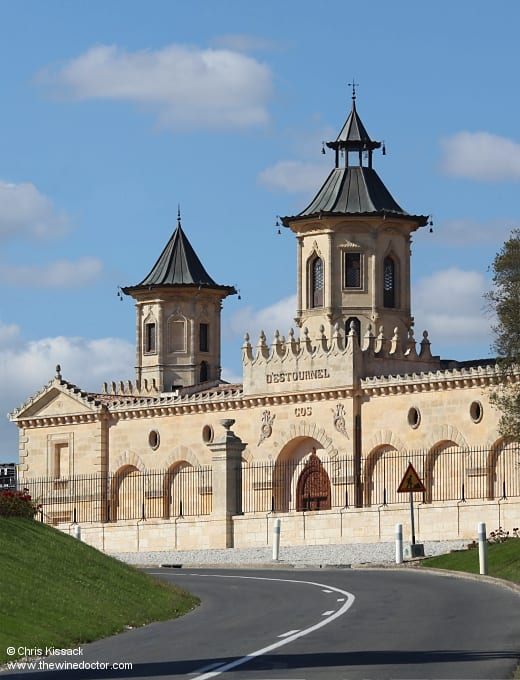
It was late on a December afternoon when I first saw it. It was the week before Christmas, and I was in Bordeaux for a few days of tastings, visiting the likes of Chateau Brown, Sociando-Mallet, Margaux and a number of smaller estates. We were on the D2, having already left behind Bordeaux and the communes of Margaux, St Julien and Pauillac; we were heading north into Médoc territory, homing in on our residence after a fairly long day, with dinner and an evening of relaxation ahead. Within the car it was warm, but outside was bitterly cold, as it had been since 8am, when our day had begun with a vineyard inspection and quick pruning lesson. And above us, the sky was beginning to darken as night advanced, ousting the dim light of day. And there, situated on a turn on the D2 just ahead of us, catching a few of those final, fading rays, was the golden sandstone of the chai at Cos d'Estournel, its Oriental pagodas sitting proud and yet conspicuously alien, as if the whole building had recently been lifted and transplanted here from some foreign hilltop.

In more recent years visitors are more likely to have seen the sun's rays scattered across scaffolding, cranes, plastic sheeting and more. The sandstone that has given the edifice its fabulously golden glow has not proved as resistant to the effects of the Bordeaux climate as the more familiar creamy stone found throughout the rest of the Médoc, and as a result there has been an extensive restoration underway; indeed the process is so extensive that some might prefer to think of it as a rebuilding. But I am sure it is worth it; such an esoteric construction must be preserved for the visual delight of all Bordeaux acolytes of the future.

Louis Gaspard d'Estournel

To learn more about Cos d'Estournel's fabulous chai, and of course its wine, naturally involves a little historical research. We begin with the birth of Louis Gaspard d'Estournel, in January 1762, to a family from Quercy, a region to the south of Bordeaux more readily associated with Cahors than claret. His origins are of significance, however, if we are to also understand the origin of the name of this chateau. For this information I am indebted to Clive Coates, who wrote in Grand Vins (University of California Press, 1995) that Cos is most likely to be a derivative of caux, itself derived from colline de cailloux, meaning ‘stony slope'. Although in French the terminal consonant in caux is silent, in the Gascon tongue the end consonant is most certainly vocalised, accounting for how caux may mutate into Cos over the years.

In 1791, when Louis was just 29 years old, he inherited the family estate consequent upon the death of his father, Guy d'Estournel de Maniban. Over the ensuing years he added other lands to his estate, which included Pommies, today known as Chateau Pomys, a Cru Bourgeois estate, and some vineyards in the commune of St Estèphe. At the time this latter addition was perhaps unexpected; most of the great vineyards of the Médoc were already established, and they were further south, in Pauillac and beyond. St Estèphe was yet to be fully exploited, as evidenced by the late appearance of Montrose which only came into being in the early years of the 19th century, hundreds of years after some other comparable deuxièmes crus. Despite this admirable expansion, however, the property had no vinous reputation of note; it received no significant mention in an early classification of the region from Tastet & Lawton, and it was not until 1800 that the estate was listed as a third growth by André Simon, with a similar ranking in a subsequent Lawton classification. By the mid-19th century the property was ranked somewhat higher by many, and of course by the time of the 1855 classification the estate was ranked amongst the second growths. Cos d'Estournel had arrived.

Cos d'EstournelThis success was no doubt something Louis d'Estournel aspired to, but it was not something he achieved quickly or easily. Along the way there were major difficulties; despite his fiery enthusiasm his creditors withdrew their support for him in 1811, and he was forced to relinquish his ownership of Cos d'Estournel. It was acquired by a debt collector named Jean-Louis de Lapeyrière, who held onto the estate for ten years, subsequently selling it back to Louis and a small consortium of Bordelais businessmen in 1821. Although not the owner, Louis d'Estournel had remained at Cos throughout these difficult years, and he clearly had strong ideas of how it should be developed once he regained full control. In the three decades that followed he added numerous plots of vines to his estate, purchasing neighbouring Cos Labory in the process, an act which resulted in the best plots of that latter estate forever being absorbed into the Cos d'Estournel vineyard. Success came, evinced by an improvement in the quality of the wine, and confirmed by a rise in the customary classifications as discussed above. Settled in, and seemingly financially secure, d'Estournel looked to renovate his cellars. Eschewing the usual materials, Louis Gaspard opted for the aforementioned sandstone. In terms of design, the cellars were also unique. Perhaps reflecting his many travels in the Orient and beyond, which brought him the nickname of the Maharajah of St Estèphe, the cellars sprouted tall pagodas which would be more at home on a Chinese temple than here in the Médoc. The doorway, decorated with vines, grapes, flowers and leaves, was sent over from the Palace of Zanzibar. And against the road he constructed an imposing triumphal arch, rather like the one found at Léoville-Las-Cases; in this case there sits above the archway his coat of arms, surrounded by the customary combination of lion and unicorn. Beneath lies the inscription Semper Fidelis, 'always faithful', a motto more commonly associated with any number of military regiments across the globe, such as the United States Marine Corps, than the wines of Bordeaux. In parallel his wines were exported to similarly exotic climes, in particular India.

Cos d'EstournelOne cannot help but feel, on reviewing Louis Gaspard's story, that he was certainly a showman, but perhaps a showman with more flair than sense. He was renowned for hosting spectacular festivities at Cos, and for presenting his guests with bottles marked 'returned from India'; Louis felt that the wines demonstrated a distinct improvement after making this lengthy round-trip. Bottles of Cos d'Estournel graced the tables of Queen Victoria of England, Tsar Nicolas I of Russia and Emperor Napoleon III of France, who reputedly ordered thousands of bottles to stock the cellar at the Tuileries Palace. And the patronage did not stop at royalty; the wine was also known to Henri-Marie Beyle, better known by his pen-name of Stendhal, and with time would come to be favoured by Jules Verne, the dramatist Eugène Labiche and even Karl Marx who received a number of bottles sent over to his home in London in 1857 by fellow philosopher Friedrich Engels. Nevertheless, although the success of Cos d'Estournel seems irrefutable, it was not without ultimate failure. The financial difficulties of the 1820s I have already mentioned, but by 1852 Louis Gaspard was once again in a similar predicament. Subsumed by debt and probably in ill-health he was forced to sell his beloved estate, and just a year later - two years before Cos would claim forever second growth status - he died. At least his final months were spent in some comfort, as the new owner of his properties, a London banker Charles Cecil Martyn, allowed d'Estournel to stay on in his house at Pommies until his demise.

After Louis Gaspard

Martyn was able to do this because it would seem he had no intention of using his acquisition as a residential property. An absentee landlord, he remained distant from the affairs of the estate, appointing none other than Jérôme Chiapella, proprietor of La Mission Haut-Brion, to look after the vineyards and wine. The duo must have been popular employers, as their success was measured not only in how they raised the quality of the wine, but also in their forward-thinking approach to their workers. They received free healthcare, and retired employees were housed rent-free on the estate. Some of the practises instigated by Martyn and Chiapella are still true of Cos d'Estournel today, despite the fact that the estate has seen a succession of owners since their time. In 1860 Martyn sold Cos Labory, which he also acquired with Cos d'Estournel, and in 1869 he sold the latter. The new owners were an aristocratic family from the Basque region named Errazu, who seem to have established a reputation for socialisation more than viticulture, hosting numerous high-society soirées. This lasted but two decades, however, as in 1889 the property came to the Hostein brothers, who also owned nearby Montrose, who then in 1894 passed it to Louis Victor Charmolüe, who had married into the Hostein family.

Cos d'EstournelThe modern era for Cos d'Estournel really began in 1917, when the estate was acquired by Fernand Ginestet. From Ginestet it passed through the hands of his daughter, Arlette, who married into the Prats family, to her three children, Jean-Marie, Yves and Bruno Prats. Until very recently the Prats family in particular Bruno and then his son Jean-Guillaume have been in charge at Cos, although there have been some subtle changes in ownership. In 1998 the family sold up, and the estate was acquired by the Merlaut family who, as owners of the Taillan Group, are more readily associated with names such as Chasse-Spleen, Gruaud-Larose, Ferrière, La Gurgue, Citran and Haut-Bages-Liberal. Nevertheless the Prats family remained heavily involved in the running of the estate, as they were two years later when ownership once again changed, as the estate was acquired by industrialist Michel Reybier. Jean-Guillaume Prats stayed on as president of the property, and he continues to hold this position today.

Vineyards, Wines and Controversies

The vineyards of Cos are on the customary Quaternary gravel which peppers the left bank of the Gironde. There are 70 hectares divided up into 30 parcels, with Cabernet Sauvignon holding a slight predominance, accounting for 60% of the red vines, with the remaining 40% being Merlot. There was once a small amount of Cabernet Franc, about 2% of the vineyard, but this no longer seems to play a part in today's Cos d'Estournel. The Cabernet is concentrated to the west of the vineyard, where there are well-drained gravel slopes, whereas the Merlot prefers the eastern edge where the limestone bedrock peeps out from beneath the surface gravels. The vines are planted at a density of 8000 to 10000 vines/ha, and have an average age of 35 years. Only those of more than 20 years provide fruit for the grand vin, Chateau Cos d'Estournel, with others most probably destined for the second wine, Les Pagodes de Cos. Each vineyard worker has responsibility for 45000 vines, and must oversee the routine vineyard tasks such as pruning and leaf-thinning. The harvest is also by hand, and is down to a combined work-force which includes the Cos d'Estournel employees and a team who trek there from the Andalucían village of Alcalá La Real, camping in the grounds of the estate at night, picking the grapes by day.

Cos d'EstournelOnce in the chai the fruit is fermented in short stainless steel vats which were installed during a refurbishment in 1984, with temperature controlled to below 32ºC. There is malolactic fermentation in oak, with new barrels accounting for between 60% and 100% of the wood, depending on the vintage. It sounds quite conventional, but under Reybier and Prats there has been no slow down in development or investment, as evinced by the extensive restoration of the cellars in recent years. A tour of these new cellars, which I undertook in early 2009 shortly after their completion revealed the extent of this rebuilding and refurbishment. Architecturally the restoration work is admirable, but it is the sheer scale of the project which will take your breath away. Inside the vatroom is spread out over two floors, the upper floor running across the top of the vats allowing access here, the lower floor allowing side access. These vats - and there are dozens of them - are all stainless steel with laser-welded seams and unusually they are all sourced from a milk vat manufacturer. Perhaps most impressive of all, though, are two gigantic elevator vats positioned on either side of the vatroom. These allow for vat-to-vat drainage without the use of a pump; any vat on the floor can be drained into an elevator vat by gravity within just 10 minutes, and to achieve the reverse the elevator vat - essentially a vat within a huge, glass-lined lift shaft - is raised to the top and the wine flows back. Achieving wine transfer by gravity rather than pump is seen as important in improving tannic profile and texture, but this is an incredibly expensive way of achieving it.

As if that weren't enough, there are also new barrel stores planned, and also a warm-room to encourage malolactic fermentation. It is clearly an exhaustive and costly project. When quizzed on the total expense proprietor Jean-Guillaume Prats remained tight-lipped, but he did let slip that the finance came from a 25-year bank loan; the bill remains undisclosed, but it the figure must be huge. The obvious question is how Prats plans to pay off this loan. His first response is that the improved facilities allows for production of greater volumes of wine, more specifically a greater portion of the harvest comes out of the vinification process with quality sufficient for the grand vin, so we might expect the Cos:Pagodes ratio to increase a little in future vintages. The unspoken answer of course is that Cos prices will remain high, and this was certainly the case with the 2008 vintage, when the Cos d'Estournel release price remained comparable to 2007, when many other estates, including illustrious first growths, were slashing prices.

Returning to the wines and their vinification, at the end of the work in the chai there is a selection by tasting for the first and second wines, with a total production nearing 32000 cases, again obviously depending on the vintage; in some years there may be considerably less. Today, however, there is another wine worth noting, a white produced under the Cos d'Estournel label, starting with the 2005 vintage (released in 2007), and this has turned out to be one of the more controversial of Prats and Reybier's developments. The vineyards utilised in the production of this white wine, 80% Sauvignon Blanc and 20% Semillon, are not contiguous with those providing the red fruit for the true grand vin, which has led some to question why it should bear the name at all. After all, surely Cos d'Estournel's success is tied to its terroir, rather than being a brand? And I suspect its production quantity and release price - just 250 cases, £100 per bottle - clearly conveying a 'cult intention', also contributed to the distaste expressed in some quarters.

Whatever your opinion of Cos d'Estournel, red or white, there is no denying the estate's recent successes. The wines are highly today regarded by many, and they are said to sit comfortably alongside those of other second growth estates. Returning to Clive Coates writing in Grands Vins, the wines are described as having both "power and finesse" and are clearly in his opinion superior to many wines of the St Estèphe appellation which he describes as being "occasionally a little too tough for their own good". This turn of phrase has led some to misquote Coates as describing Cos d'Estournel as tough, but this is not the case. In his words, they have "both the power and the finesse, both the body and the delicacy, both the backbone and the fruit". His words are ones of unmitigated praise. Unfortunately my tasting experience is somewhat more limited than that of Coates, and I cannot add my voice to those commenting on the success of the wines. A reasonable deduction, however, would be that this success has brought financial security, as only a few years after acquiring Cos d'Estournel Reybier decided to add another icon to his wine portfolio, settling on an historic Californian estate, Chateau Montelena. This news leaked out in July 2008, following a tease from Robert Parker posted on his webforum when he announced that "one of the biggest stories in my 30 years in the wine field" was about to break. When he revealed the big story to be the "purchase of Montelena by Cos", the majority of forum members failed to share his enthusiasm for the news, with a subsequent poll showing most thought it a let-down, or simply didn't care at all. In truth of course Cos didn't really buy Montelena, although the simplification of the true nature of the deal into the soundbite above was understandable. In fact Michel Reybier was to be the buyer, and the control of Montelena was to be turned over to an executive committee headed by Jean-Guillaume Prats alongside Cos chef de cave Dominique Arangoits, together with Montelena winemaker Bo Barrett and managing director Greg Ralston. As it happens, however, by November the same year it was revealed the deal had fallen through, so this small storm-in-a-teacup can now take its rightful place as a minor footnote in the story of Cos d'Estournel. (15/10/08, updated 16/9/09)

Contact details:
Address: 33180 St Estèphe
Telephone: +33 (0) 5 56 73 15 50
Fax +33 (0) 5 56 59 72 59
Internet: www.cosestournel.com

Chateau Cos d'Estournel - Tasting Notes

Click to locate stockists.

2008

Chateau Cos d'Estournel (St Estèphe) 2008: This is 85% Cabernet Sauvignon, 13% Merlot and 2% Cabernet Franc, and comprises 78% of the estate's production. Harvest ran from September 29th to October 13th, average yield just 27 hl/ha. Good firm fruit on the nose, fresh but moving towards dark fruit in style. Showing less oak than Pagodes, or La Goulée. Tightly formed on the palate, although it is at least expressive. A nice, ripe grip in the background, a little silky but with texture and some weight. Nicely coated, elegant but with a little creaminess. Dense finish. Lots of potential here. From my 2008 Bordeaux primeur assessment. 17-18+/20 (April 2009)

Les Pagodes de Cos (St Estèphe) 2008: The second wine of Cos d'Estournel is 45% Cabernet Sauvignon, 53% Merlot and 2% Petit Verdot, and comprises 22% of the estate's production. Harvest ran from September 29th to October 13th, average yield just 27 hl/ha. Flattering, with toasty oak, with dark cherry character. Expressive. Fresh but textured, fairly generous, firmly structured though. Nicely composed, good substance, ripe tannins, some firm oak as well. Slightly chewy finish, well structured, with a more appealing character than that other famous second wine of St Estèphe, La Dame de Montrose. From my 2008 Bordeaux primeur assessment. 15-16+/20 (April 2009)

2005

Chateau Cos d'Estournel (St Estèphe) 2005: This is a real contrast to Calon, with a pure, ethereal and complex perfume of fruit and flowers on the nose, overlaid with grainy, honeyed oak, and just a few elements of charcoal. The palate is very polished at first, but then reveals a slightly coarser element with a huge core of tannins. Lovely flavour of fruit though. Lots of structure, lovely fresh acidity, and no doubt great potential for the future. An excellent result but it needs 10-15 years. From a 2005 Bordeaux tasting at four years of age. 18-18.5+/20 (November 2009)

2004

Chateau Cos d'Estournel (St Estèphe) 2004: There is a lot of oak evident on the nose here, dense and toasty, but with good fruit too, with a sweet and gritty depth. Good weight on the palate, a touch brawny, with moderate texture and a solid, polished wood background. Firmly structured, grippy, with a firm core of fruit and a long, dense finish with tangible extract. Very good indeed. From a 2004 Bordeaux tasting at four years of age. 17.5+/20 (November 2008)

1998

Les Pagodes de Cos (St Estèphe) 1998: The second wine of Chateau Cos d'Estournel. A really dark, dense purple wine. Fairly simple on the nose at the moment, but the palate is dense, muscular and firm. Powerful tannins and acidity sit with a touch of fatness. This wine certainly needs time. The second wine of Chateau Cos d'Estournel. From a Majestic press tasting. 15.5/20 (November 2001)

1994

Chateau Cos d'Estournel (St Estèphe) 1994: Little sediment. Decanted and drank over the course of the evening. An appealing, dark hue. A glorious nose though, so typical of Cos. At first it gives just a little claretty blackcurrant, laced with nuances of green peppercorn and liquorice, before opening out to give a full blast of gravelly and violet-infused perfume, with the spicy complexity of cumin, backed by lifted fruit freshness. This is lovely, and simply dripping with style. Beautifully fresh from the outset, with a very complete, balanced composition that glides effortlessly across the palate, with only the bumping around of some ripe but unresolved tannins to prevent absolute maximal pleasure right now. But on the positive side these are ripe and sweet, and give a fine bite to it. Lovely rounded, wholesome finish. This is just delicious. I am so sorry that I have only one more bottle of this. From a 1994 Bordeaux tasting. 18.5+/20 (April 2007)

1961

Chateau Cos d'Estournel (St Estèphe) 1961: English bottled. A good density here, a mature claretty hue out to the rim, and an interesting nose, of wet stones, cool minerals, mushrooms and just a little vegetal note in the background. It takes a little while to open up, but as it does so it becomes apparent that this is very classically styled. Full, a nice weight, good fruit and firm acidity. This has a good presence, with a light, elegant, rather detached texture. Slightly hot on the finish, starting to show its failings here. Will be going downhill soon I think. Drink up now. From a 1961 Bordeaux tasting. 17/20 (June 2007)