Château Haut-Marbuzet: Vineyards
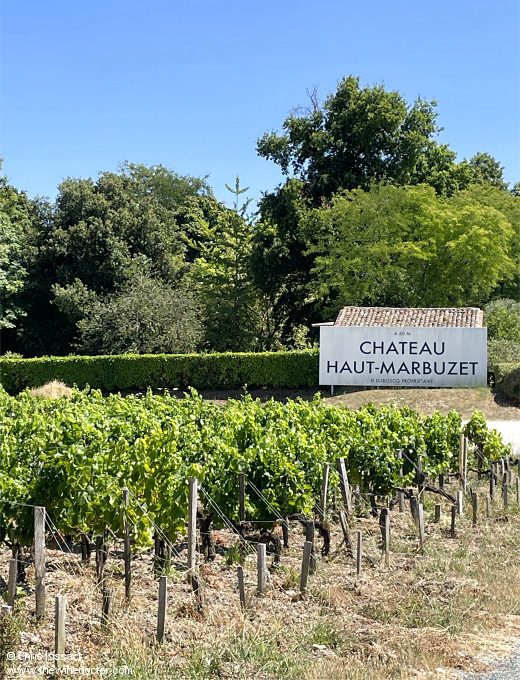
The vineyards of Château Haut-Marbuzet lie on the edge of the hamlet of Marbuzet, and the very prominent sign overlooking some of the vines is still visible today. Let’s just say you know when you are nearing Château Haut-Marbuzet.
The location of the vineyards is significant, as here we are standing on a desirable mound of gravel very close to the Gironde. Indeed, if you adhere to the mantra that the best vineyards are within sight of the estuary, it is worth noting that this is true of Château Haut-Marbuzet, and the vineyards of several prestigious neighbours such as Château Cos d’Estournel, Château Cos Labory and Château Lafon-Rochet lie behind the Haut-Marbuzet vineyards, further inland. In the case of Château Lafon-Rochet, quite some distance inland. Underfoot, this gravel mound features Terrace 3 gravel on the inland side where we find Château Le Crock, but on the estuary side there are pockets of Terrace 4 gravel running down to the palus, the same arrangement we can find further north in the vineyard of Château Montrose. Beneath the gravelly clay there is the classic Calcaire à Astéries, hard limestone rich in marine fossils, seams of which can be found both here in St Estèphe (alongside the more obvious Calcaire de St Estèphe) as well as in St Emilion.
Today the vineyard has continued to grow, up from the 61 hectares the Duboscq family owned when I first profiled the estate some decades ago (yes, it really has been that long), to a figure closer to 76 hectares today. The vineyard is planted with 50% Cabernet Sauvignon, a significant area of Merlot which accounts for 40%, with Petit Verdot and Cabernet Franc in combination making up the final 10%. The high proportion of Merlot is a little unusual for the commune, although there are a number of estates both north and south on the Médoc that have a similar or greater percentage of this variety in the vineyard.