Château Duhart-Milon
Ranking: Fourth growth (1855 Classification)
Appellation: Pauillac
Owner: Les Domaines Barons de Rothschild (Lafite) SCA
Ten-second primer: A property in the same ownership as Lafite-Rothschild, and managed by the same team, Duhart-Milon provides an understated glimpse of the style of wines made by this branch of the Rothschild family. Currently run by Saskia de Rothschild, with Eric Kohler overseeing winemaking.
This profile includes: Four pages of history and detail (links above), and tasting notes back to 1982.
It was during the primeur tastings many years ago that I made my first-ever visit to Château Duhart-Milon. Normally the estate’s barrel samples are tasted at Château Lafite-Rothschild, at that time under the gaze of Charles Chevallier in a rather understated tasting room which had the air of an old scullery. In more recent years the samples have instead been poured in a rather swanky open-plan and fully-glazed function room, or in a more bijou technical and tasting room, but the point is the same; to taste Château Duhart-Milon, you went to Château Lafite-Rothschild.
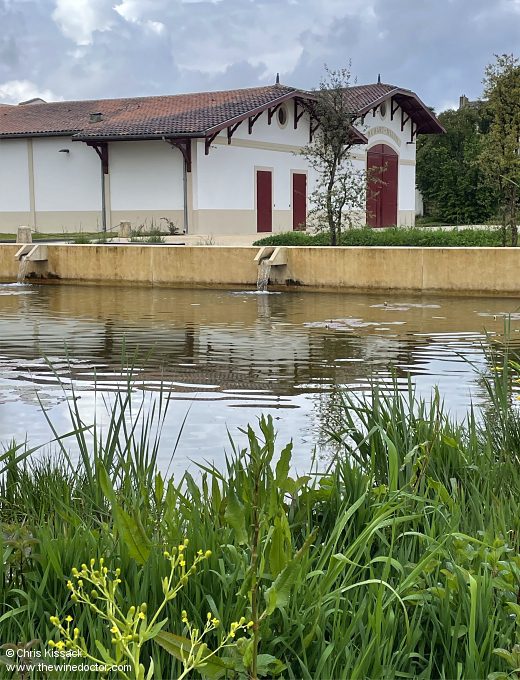
This particular year, however, there was building work at Lafite, and as a consequence the tastings were moved to Château Duhart-Milon. This might sound like an exciting diversion, but bear in mind that Château Duhart-Milon is one of the few properties in the 1855 classification of Bordeaux to lack a true château. This was, in essence, a visit to a warehouse, located off a side street in Pauillac. Even decades later several elements of this visit remain firmly lodged somewhere in my cerebral cortex, principally the freshness of the paint on this warehouse’s admittedly attractive facade, and the high-quality finish to the tarmac of the car park. No, really. It was a great car park.
Oh, and the wines. I should mention the wines. It was the 2009 vintage, tasted in early 2010, and they were pretty smart.
Fast forward to more recent times, and thanks to yet another round of building works the primeur tastings of April 2024 were once again moved from Château Lafite-Rothschild to Château Duhart-Milon. I expected another draughty warehouse experience, although being honest most of all I was looking forward to checking out the car park again. The sight that met my eyes this time, however, was very different. The property has undergone a transformation, opening up one corner of the estate by demolishing a handful of buildings and renovating others to create a visitor centre, and that expanse of tarmac has been replaced by an expansive pond home to rushes and flag irises, as well as grassy paths, trees and seating areas. It was absolutely charming, but also served to indicate the Rothschilds have their eyes on wine tourism as a revenue stream here. Under the direction of Saskia de Rothschild, there is clearly a taste for improvement and modernisation, not to mention a move towards sustainability and organic methods of working.
In this profile I examine all aspects of the estate today including these recent developments, but as is customary, I kick off with the history of the estate, which experienced a serious 20th-century decline before it was rescued by the Rothschilds.