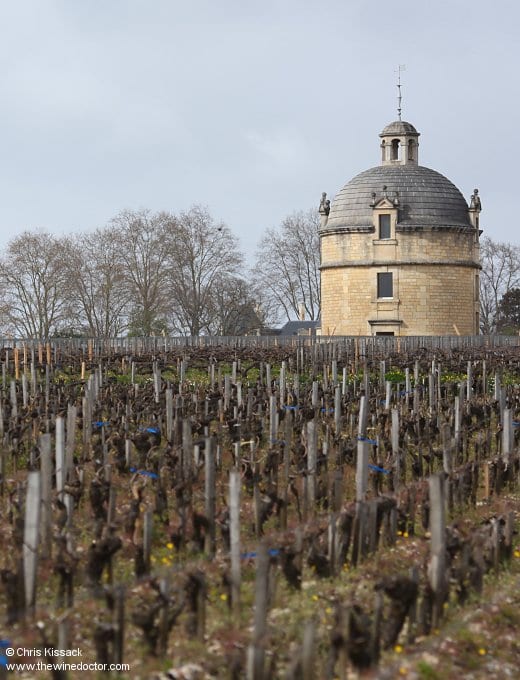
Château Latour
Ranking: First growth (1855 Classification)
Appellation: Pauillac
Owner: Artémis (The Pinault Family)
Ten-second primer: Arguably the first of the firsts? Officially that title goes to Lafite-Rothschild, which was listed at the head of the first growths in 1855, but for many Bordeaux drinkers – me included – Latour takes the crown. Also a great second wine, Les Forts de Latour. Wines made by Hélène Génin.
This profile includes: Twelve pages of history and detail (links above), and tasting notes back to 1945.
There are few – if indeed any – more evocative names to the drinker of Bordeaux than that of Château Latour. The merchants who drew up the 1855 classification of the wines of the Médoc may well have placed Lafite, later to be Château Lafite-Rothschild, at the very top of the four estates they ranked as first growths, but that hasn’t stopped legions of wine drinkers placing Latour at the top of their personal list of favourites. I would have to count myself among those who, on the whole (because no first growth can dominate in every single vintage) favour the wines of Château Latour over those from the other first growth châteaux.
My first visits to Château Latour – even if most of them were rather fleeting tasting appointments made during the primeurs tasting week, or later in the year to taste the freshly bottled wines – remain lodged in my memory. First came the trial of the gatekeeper, who guarded the entrance to the property with a commitment matched only by Cerberus, guardian of the gates of Hades (yes, I know Cerberus was there to prevent people from leaving, rather than entering, and that he was far from humanoid in form, but surely I am allowed at least one fanciful analogy per Bordeaux profile?). Once admitted on to the estate, there comes then the gentle drive – you don’t want to spook any of the horses out ploughing the vines – down to the little car park at the foot of the vineyard, on the low land not planted with vines between Latour and Léoville-Las-Cases. And then, finally, the re is the occasionally icy and windswept walk back up the mountain of gravel to the tasting rooms and cellars, which sits on the crest of the vineyard (sadly, the iconic and rather photogenic dovecot, pictured below, is never used).
Inside, the wine awaits you. Or rather wines, because this is not a property where you should overlook the second wine. Or, indeed, the third wine.
The grand vin of Château Latour is, at its greatest, a paradox. It possesses a sinewy and savoury concentration, a richness and density which comes from the deep layer of clay that characterises the vineyard. And yet this density comes framed within a light-footed poise, the palate elegant, expressive and perfumed despite its build, a finesse that reflects the layers of benevolent gravel that sit atop the clay. These various facets are fashioned by the team, who can take advantage of the investment of the current owners – the Artémis Group, headed up by the Pinault family – into a perfectly sculpted whole. No single facet stands out of place; the beauty of the wine can sometimes be breathtaking. A tasting here, in the Château Latour tasting room, with a vista over the vines on their gravelly slope which gradually descends down to the Ruisseau de Juillac to the south, and to the Gironde to the east, is an experience not to be missed, should the opportunity ever come your way. It will push all your vinous-emotional buttons.
This profile, for many years one of the most detailed on Winedoctor, sets out all I have learnt about Château Latour over many years of following its wines, and during my recent visits over the past twenty years. I start, as always with my Bordeaux profiles, with a look back to the earliest hints of the estate’s genesis.