Home > Producer Profiles > Bordeaux Profiles > Chateau Haut-Marbuzet

Chateau Haut-Marbuzet

The origins of Haut-Marbuzet lie in the 18th Century, when much of the land around the hamlet of Marbuzet in the commune of St Estèphe was in the ownership of two families. The first is a familiar name, it being none other than the nobleman Alexandre de Ségur, who held sway here until his death in 1776, when his lands were divided and sold. This estate was acquired by Marc-Antoine Domenger, who was régisseur at Latour, and these vineyards subsequently gave rise to Chateau Le Crock, now owned by the Cuvelier family of Léoville-Poyferré, and Chateau de Marbuzet. The other name, not so familiar, is Sylvester Fatin, who bequeathed his lands to his daughters in 1770. In 1825, however, these vineyards came to the MacCarthys, a family of Irish immigrants that included amongst their number wine merchants and the chairman of the Bordeaux Chamber of Commerce. It was the MacCarthy estate that would give rise to Haut-Marbuzet, but not until the middle of the 19th Century. The new Napoleonic laws decreed that estates must be divided upon their inheritance, and so it was that in 1854 the MacCarthy vineyard was partitioned into 17 separate parcels. It was one of these parcels that would become the Haut-Marbuzet of today.

The parcel in question was purchased by a gentleman named Poissonier and in 1930 the son-in-law of his descendents were still running the vineyard, and quite well too it seemed. They sold their wine for bottling as a generic to a certain Hervé Duboscq, a lively character who had progressed from illiteracy at the age of nine to the business of buying, blending and shipping wine, and by the 1950s he was the largest exporter of Bordeaux to London. A regular addition to his blending vats was none other than Haut-Marbuzet, which he regularly purchased from Monsieur Lambert, the aforementioned son-in-law. When he learnt of Lambert's intention to sell up, he purchased the 7 hectare estate, and from 1953 he set about marketing the wine under its own name. It is here that Haut-Marbuzet's history as a producer of wine worthy of our interest really begins, but first Duboscq had much work to do. He sold the entire first vintage, a mere 44 barrels, in one transaction, and set about re-establishing the rather sparsely populated vineyards. Within a few years he was gathering together the original MacCarthy estate, slowly acquiring one by one a good number of the seventeen portions that had been created over a century before, including Chambert-Marbuzet, Tour de Marbuzet and eventually purchasing the original Chateau MacCarthy itself in 1987. In 1962 he was joined in his venture by his son Henri, who has continued his father's enthusiastic tenure, and is today himself assisted by his own sons, Bruno and Hugues.

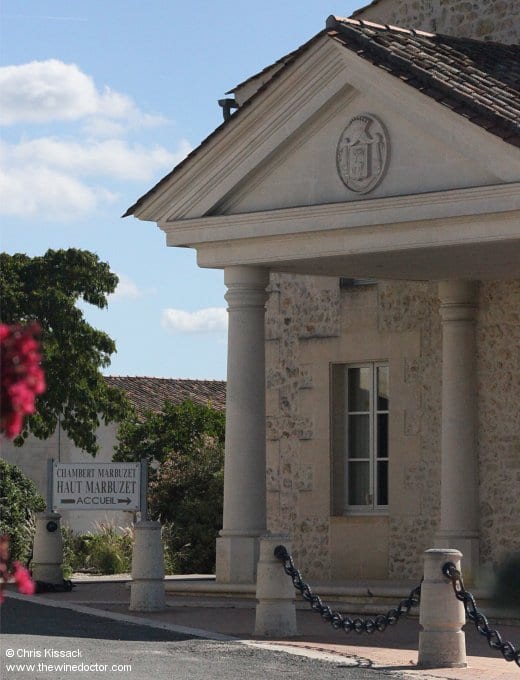
Chateau Haut-MarbuzetToday the vineyard covers 61 hectares and is planted with 50% Cabernet Sauvignon, a significant area of Merlot which accounts for 40%, and Cabernet Franc making up the total with 10%. This amount of Merlot is a little unusual for the commune, although there are a number of Cru Bourgeois estates on the Médoc that have a similar predominance of the variety in the vineyard, and in fact the area dedicated to this variety at Haut-Marbuzet has been reduced from the time of Hervé, when it dominated even more clearly. The vines are planted at a density of 9000 vines/ha and have an average age of 30 years, and the Duboscqs favour ploughing over herbicides. Once harvested the fruit is destemmed before fermentation in concrete tanks with temperature control, followed by a four week maceration with daily pumping over. The wine then goes into oak, the choice depending very much on the vintage; Allier and Tronçais give the complexity that has been favoured by Henri for the better vintages, but in less convincing years wood from Nievre would be the norm. The wines stay in barrel for up to 18 months before fining and bottling. The grand vin is Chateau Haut-Marbuzet, the second wine Chateau MacCarthy, and the Duboscq trio also bottle the wines of the other estates accrued by the family over the years as Chateau Chambert-Marbuzet and Tour de Marbuzet.

Read the works of a number of commentators on Bordeaux and it soon becomes clear that some hold Haut-Marbuzet, as shaped by Hervé Duboscq, in the highest regard, with Clive Coates once ranking it third in the commune behind only Montrose and Cos d'Estournel. Friends of mine who have been drinking claret far longer than I have also think highly of the wines, and there are occasions when it is clear that Hervé Duboscq also had supreme confidence in his products, demanding an asking price the equivalent of that for Montrose for those first 44 barrels he sold. I never met Hervé, but in some ways he brings to mind Jean Gautreau of Sociando-Mallet who I met in 2006. A determined character, who flies in the face of all around him - Duboscq ruffled a few aristocratic Ginestet family feathers at neighbouring Chateau Marbuzet when he started marketing his own wine as Haut-Marbuzet - and who has the utmost belief in what he is doing. I have only tasted a few vintages, not even a handful, and it is clear that these are good wines. I am not sure I would rank them directly behind the two second growths of the commune, but perhaps I should taste a few more vintages before I make any further comment? (20/9/07)

Contact details:
Address: Chateau Haut-Marbuzet, 33180 St-Estèphe
Telephone: +33 (0) 5 56 59 30 54
Fax +33 (0) 5 56 59 70 87

Chateau Haut-Marbuzet - Tasting Notes

Click to locate stockists:

2006

Chateau Haut-Marbuzet (St Estèphe) 2006: Rather sulphurous on the nose, with notes of struck matches. Quite a nice style on the palate, soft and round, beneath that some grip. Seems a bit dried out. It has some flesh though, is attractive, and has some interesting feral components. Nice acidity. Decent. From my 2006 Bordeaux assessment. 14-15/20 (April 2007)

2005

Chateau Haut-Marbuzet (St Estèphe) 2005: This has a very dense hue reflecting its youth and perhaps also the character of the vintage. It pales just a little at the rim. On the nose, enticing exotic ripe fruit, and plenty of it too. Pure, youthful and exuberant. There is a similar wealth of fruit on the palate which has a very good texture wrapped around a core of ripe tannins and a very correct, bright acidity. This is a delight to taste. Who wouldn't like this? From the 2007 CIVB tasting. 17-17.5+/20 (October 2007)

2004

Chateau Haut-Marbuzet (St Estèphe) 2004: A lovely style here on the nose, plenty of fruit. It has a toasty character, and a vibrancy and freshness. The palate is rather flashy, but fresh and vigorous as suggested by the nose. It opens out nicely through the middle, with a smokiness and an appealing grip. Finishes well. I like this. From a tasting of 2004 Bordeaux. 16.5+/20 (April 2007)

1991

Chateau Haut-Marbuzet (St Estèphe) 1991: A lovely mahogany red colour here. Loads of fruit on the nose, despite this wines age, with some notes of coffee. Spicy fruitcake nuances suggest a dominance of Merlot. Quite elegantly textured on the palate, fairly sharp and bright, with somewhat prominent acidity. There's a weakness in the structure which belies the inadequacies of the 1991 vintage in Bordeaux. From a 1991 vintage tasting, ten years on. 15/20 (December 2001)

Home - Site index - Site updated May 14, 2008 - © The Winedoctor 2000 - 2008 - Wine Scores - RSS