Château Pichon Baron: Tasting & Drinking
I once thought of the Château Pichon Baron style as being one of complete contrast to sibling Château Pichon Comtesse, a wine which has enjoyed a very strong following for many years because of is sensual, seductive nature. Pichon Baron, meanwhile, was long reputed to have a more structured, reserved although not quite reticent style, a counterpart to Pichon Comtesse perhaps. Whereas elements of this remain true, I do not think it is today very apt to think of the wines of Pichon Baron as being made in this sober, schoolmasterly image.
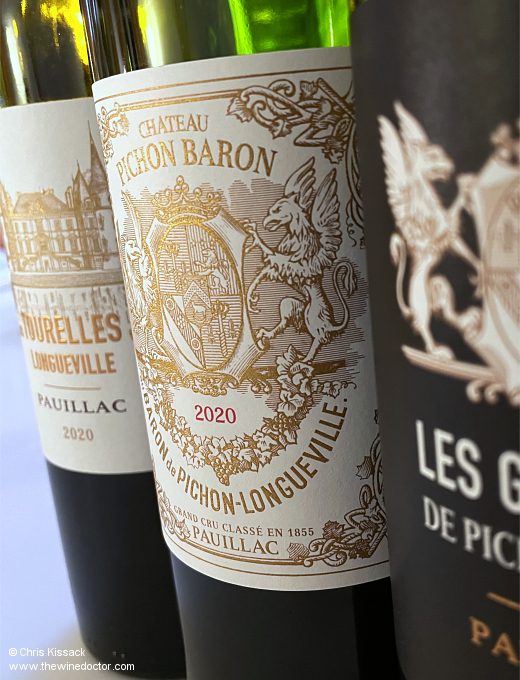
Today the wines of Pichon Baron are more silky, more refined, more elegant, and this is despite the fact that they remain focused on Cabernet Sauvignon, this variety accounting usually for more than 70% of the blend. Indeed, if you review my tasting notes below, you will see that figures between 81% and 88% are commonplace, with figures between 75% and 79% in the minority of vintages. That such elegance can be found using this lead variety betrays the quality of the terroir in my opinion – it is only on the great gravel mounds of the Médoc that this can be achieved. The Merlot largely grown on more distant plots in Sainte-Anne, a section that lies further to the west beyond Château Batailley, is now destined for the sélection parcellaire Les Tourelles, while ‘lesser’ Cabernet Sauvignon from the main Pichon Baron vineyards is channelled into the new second wine, Les Griffons. So today Château Pichon Baron remains a very substantial wine, but it comes with an undeniable charm and elegance as well; it is no surprise that these bottles have become immensely popular with lovers of good quality Bordeaux.
On a different level, Pichon Baron has a special resonance with me, as this estate was the source of one of the first bottles of classed growth claret I ever purchased, the wine in question being the 1983 vintage, which I picked up at a price well under ten pounds per bottle (those were the days….). I must confess I wasn’t very impressed when I drank it; this perhaps reflected my own limited understanding of Bordeaux at the time, not to mention the fact I did not even own a decanter, as much as Pichon Baron’s somewhat less than enthralling performance during the 1980s. While I believe the estate’s poor reputation during this era was justified (you only have to taste the vintages through the 1990s and early 2000s to sense the improvement), I have to say I did enjoy a second bottle rather more when I finally opened it over a decade later. Having a decanter helped.
More recent vintages, of course, show much more character and depth. Of all the vintages from 1997 through to 2005 there isn’t a real disappointment, with even the 1997 proving that there were some decent wines made in this difficult vintage. But it is with the success of 2000, 2003 and 2005 that the work really began to shine through, and years subsequent to this have given us yet more great wines. The 2008 was, when tasted at two years of age, one of very few true successes on the left bank in this vintage. Whereas the 2009 and 2010 reflect all the glory of these two great vintages. The consistency of effort comes though in some of the subsequent lesser or modest years, with good wines in 2011, 2012, 2014, 2017 and 2021, but it is the truly great years that wine lovers will still be talking about a century from now. The stunning 2016, for example, a superlative 2018, and brilliant wines in 2019 and 2020. The 2022 vintage was very good, although both times I have encountered it I have come away wanting more. The 2023 vintage, by contrast, is a classical delight.
Thanks to the work of a string of committed and talented individuals, including the late Jean-Michel Cazes (1935 – 2023), Christian Seely, Daniel Llose and Jean-René Matignon, and in the current era Pierre Montégut, today Château Pichon Baron really is the jewel in the AXA Millésimes crown. Long may that continue. (26/2/04, updated 26/1/07, 1/6/11, 13/11/13, 23/8/14, 10/5/15, 1/5/16, 9/7/23, 21/1/26)