
Château Mouton-Rothschild: Tasting & Drinking
Of all the first growths of Bordeaux, for many years it was Château Mouton-Rothschild with which I was most familiar. Partly this reflected early encounters with ‘lesser’ vintages, including both 1993 and 1994, neither of which were great years for Bordeaux, but as is always the case some estates managed to pull a rabbit out of the hat all the same. In part it was due to an extensive tasting of relatively young vintages, led by now-retired director Hervé Berland, that I attended many years ago. And in part it reflected the numerous times I have visited the château, both flying visits made during the primeurs, and also more lengthy visits at other times.
These days, I am perhaps familiar with all five first growths on an equal level, although memories of those early encounters with Mouton-Rothschild remain strong.
As a consequence of these early encounters I grew more aware of the style nuances here earlier than those pertinent to, for example, Château Latour or Château Lafite-Rothschild. In doing so it seemed clear to me that, of all the first growths, Mouton-Rothschild had the most distinctive style. There is a characteristic flair and flamboyance to the wines, an unmistakeable cigar-box-and-barrel ‘spice’ to the aromatics, present not only in the grand vin but also in the second wine, Le Petit Mouton de Mouton-Rothschild. Perhaps the word ‘spice’ is perhaps not the best description, as it conjures up an image of something peppery, hot or challenging, but nothing could be further from the truth. It is more of a savoury complexity, adding interest and distinction to the wines to lift and lighten what is otherwise a deft yet certainly textured wine, imbued with plush Axminster fruit.
It achieves what all the first growths do so well, sitting apart from ‘lesser’ second growth estates that could perhaps otherwise stake a claim for their crown. Although, within the Pauillac appellation, there are some estates that continue to nip at its heels, including both Château Pichon Baron and Château Pichon Comtesse.
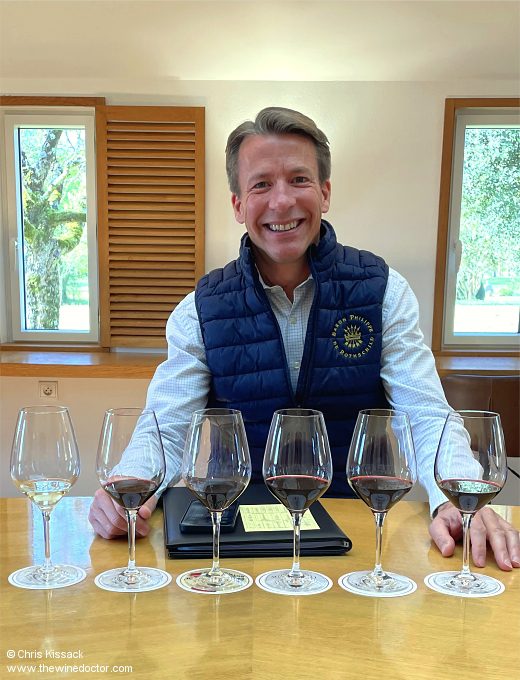
Looking to some specific vintages, it is clear that this estate has turned out some great wines over the years, on occasion producing the top wine of the vintage (the 2006 is usually cited here), and this only reinforces its position as a first growth. Wines from the late 1940s, in the immediate post-war years, are legendary, and those being produced today are reputedly very much in the same vein. Other vintages have, however, also been magnificent. In particular I am thinking of 2010 and 2009 in very recent years, and the same could be said of 2005 and 1996, although to be honest memory of these wines is now fading fast. If any should come your way, though, I implore and encourage you to obtain a taste (by hook or by crook!). Under the direction of Philippe Dhalluin the quality and flamboyant typicité was not just maintained, but improved and accentuated (coming through more strongly in the second wine in some very recent vintages – surely a reflection of much stricter selection). Having said that, I sense a greater sense of polish and panache in the wines today, which come from a team led by Jean-Emmanuel Danjoy (pictured above).
Looking to these most recent vintages, the château has enjoyed a successful run, with a very fine 2023, a gorgeous 2022, a brilliant 2020, a quite stunning 2019 and a magnificent 2018. The quality in 2017 was exceptional for a frosted vintage, the vineyards protected by their proximity to the Gironde of course, while 2016 was another stunning, first-growth performance; it will be fascinating to taste 2016 and 2018 alongside one another in future years (not that I really expect to have the opportunity). The 2015 was a good vintage, but it was much better on the right bank than the left (at least that was the case here in Pauillac) and I don’t find it far ahead of the 2014 vintage. Skipping past 2013 (always a wise move), both 2012 and 2011 were decent wines made in difficult years. These vintages have shown better than expected in recent years though, so they should not be ignored.
Looking back further we come to some obvious winners, such as the aforementioned 2010, 2009 and 2005. Both 2006 and 2004 are better than you might expect for two easily overlooked vintages, while 2007 and 2003 are good wines, but in each case perhaps held back by the challenges of those two vintages. For older vintages, I refer you to the rest of my tasting notes, further down the page.
To conclude, the wines of Château Mouton-Rothschild are grand wines indeed; count me in as a fan. There is, to my mind, absolutely no doubt that this property deserves its status as a first growth, and I shall enjoy coveting, tasting, and perhaps even drinking these wines, in the years to come. (2/1/07, updated 22/4/08, 7/10/10, 25/1/12, 12/12/13, 12/4/14, 23/10/16, 15/12/21, 15/1/26)
Please log in to continue reading: