Château D’Armailhac: Vineyards
When I penned the first version of this profile in 2005 I noted that Château d’Armailhac had 69 hectares planted to vines, a number that has risen considerably since I started writing about wine, indicating that the expansion begun by Baron Philippe several decades ago has really been carried forward into modern times. During the two decades that have since passed the growth has continued; today there are 80 hectares of vines here.
The vineyards are all situated to the north and west of the town of Pauillac, and at first glance they would appear to be sandwiched between those of Château Mouton-Rothschild to the north and Château Pontet-Canet to the south. Certainly the d’Armailhac cellars are situated between them. In truth only a sliver of vines runs between these two other properties; most of the vineyards site to the east of the cellars, or wrapped around the Pontet-Canet vineyard. There are, as is so often the case in Pauillac, also some distant parcels, situated further inland.
This brings a notable diversity to the terroir, which Jean-Emmanuel Danjoy and his team divide into four distinct sections.
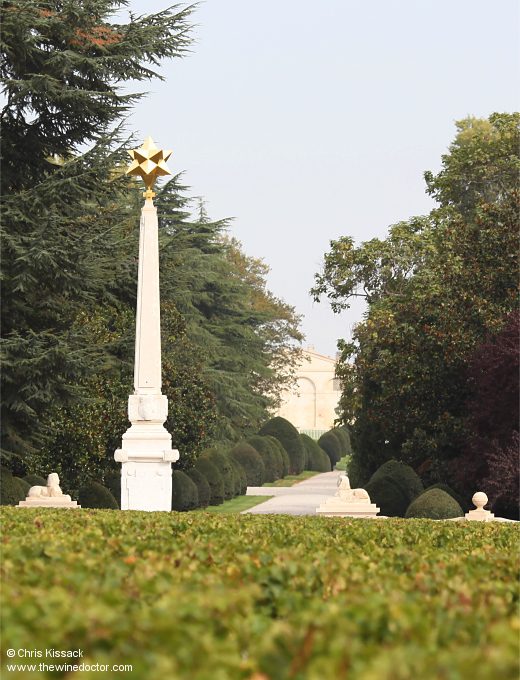
The easiest vines to identify are those in the parcel Obélisque, named for the Rothschild’s obelisk capped by a golden star (pictured below). This obelisk sits at the side of the road running west away from Pauillac, and while ostensibly it marks the end of the avenue which leads down to Mouton-Rothschild (as can be seen below) it is really more pertinent to Château d’Armailhac. It is d’Armailhac that is situated behind the trees just to the left of the obelisk, and the vineyard I was standing in when taking this photograph belongs not to Pontet-Canet (which sat behind me as I clicked the shutter) but to d’Armailhac.