The Times They Are A-Changin’: Chinon, 2025
The vineyard is much more of the Vienne than of the Loire. It descends all across the land of Véron, from Huismes, Avoine and Savigny, via Beaumont and Chinon, as far as Cravant, Panzoult and Crouzilles Crossing the river, it includes a number of communes on the left bank: La Roche-Clermault, Rivière, Ligré, Anché, Sazilly, Tavant, L’Île Bouchard and Theneuil.
In contrast with the vineyard of Bourgueil, situated solely on the right bank of the Loire, the vineyard of Chinon has a greater geological diversity because of the meeting of the two river valleys. Nevertheless, the vines are found on terroirs of the same age and of comparable origin. The gravels of the Vienne, the gravels of the Loire, slopes of chalk, with a variety of expositions, imprint on the wines of Chinon their particular character.
– Les Vins de Loire (1956), Pierre Bréjoux
Come gather ’round people
Wherever you roam
And admit that the waters
Around you have grown
And accept it that soon
You’ll be drenched to the bone
If your time to you is worth savin’
Then you better start swimmin’ or you’ll sink like a stone
For the times they are a-changin’
– The Times They Are A-Changin’ (1963), Bob Dylan
Pierre Bréjoux, onetime Inspecteur Général of the Institut National des Appellations d’Origine (INAO), is perhaps best known as one of the tasters in attendance at the Paris Wine Tasting (also known as the Judgement of Paris) of 1976. This famous (or, in some people’s minds, infamous) blind tasting pitted Californian wines against the leading wines of France. To the consternation of the French judges present the American wines won, and some asked for their ballots to be returned. I presume so they could amend their rankings after the fact? Or maybe they just wanted to burn them?
In short, it was a scandalous affair, although more because of the desire to rewrite the results rather than anything to do with the wines.
When Pierre Bréjoux was not participating in national scandals (by the way, his two top wines were Haut-Brion and Mouton-Rothschild, so it could be argued his reputation was unsullied) he was not averse to putting pen to paper, and he wrote at least two informative texts, one of which focused on the wines of the Loire Valley (hurrah!). In it, Bréjoux, did his best to describe – as cited above – the breadth and complexity of the various terroirs of the Chinon appellation.
That Chinon has a complex geological diversity has long been evident. It was tasting and retasting the wines of this appellation three decades ago that I first appreciated the relevance of terroir to the character and aging potential of Cabernet Franc. A light went on above my head (maybe literally) as I realised I could taste the difference – blind – between different terroirs in Chinon more easily than I could, say, between Chinon and another appellation such as Bourgueil.
It was a pivotal moment in my own wine journey. With the light and early-drinking wines from the sandy riverside soils at one end of the tasting spectrum, and the confident and ageworthy limestone-derived cuvées at the others, with several variations of style and quality between the two, the impact was crystal clear.
I decided I would dedicate myself to trying to understand this appellation.
Three decades on, I am still trying.
New Complexities
These days there at least two additional complicating factors to add to its complexity.
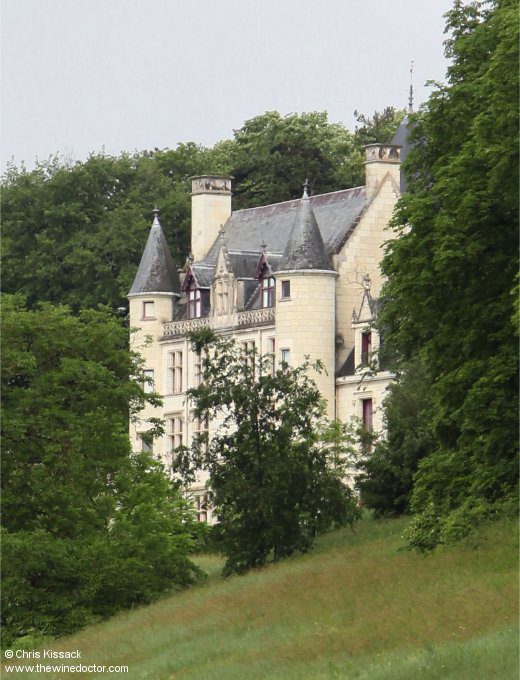
First, in 2016, the Chinon appellation was expanded, to incorporate a slew of communes now added to the brief (and somewhat incomplete) list provided by Pierre Bréjoux. The majority of these communes lay on the left bank of the Vienne, downstream of Rivière and La Roche-Clermault, and all were originally invited to join the appellation at its inception in 1937, but refused. Having subsequently seen the error of their ways, they were only too happy to have a second chance in 2016. Their arrival extends the landscape of Chinon, and opens to the door to many new domaines – such as Château du Petit Thouars (pictured below), in Saint-Germain-sur-Vienne – enhancing the complex matrix that makes up this appellation.