Domaine Beauséjour
Appellation: Chinon
Owner: Ivan Massonnat
Ten-second primer: Established during the 1960s by the Chauveau family, Beauséjour was in decline before it was acquired by Ivan in 2021. The property is now undergoing a renaissance, with a new team in vineyard and cellar. In conversion to organics. Wines made by Sarah de Mianville.
This profile includes: Four pages of history and detail (links above), and tasting notes back to 2012.
Although for many years a widely admired property in the Chinon appellation, Domaine Beauséjour does not at first glance seem to have an ancient viticultural history. Its origins seem to lie in the 18th century, when it was a polycultural farm run as a dependency of nearby Château du Roncée. This ancient château, mostly destroyed during the French Revolution, was situated at the side of the road running from Panzoult down to L’Île Bouchard; today only the dovecot, in a remarkably good state of repair, as well as an old barn incorporated into nearby buildings, remain.
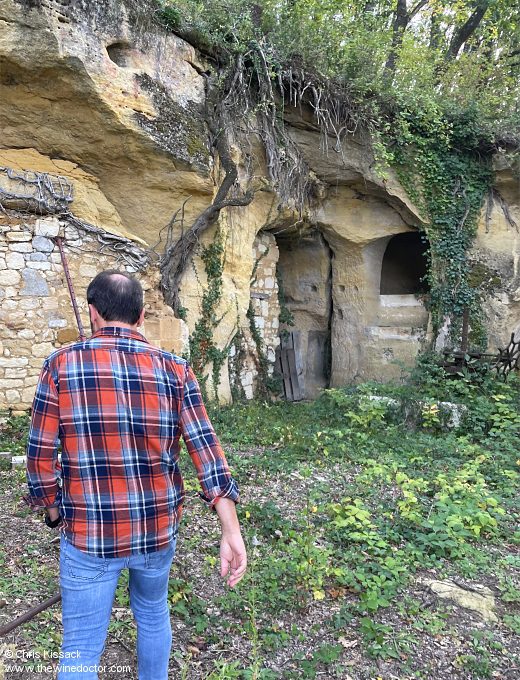
At least this is the story everyone tells you. And yet, exploring Domaine Beauséjour with new owner Ivan Massonnat late in 2023 we poked our noses into some of the troglodytic rooms (which by themselves suggest a much longer story of human activity here) carved from the wall of rock that runs along the top of the estate and discovered something which would suggest a different viticultural history. There – to my great surprise – was a limestone cuve, a fermentation vessel carved from the region’s Turonian limestone, one exactly like that utilised by Jérôme Billard at Domaine de la Noblaie. Well, in truth, it is rather smaller, suggesting it was perhaps for storage rather than use as a fermentation vessel.
But storage of what?
And given that it has been postulated that Jérôme’s domaine was worked by (or on behalf of) the Templars, could Domaine Beauséjour have equally ancient early-medieval origins?