Bernard: Baudry: La Croix Boissée
Bernard and Matthieu Baudry have two parcels of vines on the limestone slope, both of which were acquired by Bernard during the 1990s. The most prestigious is La Croix Boissée (pictured top, previous page, looking across the valley of the Vienne), which is found directly overlooking the D21, to the east of the domaine, about 2 kilometres further down the road very close to Cravant-les-Coteaux. This is one of the most coveted lieux-dits in the Chinon appellation, a steep and fully south-facing slope. We should not be surprised to learn that Bernard and Matthieu are not alone here; as of 2017 there were eleven other vignerons owning and tending parcels of vines within this vineyard (although as of 2018 only seven bottle a dedicated cuvée). The first that jumps to mind is Domaine Béatrice et Pascal Lambert, but there is also Pierre Sourdais and Domaine de Pallus.
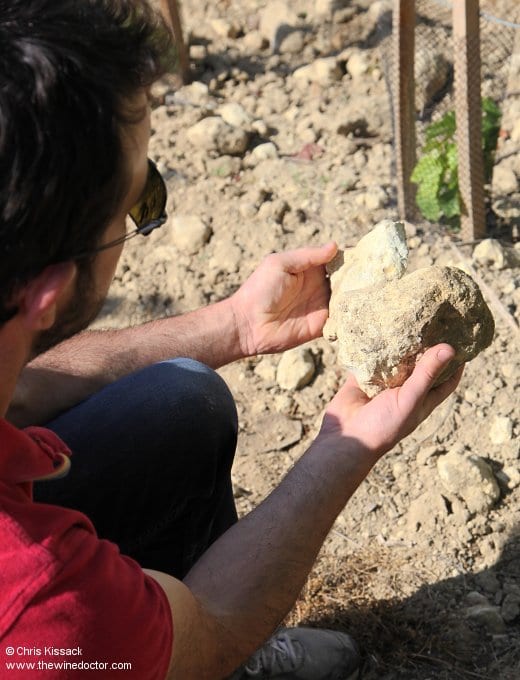
The D21 runs along a bed of limestone, tuffeau blanc (white chalk) from the Middle Turonian. This chalky bedrock extends up the slope, perhaps halfway up the vineyard, although at the eastern end of the vineyard it is covered by a widening band of colluvial material, comprising degraded limestone, sand and silt, much of the material dating to the Quaternary. Further up it then gives way to a quite narrow band of tuffeau jaune (yellow chalk) from the Upper Turonian (Matthieu holds both white and yellow limestone, below). This yellow chalk runs in a relatively thin ribbon right the way along the coteau, attenuated to a point at each end, following the contours of the land, occasionally darting into valleys or gullies as it does so. At its centre it is modestly broad, extending across the top two-fifths of the slope, up to the top where it is covered by silty deposits from the Senonian. The superficial soils are meagre at the top, the chalky limestone dominating (as pictured below), but they are richer and deeper in colour, with more clay in evidence, further down. Right at the bottom, the soils are very sandy. Matthieu is quick to liken the slope to that of the Côte d’Or, and why shouldn’t he? Where a vigneron chooses to plant on the slope has a significant effect on the character and quality of the wine, and Chinon’s grapes are no less noble than those found in Burgundy.