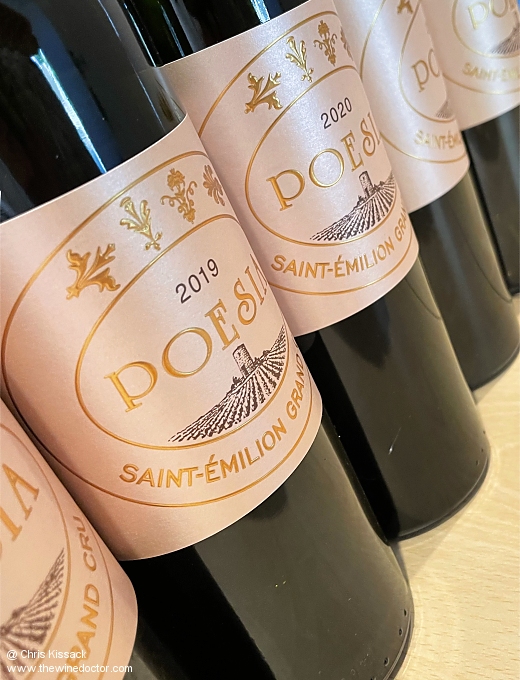
Poesia: Tasting & Drinking
There is no doubt in my mind that there is a house style to the wines of Hélène Garcin-Lévêque, one that is most apparent in the wines of Château Barde-Haut, and transmitted least obviously in the wines of Clos L’Église, especially if these latter wines are given an opportunity to develop in the cellar, as I discovered in my Clos L’Église Retrospective published in early 2018.
Based on the evidence so far, the wines of Poesia seem to sit between the two Garcin-Lévêque extremes represented by Château Barde-Haut and Clos L’Église; it shows some of the perfume and limestone freshness I would hope for from vines on the very edge of the limestone plateau, exhibiting classic St Emilion traits in the manner that Clos L’Église will reveal its Pomerol origins, provided it is given adequate time in bottle. There is another side to the wine though, at least in youth, and here the wine would seem to have more in common with its St Emilion stablemate. Alongside the powerful limestone-driven grip there is also a rich structure, of dense and brooding tannins, and a wrapping of peppery and toasted oak, all of which mean these are wines to leave alone in the cellar as they integrate. Do not rush to pull the cork on these wines, not if you have a palate as tender as mine, anyway.
Recent vintages have allowed the terroir to shine in some cases, but others have tested the resolve of St Emilion winemakers. The most admirable examples here at Poesia include a rather charming 2023 which closely matched the delicious 2022 in terms of quality, while I also enjoyed the 2020, 2019, 2018 and 2015, with the 2016 coming in next. The 2017 was pretty good, the position of the vines have offering some protection from damage in that year’s frost, and the 2014 was a decent start to the adventures on this domaine for Hélène and Patrice.
Only time and tasting will tell how these wines evolve in bottle, and I look forward to future encounters with them as they mature. (5/7/18, updated 7/8/26)