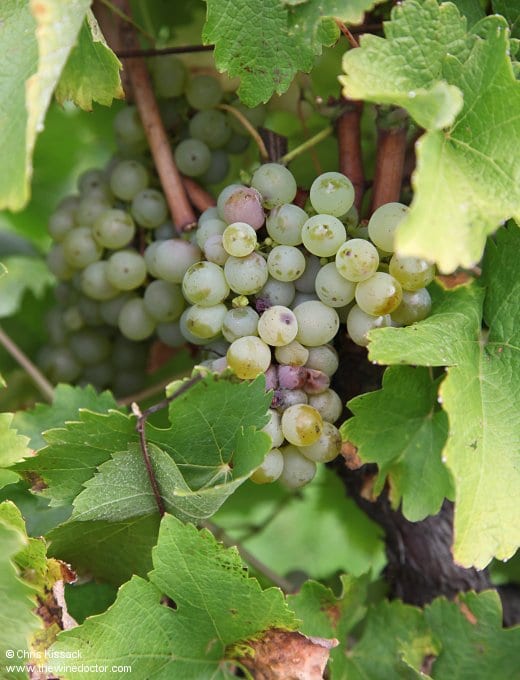
Le Sot de L’Ange: Vineyards
Sadly, Le Sot de L’Ange was wound up in 2022. This profile was written much earlier than that date, not long after proprietor Quentin Bourse had taken over Pascal Pibaleau’s old vineyards and cellars, and I leave it online as a source of historical information about this short-lived domaine.
Pascal and then Quentin had approximately 12 hectares of vines to work with, and as already mentioned in my introduction these vines were long worked using both organic and biodynamic methods, fully certified. Quentin tended a multitude of small parcels, which gave him many different types of soil to work with, including some clay on limestone, and a number of parcels were rich in flint. His vines included a number of the region’s traditional varieties, including Cabernet Franc and Chenin Blanc, as well as Côt, Gamay, Grolleau and the less commonly encountered Chaulnay.
The latter two varieties are perhaps worthy of a little more detailed examination than the first four, which will presumably be more familiar. Grolleau is familiar to Loire Valley fans as well of course, but Quentin is at pains to point out that his vines are Grolleau de Cinq-Mars, a clone named not for a date, but for the commune of Cinq-Mars-la-Pile, which sits on the banks of the Loire close to Langeais. I was never convinced that there was any evidence for this distinction, but I suppose an artist such as Quentin must be allowed to express himself as he sees fit. As for Chaulnay, this is a local synonym for Gamay de Chaudenay, itself a mutation of Gamay de Bouze both of which are red-fleshed teinturier varieties which may (or may not) be related to the much more widely planted Gamay Noir. So, to cut a long story short, this is one of the lesser teinturiers.