
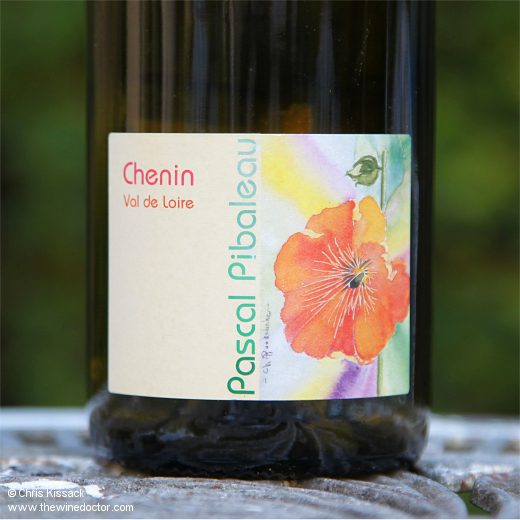
Pascal Pibaleau Chenin 2013
This week, a look beyond the Loire Valley’s most famous appellations, as I dive head-first into the wines of Azay-le-Rideau, in the less-than-lofty Touraine appellation.
Ask a native of Vouvray where viticulture in the Touraine region began and he (or she) will point – perhaps with a hint of pride – to the vineyards around the Abbaye de Marmoutier, in the extreme west of the appellation. This abbey was founded by Saint Martin, the Bishop of Tours, in 372, and this date is therefore often cited as the moment the vine arrived here. Having said that, while abbeys and monasteries were not infrequently augmented by vineyards – the wine used for the Eucharist, or possibly sold to provide an income – there is in truth little-to-no evidence that vines were planted here at this time.
Instead, let us look downstream to the commune of Cheillé, on the banks of the Indre, not far from the town of Azay-le-Rideau and its famous château. Here there were certainly vines at the time of Saint Martin, as in 1946 a local farmer uncovered a mysterious array of gigantic dressed stones in one of his fields; each stone bore indentations and grooves which meant it could only be one thing; a fruit press. More specifically, a grape press. Coins found in association with the stones dated the site to the time of the Roman Emperors Hadrian and Marcus Aurelius, in other words the 1st and 2nd centuries AD.
Now that is evidence.
Just down the road from this field sits Château de l’Islette, a stunning château set in beautiful gardens on the banks of the Indre. The meeting place of the sculptors Auguste Rodin (1840 – 1917) and his paramour Camille Claudel (1864 – 1943), the château deserves to be better known, and I think it would be were it not for the domineering presence of Château Azay-le-Rideau just down the road.
Meanwhile, on the opposite bank of the Indre to Château de l’Islette and the site where this ancient fruit press was uncovered we find the cellars of Pascal Pibaleau.
Or, rather, what used to be the cellars of Pascal Pibaleau.
The Pibaleau domaine was established in 1886, the cellars located just off the road between Azay-le-Rideau and Langeais. Pascal was the fifth generation of the family to man the press, and he tended 15 hectares of vines using methods certified by Demeter as organic and biodynamic. In these little cellars he turned out an array of Touraine styles, with Chenin Blanc for the whites, Gamay and Côt for the reds. The whites, by the way, were usually dry but would veer into a demi-sec or Turonian moelleux style at times, when they could be simply delicious.
Sadly these days Pascal Pibaleau no longer vinifies in these cellars. Or indeed anywhere. With no family member keen to take on the running of the domaine he sold up, a decade ago now, the cellars handed on to Quentin Bourse, of Le Sot de L’Ange. Sadly Quentin was less successful as a viticulteur and vigneron than five generations of the Pibaleau family, and the domaine has since been wound up, its assets worked through by the courts in Tours, the cellars now (well, last time I passed by, anyway) unoccupied.
Despite this troubled tale I have recently been able to get my hands on a few rare bottles from Pibaleau’s time. The 2013 Chenin from Pascal Pibaleau was bottled as a Vin de France rather than Touraine Azay-le-Rideau for a reason now long forgotten. It hails from the 2013 vintage, despite there being no mention of this on the label (the code Lot 01 on the back label is less helpful than most lot numbers, but the vintage is stamped on the cork, which I suppose I should have included in my photograph).
In the glass it displays a rich mid-gold hue, appropriate for twelve years under cork. The nose is quite old-school, but in a good way, with layers of desiccated yellow plum and peach, nuanced with hints of blanched almond, tobacco, liquorice and toast. There is a little warm tinge of baked orange which hints at a touch of botrytis here, although it is a vague and distant impression. It remains fresh and defined on the palate, showing more lemony fruit with brighter notes of green apples and chalk, along with little flourishes of complexity mirroring the nose. The frame feels rather robust, a touch rustic even, before it fades to a frustratingly unfocused finish. All the same, there is joy to be found in this traditionally sculpted Touraine Chenin, even with its slightly sappy and soft-focus length. I have another bottle, so I think I will wait a while, and see which way it goes. The alcohol is declared at just 11.5% on the label. 90/100 (8/12/25)
Also, read more in:
- My guide to Chenin Blanc
- My report on the Loire 2013 vintage
- My guides to the generic Touraine and Touraine Azay-le-Rideau appellations
Find Pascal Pibaleau Chenin 2013 on Wine Searcher: 
Find all Pascal Pibaleau wines on Wine Searcher: