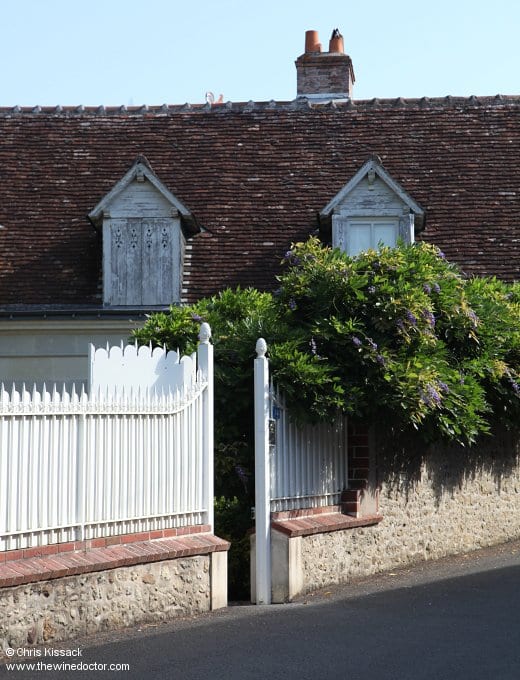
Home > Producer Profiles > Loire Profiles > Philippe Foreau

Philippe Foreau

The digital clock in the car read 10:50am, but I had realised over the last few days - comparing it to the time checks on Saumur's Radio Alouette - that this clock was four minutes fast. That meant it was really 10.46am, too soon for my arrival I thought. I waited in the car, watching the minutes pass by, while I gathered together my notebook, camera and pen. The clock advanced, until it reached 10:55am, which of course really meant 10:51am. Or thereabouts. It would take me just one minute to leave and lock my car, and then walk up to the Foreau residence, so I would be eight minutes early. That seemed reasonable; not too early, but certainly no chance of being accused of being late. The thought that might now occupy your mind is, why such attempted precision? What difference would four or five minutes make?

To answer that question, we must travel back to 2003, and my visit to Huet on the rue de la Croix Buisée. Having finished tasting there, I could not resist calling in at Philippe Foreau's house, which is just a few hundred metres up the road. I knocked on the door of the office, and was admitted by an employee with a classic Blackadder haircut (series 1, of course). Well, it was classic except for the fact it was red. In a peremptory fashion, I was shown a price list, and in quick-fire French informed that I could buy, but there was no time for tasting. Call me choosy, but the offer didn’t sound too tempting, and I left empty-handed.

Philippe Foreau

A year or two later and again I found myself outside number 14, the Foreau property. Once more I thought I would chance my hand, and I enquired at the entrance to the cellars as to the possibility of a visit or tasting. These cellars sit opposite the house, and the grey and dreary exterior is marked by a rusting sign high up on a side wall as the property of Foreau, viticuleur. Again, I was turned away, although this time by a more helpful employee who took the time to explain that with no appointment there would be no chance of a tasting chez Foreau. I put up no resistance, for in truth it was the outcome that I had been expecting, and I was in fact in town to visit Catherine & Didier Champalou, and Bernard Fouquet of Domaine des Aubuisières. I left, and resolved to secure an appointment on my next visit to Vouvray, which as it happens was during the summer of 2008.

Philippe ForeauI started with a letter, as it seemed a rather professional approach, but it went unanswered. This is perhaps not surprising; every letter I have ever sent to a Loire viticulteur, without exception, has met the same fate. The same is true of email, except for Bernard Fouquet, who does at least seem to know how to use a keyboard. In the case of Foreau, I failed to even find an email address, and so it wasn’t an avenue I would be following here. And so it came down to the telephone. Having already arranged a number of appointments, however, something told me that my French would not quite be up to M Foreau’s standards. A more fluent friend did the work for me, and worked hard to secure an appointment. M Foreau was busy, was going on holiday, and was keen to know whether or not I spoke French. Some persuasion was required, but eventually an appointment, at 11am, was secured.

And so here I was, once more alighting from my car outside the domaine, hopeful of a visit but certain of nothing. I called in at the cellars to enquire as to M Foreau’s whereabouts and was greeted by a friendly employee – the same one I had met on my last abortive visit, I think. He began to explain that there was no chance of a tasting, but I interjected with news of my appointment; immediately his face changed, taking on a look of surprise, and I wondered whether even to have an appointment was really quite unusual. Or was it merely unusual for someone with the appearance of a dumb British tourist? He directed me across the road, and so once again I found myself walking across the gravel driveway towards the office, where I knocked and entered. At this moment it felt as though a battle had been won, and yet I was still uncertain of what was to come. I was glad that I was at least arriving at the correct time.

Philippe Foreau was seated at the desk in the opposite corner, and he gave me some machine-gun French that made me glad I had not made that original phone call. His tone was negative, his posture remained quite closed, as he explained how busy he was. I though I was about to be turned away once more, but then it came; he could give me 30 minutes. Naturally, I gratefully accepted. I explained my profession, about this site, and apologised for the English speaker's accent which no doubt rides roughshod through my French, and I think with this latter point he warmed to me a little. We left the office together and went back across the road to his cellars, which run deep into the hillside, hewn from the limestone rock by the hand of his grandfather, and then his father. It was here, in the dingy light of the barrel cellar, that Philippe Foreau stopped and provided me with an account of his domaine, and his Vouvray philosophy.

Philippe Foreau and the Clos Naudin

Philippe explained that the domaine dates back to at least 1919 when his grandfather Armand returned from the Great War to take over the family vineyards. It was Armand who realised the potential of their vineyards and decided to bottle the wines and market them himself. It was not until 1924 that he acquired the prized Clos Naudin which remains part of the domaine to this day, although it is not the majority. Much of the wine comes from Les Perruches, a lieu-dit which lies behind the house on the rue de la Croix Buisée. Armand retired in the 1960s, handing over a 12 hectare domaine to his son André who ran the estate for the next two decades. Of André's four children there were three sons, of which the youngest, Philippe, born in 1957, joined him in his work in 1980. He assumed full responsibility in 1983, and has been in charge to this very day.

Philippe ForeauThe cellar in which we stood was cut by hand from the rock, started by Armand in the 1920s, with further excavation by André through to the 1970s. The humidity is good, the temperature steady at 12ºC despite the rising heat outside, and the conditions thus perfect for storing wine in barrel and bottle. We walked the corridor between the barrels, turning right halfway up into the bottle store. Here I saw that even at a domaine run with such precision and passion, not all always goes to plan; the electricity supply to this section of the cellar failed us, and I had to peer into the gloom for a minute or two, allowing my pupils to adjust to the low level of light, in order to appreciate the multitude of rows of bottles, stacked deep and high.

Today the domaine remains at 12 hectares and the vines, naturally 100% Chenin Blanc, have an average age of 38 years. There is a mix of terroirs, including flint, limestone and clay. Foreau regards the flinty soils as giving interest and elegance to the wine, whereas the clay and limestone soils bring strength. Using the fruit from these different terroirs brings the texture that Foreau seeks, and the all important balance. Too little clay and the wines are inconsequential and incapable of ageing, but too little flint and the wines lack interest, are too simple. The terroirs must be utilised in combination, the components of the wine in sympathy with one another, in order to produce a Vouvray that satisfies Philippe Foreau.

In the vineyard Foreau avoids the use of all unnecessary chemicals, and works hard with the soil, ploughing - apparently to encourage good acidities in the wines - and pruning hard to keep the yields down to 35 hl/ha. The harvest is entirely by hand in tries, from October into November, and the fruit and stalks undergo a pneumatic pressing together. The fermentation uses only natural yeasts, and the must is neither chaptalised nor acidified, as Foreau wants his wines to display the character of the vintage. There is no malolactic fermentation either, a practice which Foreau views as atypical for Vouvray, producing soft and simple wines without the potential to age. Put simply, Foreau likes acidity in his wines. They see no significant contact with wood, first going into old barrels, then into bottle in April or May the year after the vintage, with minimal use of sulphur – less than his father used - along the way.

The wines of Philippe Foreau

The wines could perhaps be considered the ultimate expression of the Vouvray vineyard. Great care in tending the vines, minimal manipulation, and the restrained use of wood translates into a very pure style, lifted and bright, fine and demanding time in the cellar. The lesser fruit is destined for sparkling wine, not unusual in the Vouvray appellation; although it is the fabulous première trie wines that seem to provoke the most debate and garner the most acolytes, most of what is harvested from the scattered vineyards of Vouvray is destined to be made into sparkling wine. Foreau uses any fruit with a potential alcohol less than 12º for his sparkling Vouvray, which comes in both vintage and non-vintage forms. And the latter, from a great vintage such as 2002, is a fabulous example of the type.

Philippe Foreau

Then comes sec, harvested at 12-13.5º, and demi-sec above 13.5º. If there is to be moelleux the vintage must yield fruit with more than 16º potential alcohol, and recent vintages that have done so include 2003 and 2005. Both of these vintages, together with 2007 and 2002, featured in my tasting on this visit. Foreau described 2007 as a good vintage for sec, classic in style, although a very good April was followed by a miserable summer. In the Loire, however, September might be said to make the vintage, and the weather then was warm and favourable. The wines of the vintage I have tasted so far would seem to bear out Foreau’s thoughts. More importantly, though, is my opinion of the wines themselves, both this vintage and others; I think they are among the greatest examples of Vouvray I have ever tasted. They show finesse, delineation, yet great character and flavour also. At all levels the wines are excellent, and I was particularly impressed with the 2005 demi-sec, although the moelleux cuvées, especially the ethereal réserve bottling, were no less fabulous. I left after taking up rather more than 30 minutes of Philippe Foreau's time, my appreciation of the great Loire vineyards and wines richer for the experience, even though my wallet was certainly somewhat lighter. (19/8/08)

Contact details:
Address: 14, rue de la Croix Buisée, 37210 Vouvray
Telephone: +33 (0) 2 47 52 71 46
Fax: +33 (0) 2 47 52 73 81

Philippe Foreau - Tasting Notes

Click to locate stockists.

2007

Philippe Foreau Vouvray Sec 2007: This has 3 g/l residual sugar, 13.2% alcohol. Perfumed, quite floral, rounded, seemingly quite soft, and a touch honeyed even. Gentle and quite rounded on the palate, balanced, pretty and appealing. There is some depth here, and there is texture too. This is very good. 17+/20 (July 2008)

Philippe Foreau Vouvray Demi-Sec 2007: This has 17 g/l residual sugar. Again it seems soft and floral on the nose, gentle and appealing. In fact I really like it; there is a little honey and the edge, but the freshness of clementines and oranges. Rounded and yet pure, this has a fine delineation, citrus delicacy, and soft honeyed richness on the palate. Very well done. 17+/20 (July 2008)

2005

Philippe Foreau Vouvray Demi-Sec 2005: This has 20 g/l residual sugar. There is beautiful lift here, ripe minerality, perfumed stone, finesse and more. What a fabulous nose. Pure, fresh, cool, yet ripe and rounded on the palate, with a subtle sweetness gently intertwined with well balanced acidity. And underneath this, complexity. Notes of lemon. Wonderful wine, which will drink well for 10-15 years. 18.5+/20 (July 2008)

2003

Philippe Foreau Vouvray Moelleux 2003: A very hot vintage, where the vines on the clay performed well, saved by the soil's moisture-retaining properties. This has 70 g/l residual sugar. My first impression is that it has a beautiful and classic nose, with huge character. It has finesse despite its generous nature, richness and elegance too. Well defined, its style almost defies description. Great minerality and texture too. Fantastic wine. 18.5+/20 (July 2008)

Philippe Foreau Vouvray Moelleux Réserve 2003: No introduction needed here for the Loire-o-philes that frequent this site. A disappointing wine though; although there are some appealing complxities of pear, quince, mango and guava fruit, and a papery note hat is typical of young Chenin, there is a more prominent baked-apple-oxidation seam which ruins the nose for me. In fact, tasted blind, I wondered whether it might be the Tokaji. The palate has a good succulent style, with lots of sweetness and a peppery acidity, but again that appley oxidation is omnipresent. Not typical of the domaine, vintage or indeed the individual cuvée. From a tasting at The Ledbury. Not scored. (January 2010)

Philippe Foreau Vouvray Moelleux Réserve 2003: A wine with 150 g/l residual sugar, and 11.5% alcohol. A great colour, very rich, with a complex nose offering an array of heady aromas. There are oranges, marmalade, blood oranges, mangoes, plums, passion fruits and more, and surely an element of botrytis. And yet it seems to have great purity, and on the palate a fine balance to it, despite its great opulence. There is even a touch of caramel and rôti character. This is brilliant, and will surely approach immortality....well three or four decades, at least. 19+/20 (July 2008)

2002

Philippe Foreau Vouvray Brut Réserve 2002: Another bottle drank while I wrote up these notes. A somewhat richer colour than I recall, with a sparse bead. Lovely nose, with notes of brioche, with lemony freshness too. Smoky and a little stony too. This carries through on the palate, firm and stony, fresh and defined, but with some welcome warmth in the background. It is just a touch austere, a characteristic which I enjoy very much; this will do brilliantly in the cellar, although I love it now. 18+/20 (August 2008)

Philippe Foreau Vouvray Brut Réserve 2002: Great appeal here, although not immediate; it takes a few minutes to open out. Starting off stony and dry it reveals with time aromas of petals and white pepper, then richer notes of frangipane and brioche. There is massive acidity here, wonderful mousse, and lots of extract, texture and substance. This has a very serious style, but remains very true to the appellation. I think this will go for ten years and many more; Philippe Foreau reckons eight. 18+/20 (July 2008)

Non-Vintage

Philippe Foreau Vouvray Brut NV: Remarkably it was a real struggle getting the cork out, not usually a problem with any sparkling wine raising fears of a flat wine beneath, but as it turned out here was no underlying problem, the closure eventually yielding, revealing a good pressure behind it. In the glass the wine has a straw-gold hue, with a light bead. The nose has a wealth of stone and citrus fruits, with great minerality, giving an imposing, very characterful style. The palate is just lovely, showing a foamy mousse at first, although this soon settles down, the wine developing a honed, well-framed, vinous sensation as it does so. There is fine, stony-bright fruit, a lovely full texture, with a little touch of cream to the weight. This sensation comes through in the flavour too, which is reminiscent of apples swirled with cream. Overall, a wine with great presence, very fine, culminating in a sappy, acid-rich finish. So good, in fact, that I proceeded a few days later to open another, which was just as good as the first. The rest I will try to cellar for a few years at least, as I suspect they will only get better. For label images and more see my Wine of the Week write-up. 17.5+/20 (August 2010)