
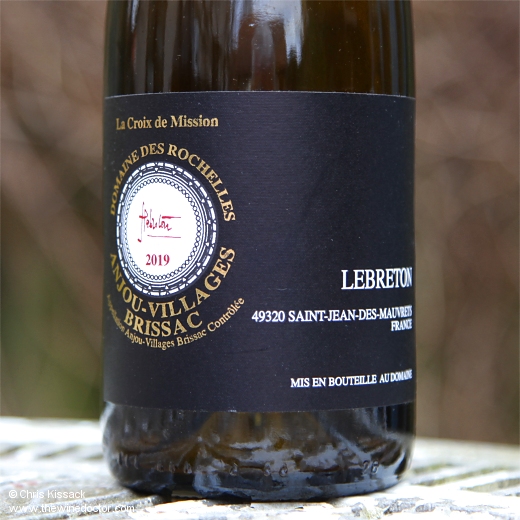
Domaine des Rochelles Anjou-Villages Brissac La Croix de Mission 2019
The Loire Valley is rich in vinous curiosities, wines that don’t quite fit the preconceived concept of what this region offers. These curiosities make a significant contribution to the region’s complexity; beyond the oceans of Chenin, Sauvignon and Cabernet Franc there lies a smorgasbord of other varieties and appellations waiting to be explored.
One of these varieties is Cabernet Sauvignon.
The presence of Cabernet Sauvignon in the Loire Valley invariably causes eyebrows to rise, but this variety has long maintained a toehold in the Anjou region. The earliest descriptions of the variety in Bordeaux are surprisingly recent, dating to the second half of the 18th century, and yet as early as the 1840s this new variety was already established in the coulées (the local word for valley) of Savennières by a Swiss viticulteur named Pierre Constant Guillory. There remain little parcels of Cabernet Sauvignon and Cabernet Franc planted in this appellation today; Tessa Laroche has not long pulled hers up to replant with Chenin Blanc (a good decision I think – this is Chenin soil), the late Evelyne de Pontbriand (1950 – 2024) continued producing a red for many years, and René Papin’s Anjou-Villages Clos de Coulaine comes from the old Roussier domaine also in this appellation.
The distribution of Cabernet Sauvignon in the Loire Valley provides us with a lesson on viticulture, terroir and climate. While Cabernet Franc thrives on the clay and limestone terroirs of the Bassin Parisien which dominate Chinon, the upper slopes of Bourgueil, Saumur and the eastern parts of the Anjou appellation, it does not do so well on the drier and less forgiving igneous and metamorphic rocks of western Anjou.
Cabernet Franc is a minor diva – not quite Pinot Noir level, but I think it has aspirations – preferring a steady and measured provision of water, something limestone does much better than schist. On slate, spilite and schistose soils Cabernet Sauvignon often performs better; add in the Anjou mesoclimate, which is relatively dry (it sits in a rain-shadow) and warm compared to other Ligérian regions, and Cabernet Sauvignon suddenly looks like an interesting proposition.
As an aside, many Ligérian appellations, including Chinon and Bourgueil, allow a percentage of the vineyard – typically a maximum of 10% – to be planted to Cabernet Sauvignon. It is traditionally said that this allowed for accidental planting; if you bought 10,000 Cabernet Franc vines from your local nursery, there was no way of knowing there weren’t some Cabernet Sauvignon vines mixed in. One indicator of commitment to quality in recent decades, however, has been to exclude the variety from the wine, either by selecting out, downgrading to rosé, or pulling up these vines. I do wonder, however, given the changing climate, if some vignerons with favourable soils – such as the gravel terraces of Bourgueil and St Nicolas de Bourgueil – should not revisit this variety? After all, I know several vignerons in Chinon who have made experimental plantings of Syrah. Why not take another look at Cabernet Sauvignon?
While the Amiraults, Bretons and Mabileaus of the world ponder this thought (well, you never know), what about the 2019 La Croix de Mission from Domaine de Rochelles, in the Anjou-Villages Brissac appellation? The appellation was, by the way, rechristened Anjou Brissac in 2020, although many vignerons are continuing to use the old name. As usual this cuvée is a blend of 90% Cabernet Sauvignon and 10% Cabernet Franc, and at this stage it shows a dark and concentrated hue, with a vibrant raspberry rim. This is matched by an enticing and youthfully perfumed nose, with scents of currant, dark chocolate, dried cranberry fruits and a touch of white pepper. The palate follows with a finely polished style, with layers of dark, savoury and mineral fruits, dry currants perfumed with violets and roses, with a fine boned frame of powdery tannins, before it concludes with a fresh and perfumed length. This is a fine Ligérian example of Cabernet Sauvignon, one which really demands some cellar time to display its true worth. Hold for now. The alcohol is 13.5% on the label. 92/100 (1/6/26)
Read more in:
- My profile of Domaine des Rochelles
- My reports on the 2019 Loire Valley vintage
- A full guide to the Anjou Brissac appellation
- Detail on Cabernet Franc and Cabernet Sauvignon in the Loire Valley
Find Domaine des Rochelles Anjou-Villages Brissac La Croix de Mission 2019 on Wine Searcher: 
Find all Domaine des Rochelles wines on Wine Searcher: