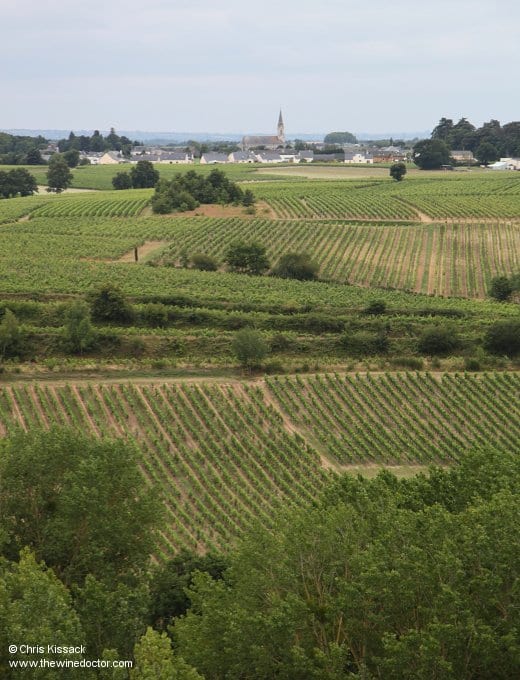
We’re Not in Kansas Anymore: Anjou, 2026
Toto, I’ve a feeling we’re not in Kansas anymore.
– Judy Garland as Dorothy Gale, The Wizard of Oz (1939)
At the risk of mixing up my cinematic metaphors, allow me to remind you of what happened the last time we sat together in my DeLorean.
You might recall, in my Central Vineyards 2026 report, that once we hit the requisite speed (I’m pretty sure I don’t need to tell you the number on the digital display) we disappeared in a storm of electrical discharges, only to arrive in Sancerre, in the summer of 1993.
Why? Because when I first set foot in the Loire Valley in 1993, Sancerre was important. Indeed, the entire Kingdom of Sauvignon Blanc – a term first coined by Pierre Bréjoux in Les Vins de Loire (Parisienne d’Editions Techniques et Commerciales, 1956) – was important. Sufficiently so for me to spend two nights in Sancerre, and a third memorable night in a railway hotel in Vierzon, a useful base for exploring the vineyards of Quincy and Reuilly, which lie just to the south.
Anjou, though? Not so important.
While I am sure Anjou at that time made some serious wines, they were not sufficient to cut through. I was not a writer, critic, commentator or influencer. I was nothing more than a keen imbiber, eager to eat and drink my way along the Loire, and I was following the recommendations of others more erudite and experienced than I (one of whom, funnily enough, I was sitting next to at last week’s Union des Grands Crus de Bordeaux tasting in London). This was the early 1990s, and the wines the British wine press promoted did not usually include those from Muscadet (its star had faded, and it was de rigueur to dismiss it) or Anjou (sweet or sulphurous, or even both, the choice was yours). Montlouis-sur-Loire was similarly ignored. I thus followed my guides to Saumur, Bourgueil, Chinon and beyond, until – via Sancerre – I reached my little railway hotel.
And this was Anjou’s problem. The sweet wines naturally had limited appeal. The supposedly dry whites were often rather sweet, golden, sulphurous and unclean, and thus easy to ignore. The reds were, well, an acquired taste. And the rosés? Well, they could be fun, if you were in the right frame of mind, as I occasionally was. They certainly sold well. But the region lacked a quality focus, as well as a unifying image.
The question is, in this wine region with centuries of history, how did it come to this? Where did it all go wrong? And, more importantly, how has it now started to go so right? Anjou is now the Loire Valley’s most exciting region, and perhaps the most dynamic region in all France right now.
In this 2026 report on the wines of Anjou, I will publish my most recent tasting notes, including 91 new notes on Chenin Blanc from Anjou (either in the Anjou appellation, or in Vin de France), as well as 93 notes on Savennières, surely the most comprehensive report on this appellation since Emperor Probus ordered vines planted on the banks of the Loire (you see, I can perpetuate a good wine myth when it suits me). And, not forgetting the other facets of vinous life in Anjou, I will include a sizeable report on the region’s red wines (71 notes), and smaller reports on a selection of seductive sparkling wines (16 notes), and some stunning sweet wines (44 notes). All in all, at the last count, 315 new tasting notes on the wines of this region.