
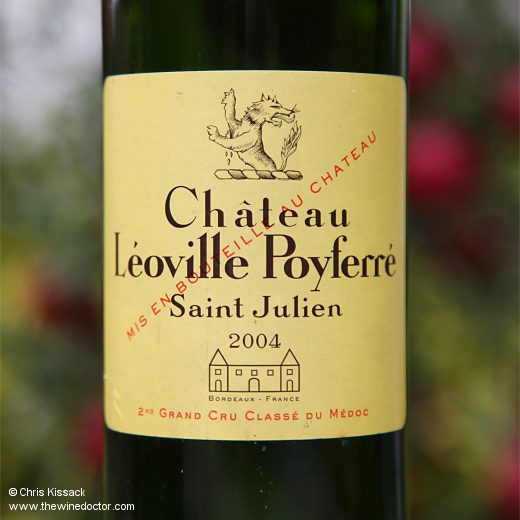
Château Léoville-Poyferré 2004
Freshly returned from a marathon tasting session taking in the Salon des Vins de Loire, Madavin in Angers, Biodyvin Paris, Wine Paris and other associated salons, I reached for a bottle from the ‘drink now’ rack and my hand landed on this, the 2004 from Château Léoville-Poyferré.
It is not the only 2004 to have made an appearance here recently, this vintage also cropping up in my Weekend Wine slot in the shape of the 2004 Château Montrose, 2004 Pontet-Canet, 2004 Vieux Château Certan and 2004 Château Quinault L’Enclos. Not to mention the 2004 Vouvray Cuvée Tradition from François Pinon and 2004 Coteaux du Layon Les Bruandières from Patrick Baudouin. I pulled all these wines from the depths of the cellar for drinking back in 2024, but it has taken more time than expected to get around to pulling the corks.
I really must try harder!
In the hands of the Cuvelier family since their acquisition in 1920, it is fair to say that through the mid-20th century, up until the end of the 1970s, when the property was under the direction of a régisseur working on behalf of the owners, Léoville-Poyferré was underperforming. In this it was not alone; a number of prestigious second growths, among them Pichon Baron and Lascombes, were in the same boat. All have since been revitalised, and in the case of Léoville-Poyferré the success of the renaissance was down to the leadership of one man, Didier Cuvelier.
Didier took charge in 1979, and oversaw extensive developments, starting with the vineyard, which over time he restructured to raise the percentage of Cabernet Sauvignon (although it is worth noting that this is one St Julien – alongside Château Beychevelle – that usually includes a significant proportion of Merlot in the blend of the grand vin). Indeed, the back label of the 2004 vintage tells us at this time just 62% of the vineyard was planted to Cabernet Sauvignon, Merlot weighing in at a hearty 28%, along with 8% Petit Verdot and 2% Cabernet Franc. As for the winemaking facilities, these were overhauled in 1984, again in 1990, and again in 2010. Perhaps controversially, the estate was one of very few big-name left-bank properties to bring Michel Rolland on board as a consultant.
As a result of Léoville-Poyferré’s rather lacklustre reputation during the mid-20th century it is only rarely that I took a look at very old vintages. Having said that, I did once encounter the 1961 vintage, many years ago now, and it was very good. Not amazing, which it perhaps could have been in such an illustrious year, but still very good. Most of my early experiences date back to the 1980s, with notes from a Léoville-Poyferré vertical tasting being one of the earlier additions to this site, back in 2003 (Winedoctor history!). I found joy in the 1982, 1983 and 1985 vintages, and later encounters with 1986 and 1989 were also positive.
It seems that under Didier Cuvelier the estate was on the up, although it was really during the mid-1990s that this became undeniable. Skipping gleefully past 1991, 1992 and 1993, a success in 1994 – otherwise a rather staid vintage – was noteworthy, but it was really with a very fine 1996 vintage that Didier made his mark. As an anecdotal aside, I remember being offered the wine by a wine merchant in Nantwich, in Cheshire, but I recoiled at the (on reflection justified, I suppose) rise in price. The exact price has long dropped out of my memory bank, but it was probably in the order of £260 per case (in the days when a case was twelve bottles). Oh, for such prices today!
Like 1994, 2004 was another rather staid vintage. Coming between the highs and lows of the complex 2003 vintage, and the universal success of 2005, it was – perhaps like the more recent 2023 vintage – always going to be overshadowed. Which is, of course, the sort of vintage perceptive Bordeaux drinkers should keep some awareness of. It is where under-appreciated gems can be found.
Revisited at a little over 21 years of age, the 2004 Château Léoville-Poyferré presents a quite glorious colour in the decanter, with a richly pigmented purple plum hue at its heart, with a raspberry bright rim. There is an enticing sense of freshness and density combined on the nose, bright fruit still to the fore despite the wine’s age, with layers of blackberry, currant and damson, with light touches of black violet and liquorice, thyme and a subtle trace of mint. It continues in an immediately pure and fresh style on the palate, with youthful fruit set in a supple density which sits forward on the palate, maintaining a plump and textural substance through the middle, filled with dark plum, violet and more mature nuances of tobacco, backed up by a dry but tightly knit core of tannins. It culminates in a bright, acid-fresh finish, easing into a length rich in powdery, sooty and peppery tannin. Overall it is a restrained but seductive interpretation of St Julien, one which for its age retains a noteworthy degree of substance, texture and structure; while it drinks fine now, there is much potential here. Give it another five or ten years in bottle and this will be shimmering, I am sure, so hands off for now. The alcohol is 13.5% on the label. 94/100 (16/2/26)
Read more in:
- My guide to the wines of St Julien
- My reports and tasting notes from the 2004 Bordeaux vintage
- My profile of Château Léoville-Poyferré, today run by Sara Lecompte-Cuvelier
Find Château Léoville-Poyferré 2004 on Wine Searcher: 
Find all Château Léoville-Poyferré wines on Wine Searcher: