
Domaine Huet Vouvray Le Haut Lieu Moelleux Première Trie 1990
If I look back through more than two decades of my Weekend Wine choices, Vouvray features rather prominently. And not infrequently via the joys of the 1989 vintage, such as the 1989 Grande Année and 1989 Sélection Grains Nobles from Domaine des Aubuisières, the 1989 Réserve Passerillé from François Pinon and the 1989 Vouvray Moelleux from Domaine du Clos Naudin, and maybe a half dozen more.
The 1990 vintage, by contrast, appears less frequently, the recent appearance of the 1990 Goutte d’Or on these pages a rare exception.
These two vintages were once the subject of hot debate for imbibers of Vouvray, a preference for 1989 or 1990 was no different to deciding whether Blur or Oasis were the better group – a grave issue to be given solemn consideration. So it is perhaps surprising that I have given 1989 so much airtime over 1990. I suppose it reflects my decision, made more than a few years ago now, that I preferred 1989, and it is only natural that my cellar, and the wines which crop up in my Weekend Wine slot, reflect this.
Well, regardless of my preferences, it is time to redress the balance a little, with another 1990 from one of the appellation’s leading names, Domaine Huet.
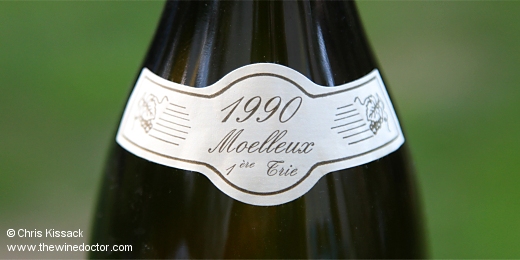
While both 1989 and 1990 were excellent years for the Vouvray appellation, the stories of these two vintage, and thus the style of the wines, bear some remarkable differences. The 1989 harvest was marked by passerillage, with tiny volumes of grapes affected by noble rot. Tiny, but still significant, these berries forming the basis of the Moelleux Réserve and Cuvée Constance cuvées from Domaine du Clos Naudin and Domaine Huet respectively. But on the whole, this was a vintage of clean, pure Vouvray fruit, a vintage which allows the minerality and terroir character to show through.
The 1990 harvest, meanwhile, was distinguished by a wave of noble rot, which swept through the vineyard ensuring that the predominant style in the finished wines would be sweet, dense, concentrated, and laden with botrytis character. At Domaine Huet the range of cuvées produced was smaller than it had been in 1989, reflecting this, and what was produced was predominantly sweet. There were just two sec cuvées, one a blend and one under the Le Haut Lieu label, and all the other wines were sweet. A lone Le Haut Lieu Moelleux provided the stepping stone up to the three Moelleux Première Trie cuvées, one each from the three vineyards, Le Haut Lieu, Le Mont and Clos du Bourg.
All three vineyards yielded huge volumes of nobly rotten fruit, and Noël Pinguet decided to keep the three harvests entirely separate for the three vineyard specific première trie cuvées, which were made using exclusively botrytised fruit. Fair enough, although I am sure nobody would have been unhappy if he had chosen to blend a little more adventurously, producing a 1990 Cuvée Constance in the process. It would have been a fitting partner for the 1989 vintage, which was of course the inaugural release. Noël decided, however, that it was not to be.
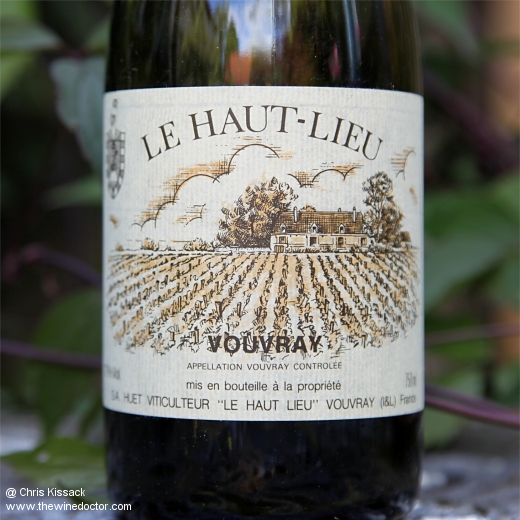
More than forty years on, the differences between 1989 and 1990 vintages are now stark. The 1989s remain linear, the sweetness tempered by acidity, the palates tending towards athleticism and great energy as a result. They are hundred-year wines, for sure. The 1990s, meanwhile, are perhaps already at peak, albeit a very broad peak; they will drink well for decades, but their value is evident now, and it is in their luscious, hedonistic, velvety, botrytis-driven seduction. All three are wines which could stand up to Philippe Foreau’s 1990 Goutte d’Or, although there is undeniably a pecking order, with the 1990 Clos du Bourg and 1990 Le Mont generally regarded as superior to the 1990 Le Haut Lieu.
Whichever bottle you next lay a hand on, do not shy away from opening the 1990s right now. They will reward you doing so. And it means you can leave your 1989s in the cellar for just that little bit longer.
In the glass, at 46 years of age, the 1990 Vouvray Moelleux Première Trie from Domaine Huet displays a quite incredible colour, a dark and caramelised hue, with a delicately green rim. It has the look of a much older Vouvray or Layon wine, although if tasted blind I can’t help thinking the luscious and intensely sweet palate which follows, partnered with that little trimming of green, would have many people wondering if they had just been poured a glass of very good old Madeira. The nose, meanwhile, is just as incredible as the colour suggests, with multifaceted layers of orange marmalade, caramelised citrus, coffee bean, bergamot, liquorice and black tea leaves, the deep botrytis character coming through in these dark and perfumed scents. The palate is all rich texture and creamed substance, carrying toasted praline flavour, and despite the vintage’s reputation for hedonism it does still have a fine peppery energy and plenty of freshness, zip and grip. And of course it culminates in an incredible length, shaped by the sweetness and that lingering acidity. A super Vouvray here, pushing into the liquoreux style such is its intensity. Hats off to Noël Pinguet, as this is a fine result in what was his first full biodynamic vintage after the 1989 trials. 96/100
This is such an impressive wine, but also a fascinating lesson in just how these two great vintages differ. Here’s to many more future comparisons!
Oh, and if you aren’t sure, Blur were always the better group. (17/8/26)
Read more in:
- My detailed profile of Domaine Huet
- My guide to the wines of Vouvray and some of the top Vouvray vineyards
- My guide to Chenin Blanc
Find Domaine Huet Vouvray Le Haut Lieu Moelleux Première Trie 1990 on Wine Searcher: 
Find all Domaine Huet wines on Wine Searcher: