
Château Gruaud-Larose 1970
Time for another step back in time, courtesy of Bordeaux.
The vintage is a familiar one, 1970 being one of the more strongly represented vintages among those that slumber in the Winedoctor cellar. You only have to look back across prior Weekend Wines, to the likes of 1970 Rieussec, or 1970 La Croix de Gay, or other weird and occasional wonderful bottles such as the 1970 Riveyrac Rivesaltes, for evidence of that. Why the penchant for 1970? First, because it is one of only two or three half-decent vintages in this decade. Secondly, it might have something to do with it being the year I emerged occipito-posteriorly into the world.
And so, this weekend, the cork was pulled on the 1970 Château Gruaud-Larose.
This is not exactly my first encounter with the wines of this St Julien second growth. Indeed, only a week or two has passed since I was standing in the tasting room at Gruaud-Larose with Nicolas Sinoquet, who manages the estate on behalf of proprietor Jean Merlaut. That was to revisit the 2023 vintage (full report coming in January). As for prior vintages, encounters with the wines of Gruaud-Larose constituted some of my earliest experiences with classed growth Bordeaux, and it was also one of the first châteaux to make a splash on Winedoctor after a vertical tasting back in 2003. More than twenty years ago!
And yet, despite being a long-term follower of the property and its wines, this is the first time Gruaud-Larose has graced my Weekend Wine pages. Arguably long overdue.
Gruaud-Larose has a long and illustrious history which features a relatively small number of owners. The earliest records describing the planting of vines here date to the first half of the 18th century, a little later than the other second growths of St Julien. The man tending the vineyard was named Gruaud, and the property was passed down through his family to a daughter, who married into the Larose family. So now we have the origin of the name. From them it came into the hands of a consortium of négociants including one named Jean-Auguste Sarget (which gives us the origin of the name of the second wine, Sarget de Gruaud-Larose).
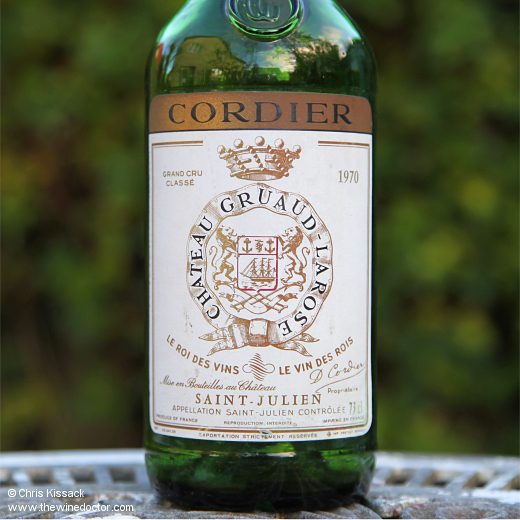
This resulted in a complicated period of ownership, as the property was divided between their descendants. It became increasingly fragmented until it was reunified by Désiré Cordier who made at least two major purchases in the first quarter of the 20th century to do so. The Cordier family held on to the property until the 1980s when it was sold several times, before the current owner, the aforementioned Jean Merlaut, stepped in to take it in hand in 1997. Of course, this is a ridiculously concise version of this estate’s history; for a more appropriate level of detail, stretched over eight pages, see my Château Gruaud-Larose profile.
Old labels and bottles fascinate me, for the clues and curious nuances they bear. This label, for example, bears the signature of Désiré Cordier (naturally erased from current vintages), not to mention the inscription Le Roi des Vins, Le Vin des Rois (the King of Wines, the Wine of Kings), reputedly coined by the proprietor Larose to publicise his wine’s popularity at the royal table. It is a phrase also applied by savvy proprietors in Tokaj and Burgundy, and it is still present on the modern-day label. If you have keen eyes (they need to be very keen!) you can just make that the bottle holds 73 cl rather than the modern norm of 75 cl; you could therefore argue this bottle has been useful in lowering my alcohol consumption. Having said that, unlike modern labels, the alcohol concentration is not declared. So surely it has no alcohol at all then? The ultimate in moderation!
Despite my familiarity with the wines of Gruaud-Larose, encounters with vintages older than this one have been infrequent. The 1961 showed well when I last tasted it, but I am shocked to see looking at my notes that this encounter was nearly twenty years ago! Nevertheless, I am sure based on its performance then that it would still be going strong today. And the 1979 was doing alright when I last tasted it, but that was also an absolute age ago, and I am less certain of how that vintage would taste today. Others that have shown well over the years include 1988, an easily overlooked vintage, and the stellar 2000, which I loaded up on. I still have a few bottles, and a quarter-century later this remains a superlative vintage for the estate.
Which bodes well for this 1970, surely? Well, maybe.
The 1970 vintage from Château Gruaud-Larose was released from its curiously shaped bottle after pulling the cork – long and clearly of high quality – with ease. In the glass it presents a surprisingly faded hue, with a mahogany core, and a brick-pink rim. The nose is clearly very tertiary in style, rather fungal, the first glass really quite funky with bottle-stink, although on subsequent glasses poured from the decanter, this character fades. Instead the aromatic profile cycles through notes of undergrowth, leaf litter and incense, tinged with distant nuances of black truffle and black olive, as well as a little salty kelp. As for the palate this too feels evolved – I suppose I could call it charming – and it is as fungal as the nose, although it then parts to reveal a rather dry and grained grip of bare-boned tannins through the middle and end. Taking into account its age, this wine has some grace, but the abrading effects of those years are also plain to see, as it discombobulates into a gentle, dark, grained and powdery finish. On the basis of this bottle, this would be better drunk now than held for longer, but as always, other bottles may be better. 88/100 (15/12/25)
Read more in:
- My review of 2023 Bordeaux
- My guide to the wines of St Julien
- My detailed profile of Château Gruaud-Larose
Find Château Gruaud-Larose 1970 on Wine Searcher: 
Find all Château Gruaud-Larose wines on Wine Searcher: