
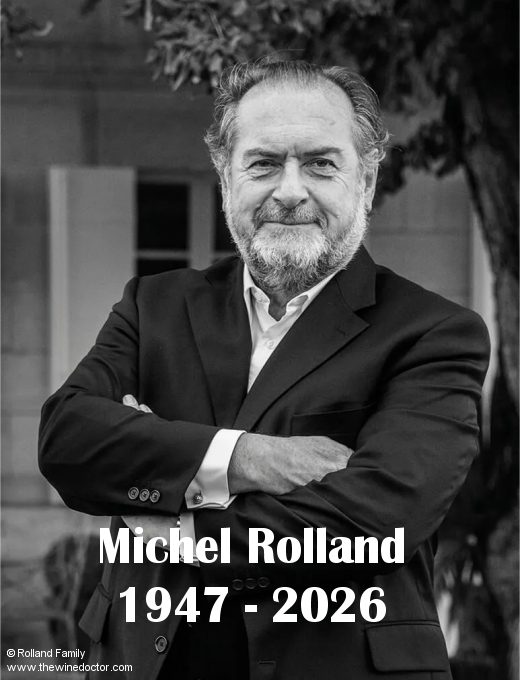
Remembering MIchel Rolland
News of Michel Rolland’s passing came like a bolt from the blue on the morning of March 20th. It brought forth a tidal wave of appreciation for a man who many recognised as having – during more than five decades in the business – shaped Bordeaux (and the entire world of wine) into what it is today.
Born on Christmas Eve in 1947, Michel spent his formative years at Château Le Bon Pasteur, where he and his brother played among the vines and in the tractor shed. As a young man he left home to pursue the study of wine, an academic path that took him first to the oenological school at Château La Tour Blanche in Sauternes, before then enrolling at the University of Bordeaux, where he took classes from renowned oenologists including Émile Peynaud and Pascal Ribéreau-Gayon. He also met his wife-to-be at this time; having enrolled at the university to study medicine, fate saw Dany switch to the oenology course instead. A long future together began.
Once graduated the couple could have settled for a comfortable rural existence somewhere in Pomerol, perhaps to one day take over the running of Le Bon Pasteur. Nobody would have batted an eyelid. But instead they threw their towel in with Jean Chevrier, a local who ran an oenological laboratory on the Cours des Girondins in Libourne. They bought into the business, eventually taking it over completely; for many years the young family – they now had two daughters – lived in the cramped apartment above the laboratory. It was far from ideal, but the path they had chosen was the one that would catapult Michel to stardom.
Under their direction the laboratory was a great success, and Michel was soon analysing wines and dispensing advice to many of the leading right-bank estates. He would also prove his mettle at Le Bon Pasteur when the time came, taking over sooner than expected after the premature death of his father in 1979. In 1982 he met Robert Parker and the two formed a life-long friendship, built around mutual respect for the other’s achievements. And with time Michel’s renown would lead him to consult not just in Bordeaux but across many wine regions of the world, making him arguably the first ‘flying winemaker’.
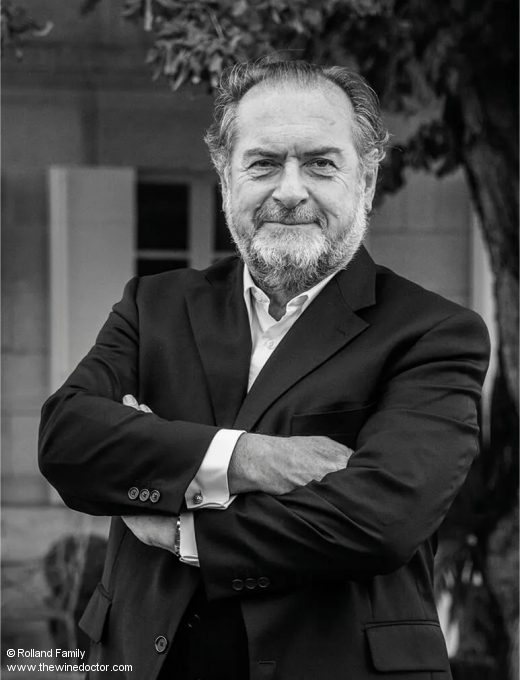
In more recent years Michel began to slow down. He cut ties with many properties in Bordeaux he was working with, in order to reduce his clients to a more manageable number, and he began taking on associates, principal among them Julien Viaud, Jean-Philippe Fort and Mikael Laizert, the Laboratoire Rolland becoming Rolland et Associés in the process. Despite these developments his zest for life remained strong and he remained actively involved in several Rolland projects, particularly in Argentina, where he was working only a couple of weeks before his passing.
Along the way it is fair to say that during the course of his career Michel was on the receiving end of some opprobrium, more than he deserved in my opinion, which I think is a sad reality for many who achieve a degree of fame and notoriety. In Michel’s case I think many saw him as a proxy for Parker, and disliking the style of wine the critic favoured and the way the wine world was following that taste it seemed appropriate to them to attack the consultant as much as the critic. Others disliked the homogeneity they say they found in his wines, but on every estate Michel consulted he delivered, giving the owners a wine of better quality able to secure a higher score from Rober Parker. In short, Michel knew his job and did it well. His critics also enjoyed the ‘exposé’ of Nossiter’s Mondovino, a documentary film project which did not cast Michel in a good light. My own opinion was that the film misrepresented Michel and his methods of working.
Reflecting on all this in the context of Michel’s passing with a colleague, as well as Michel’s penchant for picking late, he opined “…it’s easy to forget how green and weedy so many wines were when he started out.”
And that is perhaps the most fitting testimony to Michel Rolland’s impact on the world of wine. It is a tragedy that he leaves it so suddenly, but it is without doubt a much improved wine world compared to the state of play when he entered. And much of this change for the better is down to Michel himself.
Reflecting on my own encounters with Michel, I first met him at lunch in Bordeaux, naturally, during a primeurs visit. My most recent encounter with him was also during the course of the primeurs, a few years ago now. I recall the latter lunch well, not least because it was such a family affair; it was not just Michel, and not just Dany, but their daughters too, their respective partners, and more than a handful of grandchildren. I cannot think of any other encounter in Bordeaux, any lunch, dinner, tasting or similar soirée, where I have been so warmly welcomed into a family’s fold. This is the Michel I will remember.
My condolences to his family on Michel’s passing, especially Dany and their two daughters Stéphanie and Marie.
Jeffrey M. Davies
You’re spot on in your short summary of Michel’s life, career, and contribution to the world of wine. Thank you for that.
Chris Kissack
Thanks for your comment Jeffrey.