
Duchâtel’s Tower: Château Lagrange, 2006 – 2022
In the fading light of a July afternoon, Charles and his wife Eglé walked slowly through the gardens of their Bordeaux estate, down to the edge of the pond, its surface shimmering with golden light. Behind them rose the grand château, its pale walls similarly illuminated by rays of warm sunshine. It had been another day of peaceful meanderings for the couple, who were still growing accustomed to the bucolic expanse of the gardens which surrounded this new property.
Especially Charles, who spent much of his time in Paris, on affairs of state.
Comte Charles-Marie-Tanneguy Duchâtel (1803 – 1867) – to give him his full name – was new to Bordeaux and the region, but he was not new to the concepts of power, responsibility and leadership. Surprisingly his lineage was not an ancient or aristocratic one; his father had risen through the ranks of the civil service and eventually entered politics, serving under Napoleon I (1769 – 1821), and it was the self-appointed Emperor who had rewarded him with his title. Charles inherited this title, but not before he had earned his place in government, secured through his expertise and dedication to the cause. Charles was very much a self-made man.
It was this sense of upward mobility which drew Charles to the side of François Guizot (1787 – 1874), a highly regarded statesman and the dominant figure in the politics of the era. Together he and Guizot had formed the government of the July Monarchy, France’s final gasp of constitutional monarchy following the July Revolution of 1830. Louis Philippe I (1773 – 1850), the self-styled King of the French, now sat on the throne, but it was Charles and François who were running the country. Charles was a financial wizard, testament to which was the considerable wealth he had accrued; so much wealth that the purchase of this grand estate on the Médoc had not even dented his finances.
For a man accustomed to the noise and urgency of public life, a walk with Eglé through the grounds of his country retreat offered Charles a different kind of order: they had only taken possession of the property the previous year, but Charles already felt he was becoming one with it. He sensed the measured rhythm of the seasons, and could almost feel the patient growth of the vineyard. Put simply, he relished the calm beauty of this landscape.
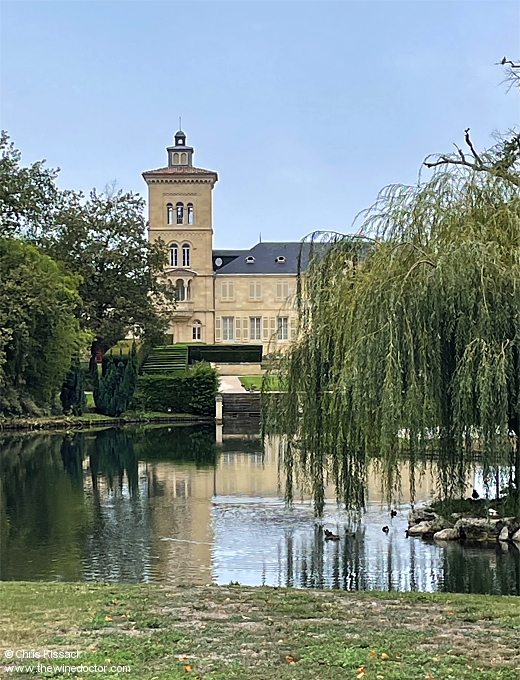
Charles and Eglé followed the water’s edge for a short distance, around one of the two square ponds, where the still waters reflected the dark shadows of the trees and the ever changing colours of the sky, the golden hues now fading into a sunset pink. Ducks moved gently among the reeds, while the soft movement of insects filled the air above the grass and vines. It was this idyllic spot which had seduced them when they had first visited the property. Eventually they came to a stop, and turning around they drank in the view, the château blazing a golden peach as the sun touched the distant horizon.
“I really do not know how this could be any more perfect,” sighed Charles, the Comte speaking in the mid-19th century French of the political class, of course.
Eglé turned to him and smiled. “I like it, but as I said last time, I would really like a tower. Something with an Italian feel to it,” replied the Comtesse.
Charles stared at his betrothed for a moment, before his face was illuminated, not by the last rays of the sinking sun, but by an idea.
“And I know just the man to design it,” he replied.
Please log in to continue reading: