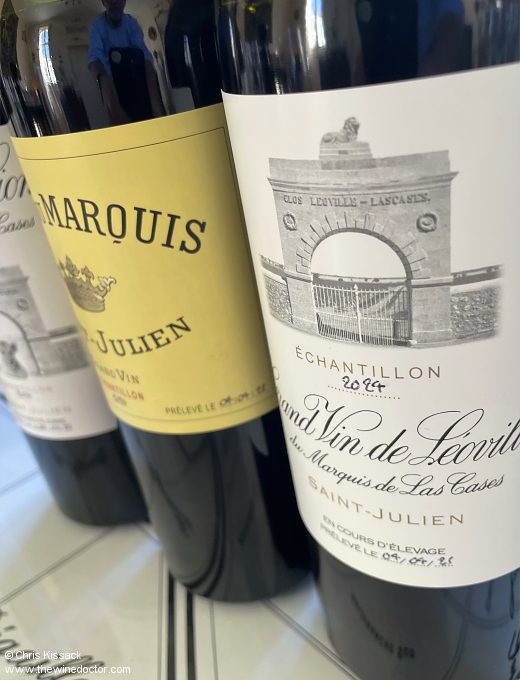
Château Léoville-Las-Cases: Tasting & Drinking
In the Léoville order, to my mind Château Léoville-Las-Cases is the most impressive of the three estates, pre-eminent in St Julien, the first and most tangible challenger to the first growths and the prime example of a ‘super-second’, those châteaux that would pretend to the crown of premier cru. In 2008, a Cornell University study suggested that it should be promoted to first growth status, an opinion based on ratings of the wine over 35 vintages, from 1970 to 2005. I suspect, two decades on, many fans of the estate would still be in agreement with this conclusion.
Essentially this domaine is what remains of the original Léoville estate; it is the larger part, mere portions having been carved off in the creation of the Château Léoville-Barton and Château Léoville-Poyferré vineyards. And whereas the latter two estates have been owned by a number of different families, Château Léoville-Las-Cases remained, for a long time, in the ownership of the descendants of the Marquis de Las Cases, and throughout the 20th century they retained a minority share, long after control was ceded to the Delon family.
If history and nobility are not quite sufficient, one has simply to look at the wines. Encountering a Château Léoville-Barton or a Château Léoville-Poyferré in a blind tasting is a fine experience; these are, after all, great wines, and in recent vintages they seem to have only improved, especially the latter. But Château Léoville-Las-Cases, in my experience, is more likely to stop a taster in his or her tracks, forcing them to return to their tasting sheet to double-check the tasting line-up, because they were sure there weren’t any first growths on the list when you first checked.
Great wines are not in short supply here. A list of favourites might be rather lengthy; I would be ecstatic to find myself in possession of the 2025, 2022, 2020, 2019, 2018, 2016, 2010, 2009 and even the 2008 vintage. Take any of the vintages omitted from this list and you will still find a superb wine in all but the most washout years. From older vintages, look for 2005 (terrible to think I now regard 2005 as ‘old’ – it means I must also be old, I guess), 2000, 1998, 1996, 1990 and 1985. The 1961 wasn’t half bad either, although it is twenty years or so since I last tasted it.
Other châteaux may touch these dizzy heights from time to time; I can think of one or two vintages of Château Léoville-Barton (like the 2022), Château Ducru-Beaucaillou (the 2018 was pretty smart) and even Château Gruaud-Larose (the 2000 and the 2025, perhaps) that pretend to first growth status, but Château Léoville-Las-Cases has this character with considerably more regularity. And, as noted above, in lesser vintages, the wines can still be sublime, or at least the best of the bunch. I confess I thought little of the 1975 tasted at 27 years of age, but it was still one of the more enjoyable wines in a line-up of dull and rather drily tannic wines from that vintage.
By way of complete contrast, I return to the 2008 vintage, the wine which stopped me in my tracks during the primeur tastings in April 2009, as I recalled on the first page of this profile, and which I include in my list of more successful vintages above; what a stunning result in a less exalted year. More recent tastes of the wine, at the primeurs but occasionally into maturity, have only served to cement this opinion in place. This great estate, turning out fabulous wines, demands our full attention. (6/2/07, updated 5/8/09, 26/2/16, 13/11/26)