Château Gruaud-Larose: Tasting & Drinking
I think we will all have our own opinion about whether or not the new viewing tower at Château Gruaud-Larose, inaugurated in the summer of 2014, really contributes to the architectural standing of the estate, or of Bordeaux as a whole. Behind it sits a graceful 18th-century château, with accompanying stone tower, one of the most charming in the entire region. I suppose it could be argued that it provides an interesting contrast, and is a nod to an ancient and eccentric proprietor who also built a tower to look across the vines.
What really matters though, is the wine. I find it more difficult to make a single catch-all statement, because I have found extremes of both quality and style here during the last two decades. Without a doubt the most impressive vintage I have tasted until recently was the 2000, a stunning wine of huge colour, substance, depth and confidence. I was fortunate enough to come across some of these bottles when I was stocking up with this vintage, and the wine has never yet disappointed. It is a towering example of what can be achieved on this particular terroir, a vintage in which Château Gruaud-Larose suddenly seemed to fancy itself as a pretender to first growth status. Thanks heavens I still have a small handful left in the cellar.
Looking backwards from this vintage, the 1999, 1998 and 1995 vintages were good enough, but never really rocked my world, showing little more that was offered by lesser years such as 1991 and 1992. Back in the 1980s and 1970s, however, there was greater joy for this particular palate, with a very strong 1988 vintage, a pretty decent 1979, and a passable (just!) 1970. One of the oldest vintages encountered in recent times, the 1961 vintage, also showed very well.
These older vintage make clear the quality achievable here, which only makes my encounters from the early 2000s through to about 2016 all the more frustrating. The wines never seem to display their second-growth status, and seemed to me to fall short of what had been achieved in 2000. I always thought 2002 was a good wine for this weaker vintage, the 2004 also gave joy, while the 2005 was very good indeed. But subsequent vintages often seemed ordinary, especially 2006, 2007 and 2008, followed by a 2009 and 2010 which failed to grasp what these otherwise great vintages offered. The 2011 and 2012 vintages were lacklustre, especially the 2012 which already seemed tired when I revisited it at ten years of age. The 2013 vintage was a wash-out here and everywhere else, while 2014, 2015, 2016 and 2017 failed to light any fires for me.
Then came the 2018 vintage, which was a revelation, with more depth and substance in evidence. At the time it took me by surprise, and seemed inexplicable; on reflection it surely reflects the arrival of Virginie Sallette as technical director. Subsequent vintages were suddenly more interesting; the 2020 was very good, 2021 passable for a frosted vintage, 2022 was excellent, 2023 was pretty smart and for such a wet and miserable vintage I was impressed by the results in 2024.
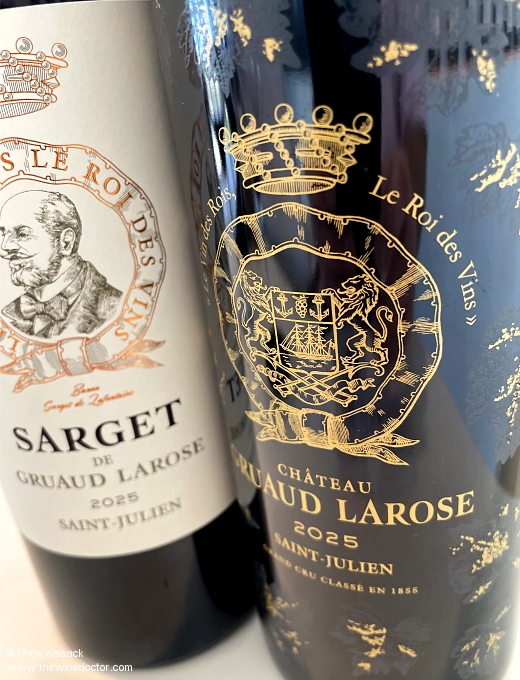
And then came 2025, wearing its special tercentenary label (the records describing vines here in 1725). I will let my notes below speak to the quality of this wine.
Despite the joy in the 2000 vintage, Château Gruaud-Larose has provided little interest to this palate in recent years, but that change in 2018. This is now a property turning out top-notch wines, and yet like one or two other St Julien classed growth properties it remains demure and quietly spoken. Promotion seems classy and reserved, rather than the brash character of some peers. It is a property and a wine I now follow again with interest, and that interest is likely to mean some of that 2025 finds its way into my cellar. I always said I would wait for the next 2000 to come along. It loos like it has arrived. (16/7/03, updated 5/10/06, 3/8/16, 26/8/26)