Home > Producer Profiles > Bordeaux Profiles > Chateau Léoville-Las-Cases
Chateau Léoville-Las-Cases
The story of Léoville-Las-Cases begins with marshland, this being the Médoc after all, as to fully appreciate its history we must look back beyond the creation of Las-Cases itself to the time of the great Léoville estate, beginning in 1638. At this point the estate, clearly one of the oldest in the Médoc, was centred upon a mound of gravel around which there was only marsh, which regularly flooded at high tide. This was the Mont-Moytié estate, the mont being the gravel mound, Moytié a wealthy local who owned the property.
It was the Moytié family that were the first to plant vines here, during the twilight years of the 17th Century, and it is through the marriage of one of the Moytié women that the estate then passed into the hands of her husband, Blaise Antoine Alexandre de Gascq. De Gascq was the seigneur of Léoville and a president of the Bordeaux parliament, locally an extremely influential and also wealthy figure, who did much to bolster the reputation of the estate. Even at this early point in the history of the Médoc, Léoville was recognised as being second only to the four accepted first growths, Latour, Lafite, Margaux and Pontac (Haut-Brion).
From De Gascq to Delon
When Blaise de Gascq died without having sired an heir in 1769, the estate was inherited by four family members, these being the Marquis de Las-Cases-Beauvoir, his brother and two sisters. But these were dangerous times for such nobility, and during the Revolution the Marquis, fearing for his life, was forced to flee France. The family property was sequestered and, although the intention was to sell it whole, as a consequence of his disappearance and the shared ownership Léoville was divided up. Initially just one quarter was sold off, this being the origin of Léoville-Barton. The remaining three quarters remained in the family, and this was the state of affairs when the Marquis was succeeded in 1815 by his son, Pierre-Jean, the Maréchal de Camps under Napoleon. Pierre-Jean inherited most of what that remained of the estate from his elders, with a smaller stake coming to his sister, Jeanne. This was effectively the second major division of the estate, one that was formalised in 1840. Jeanne's daughter married Baron Jean-Marie de Poyferré, and her vineyards were thus destined to be the Léoville-Poyferré of today; Pierre-Jean's holding, half of the original Léoville estate, was the beginning of Léoville-Las-Cases.

It was not long afterwards that the 1855 classification was drawn up as ordered by Napoleon III, prior to the Exposition Universelle de Paris that year. All three of the Léoville estates were classed as deuxièmes crus, all in my opinion merited judged on tasting of the wines today. Léoville-Las-Cases remained in the Las-Cases family thereafter, passing first to Pierre-Jean's son Adolphe, and then to the three members of the next generation, Gaston, Gabriel and Clothilde. Although the children had equal shares, they did not all have an equal level of interest in the estate; Gabriel wished to sell his share, probably to pay off his debts, and in the process a holding company was formed for Las-Cases. Clothilde came out the biggest stakeholder, having eight of the twenty shares, the remainder largely bought up by the wealthier members of the local wine trade, including a gentleman by the name of Théophile Skawinski, who was not only the general manager of the estate but also, I suspect, a very shrewd businessman. Skawinski poured his heart and soul into the property, before his share passed to his son-in-law André Delon. With time the Delon family acquired a greater and greater proportion of the shares in Las-Cases, until they eventually became the majority shareholders, thus effectively gaining control over the property. The Delon family remain at the head of Las-Cases today, André having been succeeded by his grandson Michel, and then the current incumbent Jean-Hubert, Théophile Skawinski's great-great-grandson, and the fifth generation of the family to run the estate.
Léoville-Las-Cases: The Vines and Wines
The vineyards of Léoville-Las-Cases lie in the northernmost
tip of the
St Julien
appellation, abutting the Gironde, and only separated from those of
Chateau Latour to
the north by the Juillac, which drains into the Gironde. Whereas the
other Léoville vineyards, those of
Barton
and
Poyferré, consist of a patchwork of numerous plots, those of Las-Cases are
largely concentrated in this single block. This is the Grand Clos, a
walled vineyard, the stone wall contiguous with that running around
Latour, the
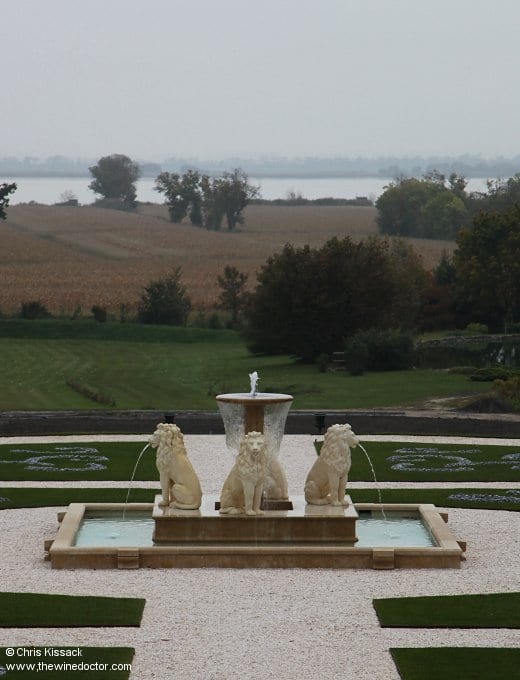
highlight of which is the stone archway surmounted by the lion of
Las-Cases, which can also be found above the doorway to the tasting room at the
chateau (above), and which also graces the label.
In total the estate borders on 100 hectares, of which half is in the Grand Clos, whilst a significant portion, about 20 hectares, lies inland on the other side of the D2, mingling with the Barton and Poyferré vineyards. There is a 5 hectare vineyard in the appropriately named Petit Clos, to the south, and another 7 hectares cleared of woodland and planted by Michel Delon, having originally been purchased from Ronald Barton. The vineyards are planted to 65% Cabernet Sauvignon, 19% Merlot, 13% Cabernet Franc and 3% Petit Verdot, with an average age of about 30 years. The fruit is harvested by hand, usually by a team of workers from Spain, before transport to the chai, where the berries are destemmed before a gentle pressing and then fermented under temperature-controlled conditions. The fermentation vessels include a fascinating mix of wooden, cement and stainless steel vats. The first of these three are the traditional, broad, tronconic oak vats which lie in the main cellar, renovated in 1977; these vessels range in size, up to the largest which is 270 hectolitres. The cement vats lie in a smaller adjoining room, and there are also some stainless steel vats, the most recent addition to the cellar. These vary considerably in size, from 40 up to 216 hectolitres, allowing for small-plot fermentations where desired. The fermenting must is pumped over to submerge the cap and there is a maceration of between two and three weeks. When finished the wine is pumped from the chai to the barrel cellar on the other side of the road through an underground pipe. Here it is transferred into oak barrique, between 50% and 100% new for the grand vin, Chateau Léoville-Las-Cases, depending on the vintage, something in the order of 25% for the second wine Clos de Marquis, and heads off to the barrel cellars which are to the south of the main chai where it rests for up to 20 months. Those barrels that have seen out their time at Léoville-Las-Cases may then find a new home at Delon's other property, Potensac. The wines are fined using egg whites and filtered before bottling using in-house facilities; there is more to this than simply putting wine in bottles. The glass at the base of the bottle is also laser-etched with data specific to the wine, including bottling time, a very noble and valid effort in the battle against wine fraud.

Whilst I am debating the wines, I should draw more attention to Clos du Marquis, a wine which deserves more than a fleeting mention. This is not a wine to be disregarded because of its 'second-class' status. It is perhaps the finest of all second wines, and the quality is superior, to my palate, to many wines from lesser classed growth properties. It is one of the few second wines I would buy to drink, alongside bottles from illustrious chateaux, such as Les Forts de Latour and Les Carruades de Lafite. These two wines grace my cellar, but I must confess I have more vintages of Clos de Marquis than the two of them combined. Clos de Marquis, introduced with the 1902 vintage, thereby pre-empting the appearance of the plethora of second wines by many decades, is sourced not just from young vines or rejected fruit but from a dedicated section of vineyard quite separate from the Grand Clos to the west of the town (many authors describe its origin as the Petit Clos, a smaller section of vineyard on the south-side of the town, but literature I have from the estate seems to contradict that). The vines to the west are surrounded on all sides by those of other second growth properties, including those of Barton and Poyferré. As the vines in this section have matured, so has the quality of the wine, and hence to consider it a second wine (as in second class) is a falsehood; rather this is a different cuvée, from a different vineyard of some quality and potential, hence its ability to challenge many other chateaux of the Médoc.
Las-Cases: The Original Léoville
In
the Léoville order, Las-Cases is the most impressive of the three estates, the
pre-eminent estate in all
St Julien,
the first and most tangible challenger to the first growths and the prime
example of a 'super-second', those chateaux that would pretend to the crown of
premier cru. As recently as 2008, a Cornell University study suggested
that it should be promoted to first growth status (alongside a demotion for
Mouton), an opinion based
on ratings of the wine over 35 vintages, from 1970 to 2005. Essentially it is
what remains of the original Léoville estate, it being the larger part, portions
having been carved off in the creation of the
Barton
and
Poyferré vineyards. And whereas the latter two estates have been owned by a
number of different families, Las-Cases remained, for a long time, in the
ownership of the descendents of the Marquis de Las-Cases, and throughout the
20th century they retained a minority share, long after control was ceded to the
Delon family. If history and nobility isn't quite sufficient, one has simply to
look at the wines. Encountering a
Barton or
a Poyferré
in a blind tasting is a fine experience; these are, after all, great wines, and
in recent vintages they seem to have only improved, especially the latter. But
Las-Cases, in my experience, is more likely to stop a taster in his or her
tracks, forcing them to return to their tasting sheet to double-check the
tasting line-up, because you were sure there weren't any first growths on the
list when you first checked. Other chateaux may touch these dizzy heights from
time to time; I can think of one or two vintages of
Léoville-Barton and also
Gruaud-Larose
that pretend to first growth status, but Las-Cases has the character with
considerably more regularity. And in lesser vintages, the wines can still be
sublime, or at least the best of the bunch. I confess I thought little of the
1975 tasted at 27 years of age, but it was still one of the more enjoyable wines
in a line up of dull and overly tannic wines from that vintage. By way of complete
contrast, the 2008 stopped me in my tracks during the primeur tastings in
April 2009; what a stunning effort this was. Yet another fabulous effort from a
great estate. (6/2/07, updated
5/8/09)
Contact details:
Address: Chateau Léoville-Las-Cases, 33250 Saint-Julien-Beychevelle
Telephone: +33 (0) 5 56 73 25 26
Fax: +33 (0) 5 56 59 18 33
Chateau Léoville-Las-Cases - Tasting Notes
Chateau Léoville-Las-Cases (St Julien) 2008:
The harvest here was from October 6th to the 18th, and the wine is
78% Cabernet Sauvignon, 12% Cabernet Franc and 12% Merlot. The ultimate yield
for the estate was 37.9 hl/ha. Wow - what a captivating nose! Intense black
cherry fruit, minerally and pure, crunchy but rich, layered with cream and
vanilla. Pure, but as the nose suggests stunningly rich and intense, and broad.
Elegant tannins, firm yet silkily textured, really stylish yet with real depth
and concentration. A great tannic core which is only really evident at the
finish. Great length. A fabulous effort. From my
2008 Bordeaux
primeur assessment. 18.5-19.5+/20 (April 2009)
![]()
Clos de Marquis (St Julien) 2008: The second wine of
Léoville-Las-Cases is 55% Cabernet Sauvignon, 41% Merlot, 3% Cabernet Franc and 1% Petit
Verdot, harvest dates and yield as above. An attractive nose, with dense and
dark fruits, and overall a good character. Weighty, supple fruit on the palate,
elegant but with substance. Ripe and fine tannin. Very approachable, well
judged, with firm tannins at the finish. This is really attractive. From my
2008 Bordeaux
primeur assessment. 16.5-17.5+/20 (April 2009)
![]()
Chateau Léoville-Las-Cases (St Julien) 2007: Cabernet dominates, with 58% Sauvignon and 5% Franc, then 35%
Merlot and 2% Petit Verdot. Dark and attractive fruit here, rather floral aromas, with
impressive dark fruit sweetness. Appealing, without showing overt or
overpowering oak at this stage. Impressive palate, some flesh and sweet fruit, a
good balance, and a nice texture over the tannins. Ripe, pervasive, but nicely
poised. Good harmony. This has very good potential indeed. From my
2007 Bordeaux
en primeur assessment. 16.5-17.5+/20 (April 2008)
![]()
Clos de Marquis (St Julien) 2007: The second wine of
Léoville-Las-Cases. Firm black
fruits, quite aromatic but with very firm and reserved fruit rather than
anything pretty or floral. A firm palate, good weight through the midpalate,
classically composed wine. Nice balanced of tannins and flesh. Pretty good. From my
2007 Bordeaux
en primeur assessment.
14.5-15.5+/20 (April 2008)
![]()
Chateau Léoville-Las-Cases (St Julien) 2006: Interestingly, this sample was bottled under a synthetic cork,
although the wine when bottled for sale will have a traditional cork. This young
wine has an almost exotic perfume on the nose, which overall is very expressive
and rich in sweet fruit. This has more punch than the 2007 for sure. There is a
lot of structure here, an appealing texture, good substance, and plenty of
vigour and acidity. This has ripe tannic bones, and there is lovely potential
here. A vin de garde and an admirable addition to any cellar. From a
Bordeaux 2006 assessment. 17.5-18+/20 (April 2008)
![]()
Chateau Léoville-Las-Cases (St Julien) 2005: Beautifully defined and expressive
nose here, a tight layer of raspberry and loganberry fruit intertwined with
elements of charcoal, tar and toffee. The palate speaks predominantly of
structure, as a seam of ripe and polished but very substantial tannins lie
beneath the shiny and veneered fruit. A brilliantly vibrant finish. Not so
expressive as some wines but very finely balanced nevertheless, and certainly
well placed for the cellar. I think given time this stupendous effort will be a
very fine, supremely elegant wine.
From a
2005 Bordeaux tasting
at four years of age. 19-19.5+/20 (November 2009)
![]()
Chateau Léoville-Las-Cases (St Julien) 1985: Like a few other
wines tonight this demonstrates its potential even with its colour,
which is red cut through with a purple streak of youth. Stylish,
classically styled St Julien fruit with a hard, tarry character. There
is a sense of a full, sweet richness to it. On the palate it is clear
that this firm, tannic, backward wine is still in the ascendant. Firm
fruit and balanced acidity provide the potential for future development. From a
1985 Bordeaux tasting. 18.5+/20 (September 2002)
![]()
Chateau Léoville-Las-Cases (St Julien) 1983: Good depth of
colour here. Good intensity up to the rim, paling just a fraction. Mineral,
elegant, stylish nose; little notes of coffee-toffee, overlaid with a somewhat
organic note. Intriguing. Firm palate, with ripe tannins showing quite strongly.
Great flavour and good fruit still. And superb depth. This is exuding quality in
the glass and is clearly a first-growth pretender. Excellent wine, still on the
way up. Drink now or watch it improve for another five years at least. From a
1983 Bordeaux tasting. 17+/20 (February 2005)
![]()
Chateau Léoville-Las-Cases (St Julien) 1981:
Deep and densely coloured wine, red-purple with a hint of
mahogany. Wonderful blackcurrant and currant flavours,
quite rich and yet a touch austere. A velvety texture,
with a big structure, and a strong acidic backbone. An
incredible but slightly austere length. From a
1981 Bordeaux tasting. 17.5+/20 (September 2001)
![]()
Chateau Léoville-Las-Cases (St Julien)
1975: A good colour. Another wine with a fairly classic nose. A tarry
edge and some suggestion of fruit. Good texture and weight on the
finish, although somewhat short on flavour. There are nuances of floral,
gravelly fruit, although this fades through the endpalate. Another wine
beginning to dry out. From a
1975 Bordeaux tasting. 15/20 (August 2002)
![]()
Chateau Léoville-Las-Cases (St Julien) 1961: A reasonably deep colour
here, a mature rim, with a sweet, raspberry-tinged nose. A smoky-sweetness. A
roasted, sweet, complete, textured wine, nicely balanced, but showing an
attractive bit of grip at the finish. Not the richest of palates, but it has a
lovely presence, with a tannic backbone. This full, structured
wine still has some hidden potential it seems. Very good indeed. From a
1961 Bordeaux tasting. 17.5/20 (June 2007)
![]()