
Paul Prieur et Fils Sancerre Blanc Pieuchaud 2020
This week, my Weekend Wine choice takes us to Sancerre, arguably the Loire Valley’s most widely appreciated appellation, and yet one which continues to reward exploration. There is a lot still to be discovered here.
This week’s wine is a case in point. This is the first time a wine from this domaine has appeared on Winedoctor pages, and up until the past year or two the closest I came to the wines of Paul Prieur et Fils was dining in La Petite Maison, a restaurant located within a little end-of-terrace house near the top of the town, just opposite the south gateway to the grounds of the Château de Sancerre. That the wines are listed here is not surprising if you know who is married to who in this town; the restaurant is run by Morgane Prieur, who is the wife of Luc Prieur, who is the grandson of the Paul Prieur on the label below, and the incumbent at the domaine. Luc has been in change here since 2012.
The Prieur family declare eleven generations of winemaking heritage within Sancerre, a claim I do not doubt for one second. At his cellars located in the village of Verdigny, beneath the last gasp of Les Monts Damnés, Luc Prieur vinifies the fruit of about 18.5 hectares of vines, of which 13.5 hectares are Sauvignon Blanc. Most of these vines are located on the clay and limestone slopes above the domaine, in Verdigny and Chavignol, but Luc also has 5 hectares planted on flint (or silex if you prefer, as per the label below) soils in Thauvenay, one of the villages on the north-south flinty fault which runs beneath Sancerre and Saint-Satur.
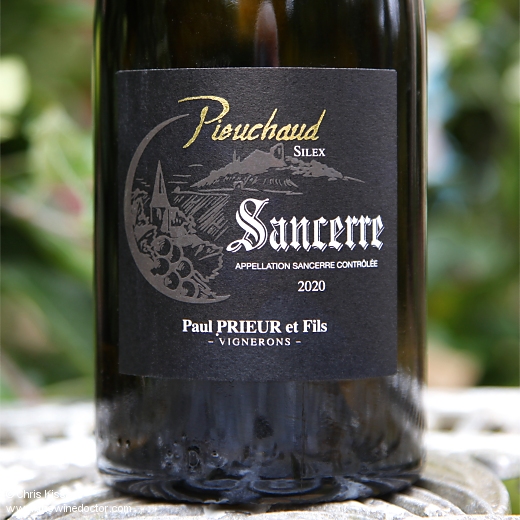
The domaine is certified organic by Ecocert, the first vintage in which this was applied being 2022, which implies – as there is a three-year conversion period – that the 2020 vintage discussed here was produced using organic methods. The fruit is hand-picked and brought to the cellars where the bunches are pressed using a pneumatic press before the juice is allowed to settle. The fermentations then take place in a combination of wooden and stainless steel vessels the ratio of which depends on the cuvée; Pieuchaud (named for the lieu-dit of origin) is generally managed in 16-hectolitre wooden cuves for 80% of the blend, with 20% in 600-litre barrels. The fermentation is by indigenous yeasts, and there is no addition of sulphites before this moment.
The whites then see a long aging on the lees, typically 15 months without bâtonnage, before bottling, usually without any filtration. The production volume is small; Luc says that about 5,000 bottles per annum is typical.
In the glass the 2020 Sancerre Blanc Pieuchaud from Paul Prieur et Fils presents a pale straw-coloured hue. It has a gorgeously expressive nose, suggesting the ripe density of a warm vintage, with layers of lime, smoked vanilla, plump citrus fruits, powdered minerals and orange rind, which gradually moves into a richer more confit lime and crushed peach chcracter, sweetness and bitterness combined. This is exactly what comes across on the palate, it being loaded with sweet orange rind and peach stone. This is a great effort in what was a warm vintage which tended to produce some rather velvety and in a few cases rather top-heavy wines. It finishes with an ethereal twist, with a tangible suggestions of crushed rocks swirled with bitter citrus, and a touch of nut husk right at the end. Tense, vital and real, I like this, although the rather plump and meaty texture speaks of the warmth of the vintage, as does the alcohol level, which comes in at an eye-watering 14.5%. Drink now or soon. 91/100 (24/8/26)
Read more in:
- My guide to Sauvignon Blanc
- My guide to Sancerre and the Sancerre vineyards
- My prior reports on the 2020 vintage in the Loire Valley
Find the Paul Prieur et Fils Sancerre Blanc Pieuchaud 2020 on Wine Searcher: 
Find all Paul Prieur et Fils wines on Wine Searcher: