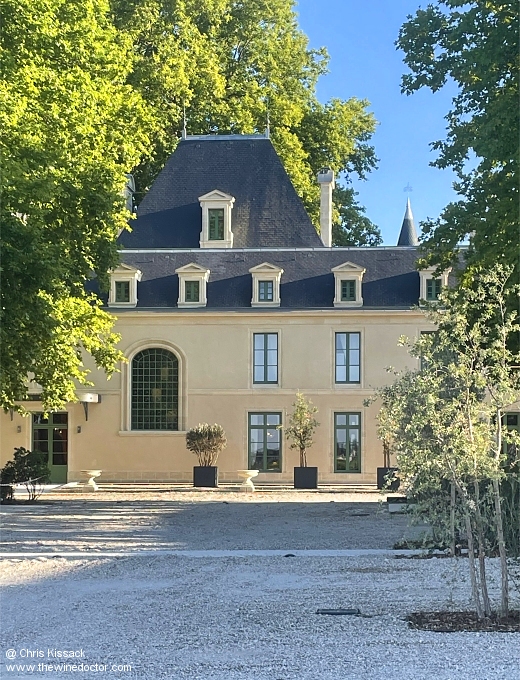
Château Cantemerle: The Modern Era
Of the four sisters who had inherited the estate, Héloïse Laure d’Abbadie (born 1842) married but does not seem to have produced any children. The others also all married but were rather more fecund, making for a suddenly very complex family tree. In short the aforementioned Caroline d’Abbadie (1835 – 1917) married Henri d’Espalungue d’Arros (1815 – 1893), and her share seems to have passed to a daughter, Marie d’Espalungue d’Arros (1859 – 1945). Marie Louise Félicité Armande d’Abbadie (born 1836) married Jacques Antoine Arthur de Lafaye (1830 – 1905) and her share also went to a daughter Marie de Lafaye, of which there were two such offspring, more precisely named Marie Armanda and Marie Charlotte (no, I cannot explain why nearly every new arrival in this extended family was suddenly called Marie), and I confess I have been unable to ascertain with certainty which was the lucky recipient. Finally, the fourth sister was Marie Laurance Julie d’Abbadie (1838 – 1862), and she married Pierre Jacques Félix Alfred de La Faye de Ponteyraud and her part went to one of their offspring, possibly one named Jeanne Marie. Yes, another Marie.
Under the direction of this expanding family of Maries, in the latter years of the 19th century, Château Cantemerle went at first from strength to strength. Alfred Danflou, writing in Les Grands Crus Bordelais (Librairie Goudin, 1867), reported that the trade regarded the wines as “très colorés, très corsés, et qu’ils ont un bouquet fin et prononcé”. The vineyard was expansive, and in the early 1880s there were about 110 hectares of vines planted, on an estate that covered 400 hectares all-told. The 1868 edition of Cocks et Féret put the production as high as 150 to 170 tonneaux per annum. This figure plummeted with the arrival of phylloxera though.
It is also worth noting that during this era the estate’s wines were already divided into first and second wines, an early example of this development on the Médoc. Both the 1883 and 1886 editions of Cocks et Féret indicate that there were 150 tonneaux of the former and 50 tonneaux of the latter. By 1897 the second wine had been christened Château Royal-Médoc, while the first wine remained Villeneuve Château Cantemerle-Médoc.