Home > Vintages and Regions > Bordeaux > Bordeaux 2006

Bordeaux 2006

After great vintages it is too easy for good quality to be overlooked; it has happened with 1982, when the following year saw some regions turn out excellent wines which have largely been disregarded - 1983 Margaux is a particularly fine example. It has also happened with 2000, which was followed by a vintage which produced many very good red wines, especially on the right bank I think. Nevertheless, it seems to me that beyond Sauternes, where the wines were plainly excellent and have quite rightly attracted much attention, the vintage is dismissed purely on the basis that it wasn't another 2000. Naturally, the 2006 vintage was always at risk of this very phenomenon. After a fine vintage in 2005, characterised by top quality fruit and wines which reportedly made themselves, rendering the régisseurs almost redundant, the vines had a lot to live up to. At the beginning of the 2006 growing season the unspoken hope in Bordeaux was, naturally, that the weather of 2005 would return - perhaps with a little rain first, to replenish stocks. Would the Bordelais get lucky again? The early months, through to the end of July, suggested that this might be the case. Or would this be another 1983, another 2001, a good vintage lost in the shadow of its predecessor? Or, more worryingly, would they see a less successful harvest - another 1991, perhaps, a vintage which does indeed deserve to remain in the shadow of 1990? Only the caprice of the Bordeaux climate would decide.

Vintage Review

My review of the 2005 Bordeaux vintage begins by discussing rainfall, which was very low - less than 50% of what was expected - during the 2004/2005 winter and the growing season that followed. As 2005 marched on into 2006, this remained a concern. The winter months were not exceptionally cold, providing some snow and frosty sub-zero temperatures, keeping the vines nicely dormant and killing off vineyard pests, but nothing low enough to worry the vines. Rainfall, however, was a different matter. There was some precipitation, but it was not until early March that the vineyards saw the sort of heavy downpours that might have a chance of replenishing the water table. Budbreak and the first leaves appeared a few weeks later in early April - a late budding - precipitated by further rainfall and warmer temperatures in late March, but with cooler nights keeping the vine in check until April. The process was somewhat protracted and was complicated by frost in the second week of April. Once completed, however, subsequent inspection of the vines suggested that yields would be low this year, firstly as many vines had reduced flowering, most probably as a result of the drought, but also some potential clusters of flowers were lost as a result of this April frost.
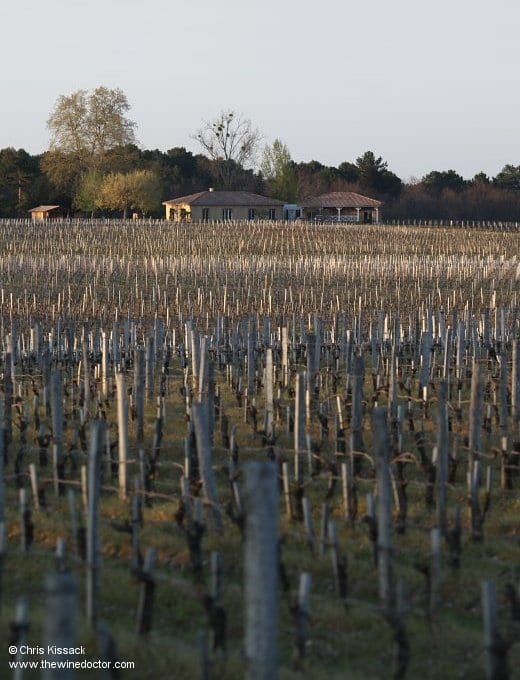
Bordeaux 2006The flowering came in late May and was characterised by some coulure - failure of the fruit to set - which affected the Merlot and white vines most significantly, with a 20% failure rate being another contributor to low yields. The nascent fruit then basked under the hot and dry conditions that followed, with May, June and July all marked by exceptionally warm temperatures, with the latter of these three months being the hottest since 1950. Although the drought was worrisome, the vines remained healthy, the grapes were small and hard still, and there was the promise of another great vintage like 2005. Unusually, however, these hopes were soon cast aside when the high-pressure systems moved away, bringing an unexpectedly cool August. Not just cool, in fact, but cool, damp, grey and drizzly, a complete contrast to the preceding months. And this brought problems. First some rot appeared, especially in vineyards which had not been sprayed - a precaution deemed unnecessary by some in the extreme heat of the summer. Secondly there was a need for leaf-thinning, omitted earlier in the year because foliage was necessary to protect the fruit from the baking sun, and because green harvesting (which usually goes together with leaf-thinning) was unnecessary with the naturally low yields. Picking leaves would improve ventilation and exposure of the fruit to the sun. Thirdly the veraison - the colour change - which began in the heat of late July faltered, leading to uneven ripeness in the fruit when finally harvested. This was no longer another 2005.

September was again hot, and this was the time for bringing in the white fruit, most of which was collected before rain returned mid-way through the month. Quality here was high, the fruit characterised by good acidities thanks to the cool August, but with appropriate sugar levels and thankfully no or little rot. Those harvesting the Merlots were not so fortunate; although by day it was largely dry, there was heavy rainfall in a series of showers, usually at night, and the threat was therefore rot. Some brought in Merlot before it had attained phenolic ripeness, but some estates that favour late harvest stuck it out and still managed to bring in good fruit. The Cabernets, brought in later, had perhaps fared a little better. And in the Sauternes vineyards, which had experienced some botrytis beginning in the last week of September, three or four tries brought in decent but not high quality fruit.

Summing up, 2006 is a story of:

Tasting the Wines

I have already written of the wines which I tasted in April 2007, where I was less than enthused by the red wines, although the efforts of some properties did stand out as having better quality, even if they weren't truly outstanding. One year later, when in Bordeaux for the 2007 primeurs, a number of chateaux were also showing their 2006 vintage. This in itself was unusual; the preceding vintage is not commonly offered for tasting, and the implication is that there is plenty of stock yet to sell through. Although it is impossible for me to compare without tasting the same wines (although is a barrel sample offered during the primeur tastings ever really the same wine as you taste one or two years down the road?) many of my fellow tasters commented on how much easier the wines were to taste and assess at one year of age compared to their first showing during the 2006 vintage primeurs one year previously. The wines had softened and seemed much the better for it. They certainly seemed easier and more approachable to me, but they were a very different cohort of wines; comparing Petit-Village and Langoa-Barton tasted during the primeurs with much more seductive showings from Le Pin and Léoville Las-Cases, tasted a year later, is a certain chalk and cheese situation. I will publish my remaining 2006 tasting notes tomorrow, but to give a more thorough assessment of the vintage, and to judge how the wines have changed in the interim, I will have to wait until the two-year in-bottle UGC tasting in London later this year. (28/5/08)