Home > Producer Profiles > Bordeaux Profiles > Chateau Troplong-Mondot

Chateau Troplong-Mondot

The story of Troplong-Mondot is very much a modern one, a tale of how one generation took the reins and turned a very adequate family business into a highly successful one. And how that success was rewarded with elevation in the 2006 reclassification of St Emilion, from Grand Cru Classé to Premier Grand Cru Classé, before the collapse of said system rendered all the leading estates without any valid ranking at all. Not that that really matters of course; after all, it is the tremendous leaps in the quality of the wines of Troplong-Mondot that really counts, and thousands of happy customers can only be grateful to proprietor Christine Valette for what she has achieved in that respect.

To present a complete tale, however, we must look back to the 18th Century, and in particular to an expanse of land to the east of St Emilion, on a crest named Mondot which reaches an altitude of 100m above sea level. This estate incorporated what are today the Troplong-Mondot and Pavie vineyards, and was owned by the De Sèze family. In 1745 the Abbé de Sèze commanded the construction of a chateau on the estate, before passing it to his brother Raymond's family. By the mid-19th Century the grand De Sèze estate had been dissolved, although it is not clear if this was as a result of the Revolution, or of later events. It appears the family held onto what is now Pavie until the 1840s, but otherwise they no longer play a role in the history of St Emilion. The core of the L'Abbé de Sèze estate, comprising the chateau and some vineyards, was acquired by the Troplong family, first on the scene being Gerus Troplong, before he passed it onto his son Raymond, a local politician, author and lawyer. Raymond consolidated the vineyard, bringing together a number of parcels so that it attained a size of 33 hectares. This chateau and vineyard was the beginning of what we know today as Troplong-Mondot, and it has changed very little since.

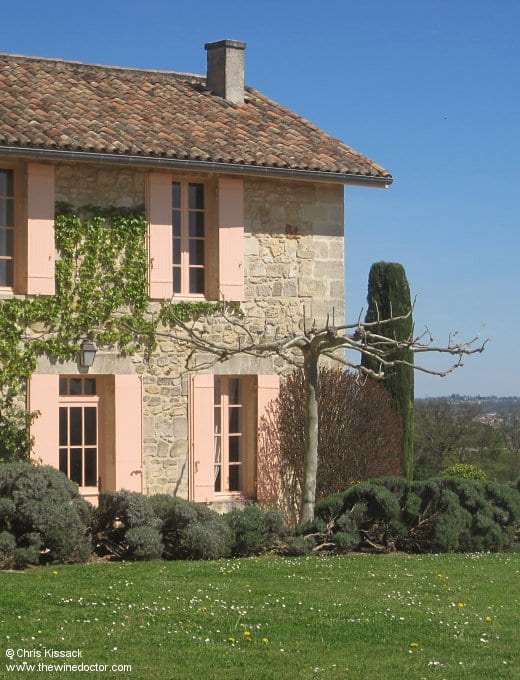
Troplong MondotRaymond died in 1869, bequeathing the estate to his widow, who then passed responsibility onto her nephew Edouard. There was active viticulture, a large output of wine, no doubt helped by the construction of a new chai. At the beginning of the 20th Century the estate was certainly enjoying some considerable success. Nevertheless, Edouard was elderly, and without children. Although it is unclear when he sold up - several published accounts differ - the property was acquired by Madame Lasseverie who, with the help of her sons-in-law Henri Gasqueton and René Dupeyron, was on a Bordeaux buying spree, acquiring property all around the Gironde. Curiously, in 1921, within only a year or two of acquiring the property, she had sold it again, the buyer this time being Georges Thienpont. Today a famous name in the region, Thienpont was then less well known. Belgian by birth, he made his mark a few years later with the acquisition of Vieux-Chateau-Certan in Pomerol, an estate that has remained with his family. Although the proprietor of such a grand estate, it appears his heart really lay at Troplong-Mondot, as this was where he would stay when visiting the region. By 1936, however, probably as a result of the Great War and the economic depression that followed, he had to sell one of his assets. As the St Emilion estate was better known than the one in Pomerol, it was the one to go under the hammer. The buyer was Alexandre Valette, a négociant from St-Ouen near Paris. Although he already owned property in Bordeaux, this was his first vineyard. He subsequently also acquired nearby Pavie, thus bringing together under the same roof two major parts of the original L'Abbé de Sèze estate. This latter property, however, was passed to one grandson Jean-Paul, then onto the next generation Patrick, before the family sold the estate on. Troplong-Mondot, however, remains with the Valette descendents; it came first to Alexandre's other grandson Claude, and then to Claude's daughter Christine and her husband Xavier Pariente, who run the estate today.

The vineyard still stands at 30 hectares at the top of Mondot, the escarpment to the east of St Emilion that affords such magnificent views over the vineyards and the Dordogne. As such it is an impressive estate, three times the size of many of its neighbours and peers, although comparable in size to the closest such neighbour, the illustrious Pavie. The soils are the typical clay over limestone, with patches of flint, and the vines predominantly Merlot which accounts for 90%, with 5% each of the two Cabernets. They have an average age of 35 years, although some have achieved an impressive 90 years. The fruit is naturally hand-harvested, then fermented in temperature-controlled stainless steel, followed by malolactic in oak, where the wine rests for between 12 and 24 months depending on the vintage. The oak is mostly new, accounting for 75% of the barrels, the remaining 25% being one year-old. There is an egg white fining if required, and no filtration. What results is then directed into one of two principal cuvées, the grand vin Troplong-Mondot (typically 10000 cases per annum) and the second wine Mondot (800 cases), a Cabernet-dominated cuvée, which was introduced in 1985.

Since Christine has taken the reins at Troplong-Mondot the wines are reported to have improved immeasurably. Although he comes in for much criticism from many corners, it seems likely that the involvement of Michel Rolland was an important factor in this change. Under his direction, the harvest was collected later, ensuring greater fruit ripeness, and harvesting by machine was brought to a halt, replaced entirely by the hand. Yields were more firmly controlled, with pruning changed to Double Guyot in line with much of Bordeaux and a strict green harvest, bringing the harvest down to less than 50 hl/ha. There was greater rigour in sorting the fruit, new equipment was installed in the chai, and the quantity of new oak was increased. The results were tangible, and it was during the 1980s that the wines showed a significant improvement. By the 1990s they were clearly top class, a good buy in many vintages even those with lesser reputations, and it is perhaps no wonder that the property was elevated to Premier Grand Cru Classé in 2006, a judgement that was made on the vintages from 1993 to 2002.

My tastings of Troplong-Mondot only involve the more recent vintages, and so they have given a lot of pleasure. The 2004 will always stick in my mind. Encountered at the UGC tasting of that vintage after bottling, when the wines were barely two years old, the Troplong-Mondot was the first wine - after tasting many dozens of others which ranged from fair to very good - that actually gave unbridled pleasure, a wine that actually made you sit up and take notice. Although I think the right bank appellations fared quite well in 2004 anyway, Troplong-Mondot must surely be one of the great successes - it was certainly the best wine there on that October day in 2006. Other vintages do not disappoint, whether the year in question be the worrisome 2002 or the sun-baked 2003. These are excellent wines which, in some cases, I have been happy to add to my cellar. (24/10/07)

Contact details:
Address: 33330 St Emilion
Telephone: +33 (0) 5 57 55 32 05
Fax +33 (0) 5 57 55 32 07
Internet: www.chateau-troplong-mondot.com

Chateau Troplong-Mondot - Tasting Notes

Click to locate stockists.

2007

Chateau Troplong-Mondot (St Emilion) 2007: A vibrant freshness of fruit on the nose at first, revealing nuances of aromatic cherry and also a little liquorice. The palate has a pure and rather rich style, with a lot of spicy and peppery fruit, with a rather an exotic edge to it all. There is a very firm structure apparent, in what is a firm and classically fashioned wine. Nice acidity too. This is potentially very good indeed. From my 2007 Bordeaux en primeur assessment. 15.5-16.5+/20 (April 2008)

2004

Chateau Troplong-Mondot (St Emilion) 2004: A lovely nose here; very ripe, plummy, Dundee cake character. This is very expressive, and it just oozes quality. Gorgeously extracted and composed palate, with a fine texture, unobtrusive, velvety-peppery tannins in a perfectly balanced frame. So complete and delineated. Really divine; certainly the wine of the tasting for me. Excellent. From my 2004 Bordeaux assessment. 18.5+/20 (October 2006)

2003

Chateau Troplong-Mondot (St Emilion) 2003: A nice, lifted, elegant black fruit nose. Similar elegance on the palate, which has a nicely rounded texture, and it has sufficient substance to cover the firm, grippy tannins that lie beneath. Lovely although quite masculine style. Very good. From my Bordeaux 2003 assessment. 16.5+/20 (October 2005)

2002

Chateau Troplong-Mondot (St Emilion) 2002: A moderate depth of colour, just showing some early fading. Quite expressive on the nose, certainly showing a little mature aroma, with vanilla pod character. Quite stylish palate, creamy and rounded, with some charcoal-edged, rather harsh tannins appearing in the midpalate. A full texture. Feels slightly forced, but nevertheless with integration I expect it will be very good. 17/20 (June 2006)

1995

Chateau Troplong-Mondot (St Emilion) 1995: A deep, glossy hue. Full, ripe, smoky berry fruit. Ripe, creamy, sweet palate. Lovely fruit, but still showing some awkward youth, with the wood still quite evident and rather obvious alcohol. It has good potential though. Drink three to four years from now. 15.5+/20 (January 2005)

1994

Chateau Troplong-Mondot (St Emilion) 2004: The wine has a very darkly coloured core, having a red-black hue which extends almost all the way out to the rim, which still has a deep colour. The nose is at first reserved and claretty, with notes of violets and iron, in a rather pure, dusty-powdery style. There is a very good weight on the palate, the wine showing a gentle fleshiness and substance behind a layer of floral flavour. Underneath it all, a slightly harsh, bitter structure, a firm tannic grip and forthright acidity. But there is substance to balance it out, and a good, savoury character. There isn't a lot of length at the finish, but there is plenty of grip. It isn't a blockbuster, but the composition is good and it is certainly approachable now, especially with roast lamb (or similar), but it will also improve over the next five to ten years I think. I certainly do not think I will have any trouble drinking my other bottles. For label images and more see my Wine of the Week write-up. 17+/20 (November 2007)

Home - Site index - Site updated May 15, 2008 - © The Winedoctor 2000 - 2008 - Wine Scores - RSS