Home > Vintages and Regions > Ten & Twenty Years On > Twenty Years On: 1989

Twenty Years On: The 1989 Vintage

Last year's Twenty Years On tasting, featuring the 1988 vintage, was a very subtle affair, to put it kindly. A mere handful of wines that were celebrating their 20th birthday, representing the Loire, Bordeaux (in the shape of Sauternes), Châteauneuf du Pape and the Mosel. In the grand scheme of wine tastings, and even just those tastings I feature here on Winedoctor, it was an insignificant event. Nevertheless, for me it was an important primer, a line-up indicative of a progressively maturing cellar, and a doorway onto future tastings of increasingly mature wines. From now onwards (or rather, from last year onwards), my Twenty Years On tastings - previously rather sporadic - will be a regular feature on Winedoctor. And these events will be important for me; looking at wines in maturity is an essential practise if we are to understand wines in their youth, which is of course the time when we most commonly taste and judge them, judgements which we must use to project a future for the wine, predicting its potential for the cellar.

1989 horizontal tasting, twenty years onAll of the wines featured in this tasting originate from the classic viticultural regions of Europe - sadly my cellar is very weak when it comes to twenty year-old wines from the New World - and for some of these regions 1989 was the second year in a triumvirate of successful vintages. That is certainly true of Champagne, and coincidentally a tasting of 1989 vintage Champagne was one of the earliest tastings posted on Winedoctor, back in June 2000. Sandwiched between the fabulous 1988 and 1990 vintages, many commentators on the region would place 1989 slightly behind its two neighbours in terms of quality, although that is no real criticism. Both 1988 and 1990 qualify for entry into the pantheon of great 20th century vintages, whereas 1989, a very warm vintage which saw the Champagne vines ripen their grapes with ease, is 'merely' excellent.

The Loire also saw an excellent harvest, but whereas in Champagne it was an admittedly superb but not supreme year, here in the Loire it was certainly one of the greatest vintages of the 20th century. When I last visited Pierre Jacques Druet, just last year, we discussed the 2005 vintage, a great year in the Loire, and Druet threw out only a few years worthy of comparison. He chose just a trio of Loire vintages, these three being 1921, 1945 and 1989. This latter vintage is clearly a great year for the Loire. Of course, we must not forget what a huge and diverse region the Loire is, and how we relate such generic judgements to regions such as the Nantais, the source of one of the wines here, is open to debate. Further upstream, however, in Vouvray, things are more certain. This region enjoyed a very warm and dry summer, with an early flowering and a safe harvest, the fruit brought in under clear, cloud-free skies. There was the full range of wines produced, from dry through to lusciously sweet, and at Domaine Huet the vintage was notable for the appearance of a new wine, Cuvée Constance, named in honour of Gaston Huet's mother.

Elsewhere in France, Bordeaux also saw a great vintage, one that I have already summarised on this site, and yet again it was another early addition to Winedoctor, as I featured a tasting of 1989 Bordeaux in May 2000. A remarkable growing season saw more sunshine, higher temperatures and less rainfall than there had ever been here, with the exception of 1961. As with the Loire the harvest was early and the fruit in good condition. Some growers were accused of picking too early, struggling to match physiological and sugar-alcohol ripeness in the fruit, but those who displayed appropriate patience brought in fruit of exceedingly high quality, full of sugar, tannin and - most importantly - potential. In Sauternes there were also some very broad smiles, as here the fine combination of botrytis and high levels of sweetness resulted in some very good cuvées. A few wines might be overly fat and rich, but the best are brilliant.

Elsewhere in Europe, we have excellent efforts from Rioja - admittedly from two brilliant producers - and also from Germany. But perhaps it would be best simply to move onto the tasting notes, and let all the wines speak for themselves. (24/11/09)

The 1989 Vintage - Tasting Notes

Tasted in November 2009. Click to locate stockists.

Champagne

Roederer Brut 1989: This wine, now fully mature, has a rich and warm golden-bronze hue. There is a fine bead still, and the wine certainly has plenty of life left in it as far as the fizz is concerned. The first element apparent on the nose though is a trace of oxidation which is undeniable, although fortunately with time in the glass it becomes less problematic, and other aromas take the front seat; mushroom, toffee, Brazil nut and praline. The palate is rich, evolved, creamy and yet in possession of a crisp mousse which gives the wine a lovely definition on the palate. It has a fine precision, although it is open and warm in style. It all culminates in a dry, lingering finish. Overall this is lovely stuff. One bottle left - but if this one is typical the last two were better, and it is time to drink up! 18.5/20

Loire

Louis Métaireau Muscadet Sèvre et Maine sur lie Premier Jour 1989: An amazingly pale hue, looking fresh as a daisy; having experienced a number of mature Muscadet cuvées before, including some older than this, I have to admit I was expecting something deeper in colour, richer and more evolved. This looks as though it might have been bottled just yesterday. The nose has some honeyed elements that suggest a certain evolution, with a complex white pepper and dry quince edge. The palate starts off honeyed, but then quickly reveals its dry character in the early midpalate, albeit nuanced with elements of toasted seeds, lightly candied orange peel, vanilla and toasted bread. There is a pervading, really quite sour acidity which has a pervasive presence from the midpalate onwards, and it is this that really spoils this wine for me today. The texture is lightly honeyed, with mineral-steel-lemon components at the edge of it all, but this is overshadowed by a powerfully acidic finish. Nevertheless, this is certainly a remarkable wine, still so fresh despite having twenty years under its belt. But does it give real pleasure? Not really, not with that painfully disjointed acidity. And does it have the potential to continue, with the eventual promise of complexity and richness, like that offered by Luneau-Papin's 1982 L d'Or tasted earlier this year? I suspect not, my concern being that power-house of acid that sits at the core of the wine. It might be argued that this offers protection to the wine, but I am concerned that it will just become more and more prominent with time, as the wine ages. If that is so, then this will never be anything more than a fascinating, albeit sour, curiosity. For label images and more see my Wine of the Week write-up. 14+?/20

Poniatowski Vouvray Aigle Blanc 1989: From a half bottle. A soft and buttery cork, but it came out in one clean piece. The nose shows plenty of good, minerally character, with straw-covered fruit and also a rich, funky element which has a more musty, cheesy style than I noticed last time. Fortunately with a little air it shows more of the cheese than the must, although I suspect some would still find it very off-putting. The palate carries some sweetness, from the residual sugar, giving it a rich character with good acidity to counterbalance the flesh and cheesy fruit. Nice wine, packed with broad character and vibrant spicy, stony, rock-dusty minerality. A touch bitter and grippy on the finish, but at least it has some backbone. 17+/20

Poniatowski Vouvray Aigle Blanc Vin de Tris 1989: From a half bottle. Rather a minerally and papery nose, with a dense and really quite aromatic character, although there is a big wet-wool element to it, which gives a somewhat unclean note, and that comes through on the palate too. There is neither great precision here, nor great intensity or interesting flavour. What it does have is an attractive, marmaladey, toffee and Demerara sugar sweetness, and a little honeyed apple too, although it is not as concentrated or rich as these characteristics might suggest; what sweetness it has is countered by a slightly dilute mouthfeel and that papery, woolly minerality. A slightly plump, soft and certainly very drinkable wine though. 16.5/20

Poniatowski Vouvray Clos Baudoin 1989: From a half bottle. A great nose at first, all chalk and minerals and gunpowder and flint. The palate is fleshy and also carries that flinty, gun-powdery element to it. It has a gently sweet feel, although it is broad, fairly well defined and it certainly has character. There are golden honey-tinged fruits with a purity that appeals, but also the trademark Chenin bitterness which pervades the midpalate and finish and does detract a little. It also seems just a little out of focus at times, soft and disconnected, but this is countered by its softly sweet nature. Nevertheless, this is certainly a very drinkable wine. 17/20

Poniatowski Vouvray Clos Baudoin Moelleux 1989: A fine golden hue here. The nose has a delightful combination of wool and honey, mineral and stone. The palate opens with a very welcoming fleshy sweetness, backed up by a gritty substance. There is depth to this wine as well as superficial flattery. Nuances of stones, powdery mineral, honey and sweet fruit follow, but all the time there is freshness, definition and acidity. This is my favourite of all the Poniatowski wines, purchased a few years ago when I (and many others) took advantage of the selling off of many wines from the cellars when the domaine changed hands, moving from the ownership of the Polish royal family to François Chidaine. Nice wine. 17.5+/20

1989 horizontal tasting, twenty years on

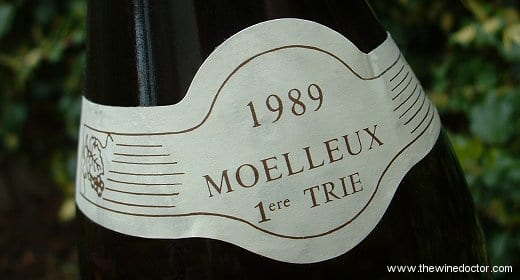
Domaine Huet Vouvray Clos du Bourg Moelleux Première Trie 1989: Great colour, a rich slightly bronzed, golden hue. The nose is maturing and complex, with aromas of mint, herbal tea, dense and honeyed crystalline fruit, smoke, straw, honeycomb and more. It suggests minerality too. The palate has a broad texture, mature and drying out somewhat compared to the intense sweetness of a young première trie, but still showing plenty of rounded, gritty fruit and weight. This is fine, rather weighty, with great depth and multiple layers of sweet, crystalline but also rich and stewed fruit, ginger cake and spice, with tinges of cooked oranges and caramel. A fabulous wine, rich and textured, and very, very long. And I think this still has more to give, even though I suspect it will slowly dry out somewhat with the passing years. 18.5+/20

Bordeaux

Chateau Haut-Bages-Libéral (Pauillac) 1989: It's always fascinating to see the procession of aromas that come from a mature wine, and in this respect the Haut-Bages-Libéral doesn't disappoint. It kicks off with a little note of rotting meat at first, but so many wines do show elements of bottle stink after nearly twenty years under a cork. And even at this point, there are notes of perfumed fruit, and indeed the wine really opens out over an hour or so, revealing rather classic elements of violets and rusty metal, with notes of damp coffee grounds. It is perhaps three hours of so after first opening that it hits its apogee, impressive for a wine of this age I think. The palate has a lovely substance to it; there is still a really delightful backbone of dry tannins, supporting a gentle flesh of fruit, and nicely balanced out by fresh acidity. It has elegance, a sappy, mature fruit finish, and a little length. It hasn't the firm definition of a great wine - the structure is doing well to keep a rounded, showy midpalate in check I think - but it is certainly very good drinking. For that, and for those moments of perfumed delight, it deserves a good score. I look forward to my last bottle - without rushing - as this wine has held up well. 17.5/20

Chateau Chasse-Spleen (Moulis) 1989: Typically mature hue. Perfumed violets, then rust, roast meat and iron, overall a very classic claret profile. A touch organic, perhaps farmyardy, and a hint of cabbagey brie too, so certainly some very evolved, tertiary aromas here. A nice entry, supple, but it seems to lack some substance on the midpalate. There are nuances of flesh and flavour, but it never seems to fully round out on the palate, although it has a nice mature character, very evolved as the nose suggests. It still has a good tannic backbone, showing a slightly rustic firmness here. This doesn't seem as praiseworthy as my last two bottles, which were both very good. An intriguing wine, still with some substance, but some unusual characters too. Nevertheless, certainly an interesting bottle. 16-16.5+/20

Chateau Meyney (St Estèphe) 1989: Quite a dark, mahogany-red colour in the glass for this wine, and so plainly more mature - in appearance at least - than the Chasse-Spleen. The nose is rather muted at first, without the early bright perfume of the preceding wine, but it soon gets going with a fine, mature, meaty nose, very much a robustly ageing claret. This is nuanced with elements of tea leaves, sweet decay, undergrowth and a soft, green, vegetal note. It might not sound very appealing, but the aromas are really quite captivating. The palate is where it has the edge though, as although it might not have the delicate finesse of some other wines it has a nicely polished, ample texture, soft and gently plump from start to finish. It shows perhaps a little less drily than my previous bottle. There is a more rustic side to the finish, where there is a little wave of stout tannin which rolls out on the palate, with a little peppery spice too, but this is certainly nothing to complain about. Very good wine. 17.5/20

Chateau Coutet (Barsac) 1989: A rich, burnished, orange-gold hue. The nose is delightful, classically rich botrytis, with a medley of aromas including oranges, sweet marmalade, toffee and a little high-toned complexity. Quince, overt rôti fruit, fabulous style. On the palate beautiful purity, richness and elegance. Rounded, polished, seamless and complete, very smoky in character, and showing more grip and intensity on the finish. Good but not overt acidity; this is really nicely balanced. Sweet, tangerine fruit length, that goes on and on. Excellent wine. What remained of this I enjoyed over several days, and it held up very well indeed. There's no rush to drink up here, and I am glad of that; I have quite a few bottles left in the cellar yet. 18.5/20

Rioja

La Rioja Alta Rioja Gran Reserva 904 1989: A very mature and paling hue in the glass, orange-tawny at the rim, darker at the core. The nose is fine and also very mature, with sweet roasted meats, iron and rust, peppered and stewed berries. A very faint touch of volatility present at the beginning disappears within minutes. The palate is sweet and rich but balanced, and whereas the nose is quiet at first, building with a little time in the glass, the palate is impressive from the very beginning, unfolding on the finish, and displaying layers of flavour. Softly textured, with fully integrated tannins showing just a little chalkiness at the core, this has a wonderfully composed texture. Good slightly grippy finish, bitter-sweet, and with a fine length. Great wine, and sadly my last bottle of this. 18.5/20

Marqués de Murrieta Rioja Castillo Ygay Gran Reserva Especial 1989: Is it really eight years since I last had a glass of this? In terms of colour, and aroma, this slowly maturing wine hardly seems to have moved in that time period. The nose has a mildly volatile polished edge, with sweetly roasted meats, and macerated fruit, all presented in a very firm, composed fashion; almost exactly what I wrote back in 2001. The fruit perhaps has a darker, more roasted character than I recall. The palate is rich, balanced, well composed and harmonious, with a balsamic edge to the fruit. The texture is fabulous, the acidity fresh, and the extract ripe and mouthfilling. It finishes with a delicious, mouth-wateringly sour cherry character which lingers on and on. Delicious wine, remarkably still with bags of potential for the cellar. I do believe I have one bottle left...and I am happy to have recently stocked up with the 1998 and 2001 vintages for the future. 18.5+/20

Germany

Reichsgraf von Kesselstatt Oberemmeler Karlsberg Riesling Auslese Goldkapsel 1989: Does this wine seem a slightly richer colour than last time? Perhaps. The nose has certainly developed a little over the last three years, as although it still shows a steely lime quality, there is a rich, caramel-tinged overtone now, like that which I once found only on the palate. Together these aromas give an unusual lime-citrus toffee character which is certainly intriguing. The palate is rich but bright and fresh, quite broad, soft and creamy but well defined, almost linear through the midpalate. And the flavours are as lovely as those on the nose, with notes of apple-mint, minerals, lime and honey. Great length, just going on and on. Delicious and still overtly sweet, so yet more time for this in the cellar I think, and it should only get better. 18.5+/20 AP number: 3 561 077 103 90