
Bollinger Vieilles Vignes Françaises 1999
Having just returned from my trip to Bollinger on Saturday morning on the sleeper service (or should that be ‘non-sleeper’ service? – I never sleep that well on it), I spent the rest of Saturday recuperating, including catching up on my sleep on Saturday afternoon (an event almost unheard of for me). So wine hasn’t really been a huge part of my weekend, at least not until Sunday dinner when I opened a bottle of 1999 Beaucastel. So which wine to write about then? Well there is one obvious choice, this particular cuvée from Bollinger, which I shared with some colleagues and friends over lunch on Friday.
I hadn’t been expecting to taste Vieilles Vignes Françaises during my two days in Champagne, after all this micro-cuvée is both extraordinarily rare and ultra-expensive. Just a few thousand bottles are produced and that is only in the best vintages, in lesser years the fruit goes into the other Bollinger wines, and so even an important export market such as the UK will see an allocation of only a handful of cases. The price tag naturally reflects this rarity, exclusivity and high quality.
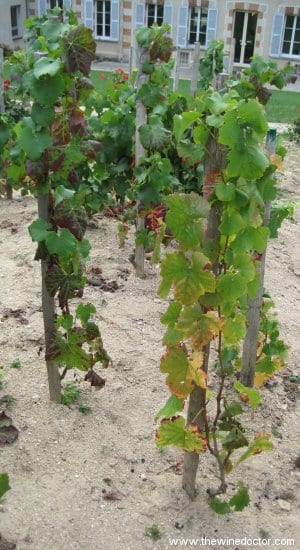
The vineyards for Vieilles Vignes Françaises are fascinating. There were once three, these being Clos St-Jacques and Clos des Chaudes Terres (the latter pictured, left) both in Aÿ, and Croix Rouge in Bouzy. The three were unified by their ungrafted status, each one seemingly resistant to the phylloxera louse which devastated all the surrounding vineyards many decades ago. Until 2007, that is, when for some unknown reason Croix Rouge suddenly succumbed, leaving just the two vineyards in Aÿ, which sit behind and in front of the Bollinger headquarters. Some ascribe the vineyards’ resilience and ultimate survival to the surrounding walls, but I am not convinced this is an adequate barrier. Standing in the vineyard another explanation becomes apparent; the soils here are remarkably sandy (as can be seen above), and the louse’s disinclination to infect vines rooted in sand is well described.
Another feature of the two surviving vineyards, which are planted purely with Pinot Noir, is that many of the vines (specifically, all in Chaudes Terres, perhaps half in St-Jacques) are trained using the traditional en foule technique. Rather than being planted in rows and trained horizontally along wires, the norm for Champagne and any other wine region, the individual vines are trained vertically up stakes, as shown above. Working on their own roots the vines put out new canes from beneath the soil, and so during the growing season new growth can sometimes be seen breaking forth some distance away from the original vine. When this happens the fresh growth is trained up a new stake, replacing the old cane, and as all the vines are doing this the whole vineyard slowly marches uphill over the years, necessitating the establishment of new vines at the bottom of the slope. Once harvested the fruit is pressed at Bollinger’s facility at nearby Mareuil-sur-Aÿ, today using a traditional but beautifully refurbished basket press.
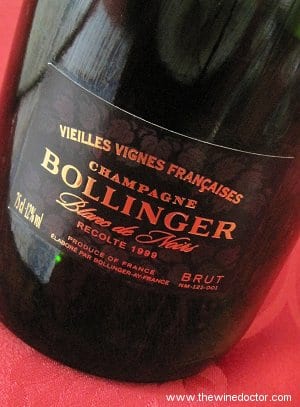
And so to the wine, in this case the 1999 vintage of Bollinger Vieilles Vignes Françaises. Served blind this wine showed a rich but well-judged, pale golden hue in the glass, and a captivating nose that immediately suggested this was a pure Pinot Noir cuvée, with the meaty-biscuity richness of that variety presented in an intense, evocative, very linear and defined fashion. There is concentration here, but also freshness and great style; we’re at Bollinger, so the only wine that would fit this description is of course the Vieilles Vignes cuvée from the old ungrafted vines described above. The palate is divine – although I could easily be accused of being less objective now the identity of the wine is clear. It has a great paradox of concentrated, honeyed fruit set against a fine and rather light mousse and overall an elegance, a finesse, which is unparalleled. Broad, substantial but never unbalanced or ponderous, all culminating in a considerable finish, this wine’s reputation is surely well deserved based on this particular example. I don’t have any knowledge of other vintages of Vieilles Vignes Françaises in order to place this wine within a tighter context, but placed against a backdrop of other Champagnes this wine is superb, and a must-taste experience for fans of the region, especially those that prefer Pinot-based cuvées. Quite simply, a wonderful wine. 19+/20
This wine is rare, nevertheless clicking through on the Wine Searcher links below reveals that it is not difficult to find a bottle, perhaps reflecting the price tag; it is this latter point that will, I suspect, deter most readers from making a purchase. (21/9/09)
Find Bollinger Vieilles Vignes Françaises 1999 on Wine Searcher: 
Find all Bollinger wines on Wine Searcher: