
Bordeaux Fives, 2025: 1845 – 2015
For several years now I have published, at some point near the closing of the year, a look back at older vintages – mostly but not exclusively Bordeaux – on a numerical theme. Last year my Bordeaux Fours report was built around a theme of old wine and old photographs. This year I continue the theme, but matching the dates of the photographs and wines in a more exact fashion.
Having said that, the oldest wine included here dates to 1845, a time when the USA had only 26 states (although it would soon rise, with the admission of Florida to the Union, and the annexation of Texas), Ireland’s potato blight opened the door to seven years of famine in An Gorta Mór, and Isambard Kingdom Brunel’s steamship Great Britain was the first ever screw-propelled ship to make a Transatlantic crossing.
In other words, different times.
I even heard a rumour that there were no smartphones in 1845. Surely, no smartphones means no photographs?
As it turns out, I should have had more faith! Apparently, photography existed before the invention of the iPhone. Who knew!?
So, join me on a not-entirely-serious canter though a smorgasbord of wines from vintages ending in ‘5’ which, after 1845, takes in every eligible vintage of the 20th century from 1915 to 1995, plus a wine or two from 2005 and 2015.
1845
My 1845 image comes courtesy of Louis Daguerre (1787 – 1851), one of the founding fathers of photography. His pioneering system – which would be known as the daguerreotype – involved first plating a copper sheet with silver, then wafting it with iodine vapour, and after the exposure fixing it with mercury (everybody’s favourite neurotoxin) and a hot salty bath (for the plate, not for the photographer).
It was clearly a lot more complicated (and more risky to your health) than simply whipping out your iPhone.
Nevertheless two fellow scientists, Hippolyte Fizeau and Léon Foucault (no relation to the Foucaults at Clos Rougeard, as far as I know), were able to put the method to use in 1845 to capture the first ever image of the sun (pictured below – don’t stare at it for too long). Happily Daguerre lived long enough to see his invention employed in this scientific endeavour. Although he died just six years later, in 1851, probably of mercury poisoning.
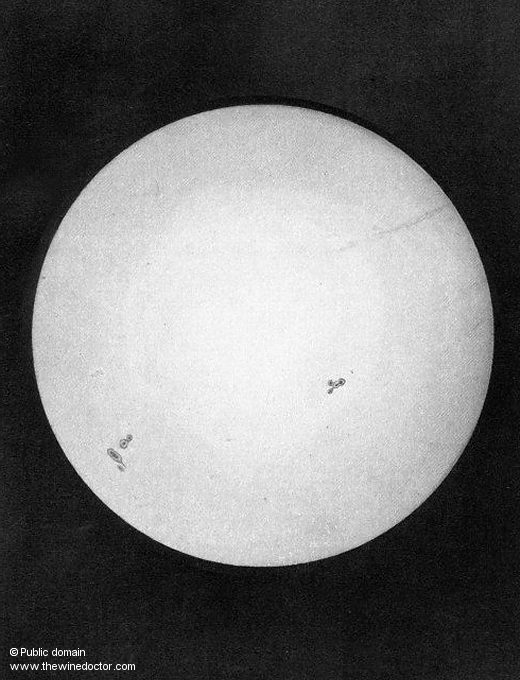
Legend has it that Fizeau and Foucault returned to their residence in celebratory mood, and spent the evening quaffing aged Madeira.
Well, not really, I made that last bit up. Fizeau probably spent the evening designing his spinning wheel experiment to determine the speed of light (a stunning achievement which he completed in 1849). Whereas Foucault spent the evening wishing he had grandsons with a vineyard in Saumur-Champigny.
But, if they had popped a few Portuguese corks to celebrate, I hope the wine was as intriguing as the two – yes, two – bottles of 1845 Bual Solera from Cossart Gordon that showed up at Olivier Bernard’s dinner in April this year. One wore a label with red text, the more commonly seen, while the other wore a more modern label with black text, with a stencil-painted label on the reverse side. The former is pictured below (sandwiched between a 1935 Niepoort Colheita Port and the other 1845 Bual).
Please log in to continue reading: