Home > Vintages and Regions > Loire > Vins Clairs at Langlois-Chateau

Vins Clairs at Langlois-Chateau

Langlois-Chateau

This update relates to wines tasted in February 2010.

For more on this estate, including all my relevant tasting notes, see my Langlois-Chateau profile.

As the taxi lurched around yet another rond-point I wiped away a little condensation from the inner surface of the window to my right and stared through my little porthole. I know the roads quite well around Saumur, and fairly well around Angers, but right now I had no idea where I was. I knew we were currently en route from the first of these two towns to the second, but in the dark of the night, and with the late hour weighing heavy on my eyes, I had switched off and thus lost track of our position. Visible through my little grey-framed circle was an inky darkness, punctuated with the occasional light in the distance, in each case the orange hue reflected in the lightly rippled waters of the Loire beneath. So we were travelling along the left bank, heading west. But beyond that I was lost.

My two back-seat travelling companions were, however, most certainly not lost, and upon realising that the taxi driver whisking us back to our hotel was taking a rather circuitous route so that he could drop off his friend in the front seat before us - and charge a higher fare in the process of course - they began to object loudly. It was not long before a fairly heated spat developed; I suspect the driver had not expected two of these three weary Brits to be firstly, fluent in French arguing, and secondly, ready to put up a fight. Unfortunately the proffered resistance did not have a positive effect; and as the squabble ensued the driving style deteriorated, degenerating into a sequence of sharp cornering, hard acceleration and even harder braking. The British contingent saw sense and declared a self-imposed cessation of hostilities; a stony silence ensued, punctuated only by the occasional subdued muttering of expletives.

How did I get here again?

The answer to that question is simple. Only last year I visited Bollinger, the famous Champagne house now managed (and revitalised it seems) by Jérôme Philipon and Stephen Leroux. And Bollinger, as it happens, owns Langlois-Chateau. And Bollinger PR queen and all-round good egg Elizabeth Ferguson knows of my attendance at the Salon des Vins de Loire. And so, having finished a full day of tasting at the 2010 Salon in Angers I was invited - along with a handful of other UK journalists and a coach-load of German sommeliers - to come and taste the 2009 vins clairs (which, in case you are wondering, are the still wines that go into bottle for a second fermentation, ready to be transmogrified into sparkling wine) at Langlois-Chateau's headquarters in Saumur. That is where I had spent my evening, and this was the journey home. More on that later; I should first focus on my visit to Langlois-Chateau.
A Tour of Langlois-Chateau

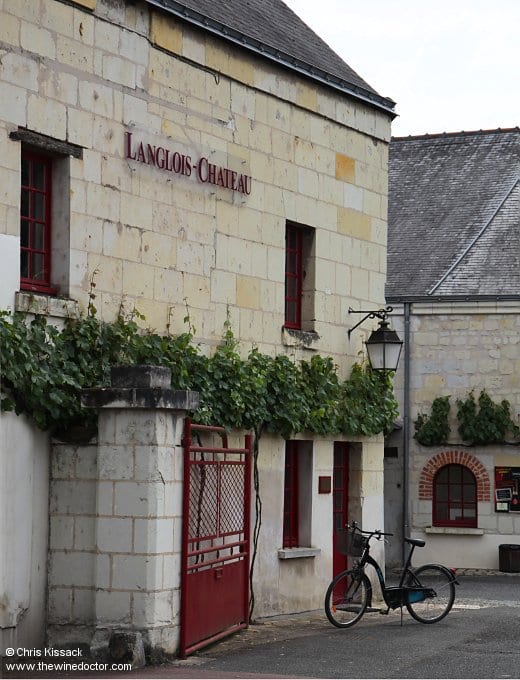
Langlois-ChateauUpon our arrival at Langlois-Chateau we were greeted by director François-Régis de Fougeroux (right) and started the evening with a walk around the Langlois-Chateau facilities in Saint-Hilaire-Saint-Florent. This small town, where many of the major sparkling wine houses are based, lies just downstream of Saumur, and is in fact now essentially a suburb of its more widely-known neighbour. Many of these famous houses are situated along the riverside, and opportunities for expansion are rare; thus when Ackerman decided they wanted to sell their property just next-door to Langlois-Chateau in 2006 it was quite rightly quickly snapped up, bankrolled by Bollinger of course. We toured the extra facilities now enjoyed by Langlois-Chateau, which are on multiple levels - in fact I became quite disorientated as we climbed and then descended one staircase after another - allowing Langlois-Chateau to carry out stainless-steel primary fermentations on the upper level, before delivering the wine by gravity feed to the lower levels for the next steps, such as blending and bottling for the second fermentation.

When it comes to making the sparkling wine, Fougeroux explained that Langlois-Chateau buys only grapes, never juice or must, sourcing Chenin Blanc, Chardonnay and Cabernet Franc from six principle terroirs for blending into their sparkling wines; these wines were of course the focus of our visit, even though there are also very respectable still cuvées produced here, as was proven by several vintages served during dinner. Coming back to the sparkling wines for the moment, each grower's fruit is handled separately on that upper level, making use of a broad array of 120-hectolitre tanks, processing the fermentations on a plot by plot basis. Next, we moved down into the cellars, long tunnels carved from the tuffeau extending out underneath the road, a blend of the manmade and also some naturally occurring caverns and spaces. Here we met the 2009 vins clairs, seven embryonic wines ready for blending, plus also the finished blend itself (prior to second fermentation). The 2009 vintage was a dream it seems, a long run of warm weather, although there was a point when the heat blocked the maturation of the fruit, only for it to be kick-started again by some September rain. The white varieties were brought in from mid-September, starting with the Chardonnay on September 15th, then following on with the Cabernet Franc two weeks later. It was an instructive tasting, and I found these neonatal wines easier to taste than I expected, an effect of the generous climate during the 2009 vintage I expect.

Langlois-Chateau: Not Just Fizz

Langlois-ChateauOver dinner there came an opportunity to taste some of the still domaine wines from Langlois-Chateau, wines which I must confess I have perhaps never given due attention before now, always favouring those from smaller, family-run domaines, as much to do with the story behind the wine as the quality to be found within the glass. But perhaps that attitude is not so wise; these wines, admittedly featuring some excellent vintages, were highly admirable efforts. Having kicked off with the 2002 Quadrille as an apero we quickly moved onto the white Saumur Vieilles Vignes, a cuvée produced since the 1990 vintage; we tasted the 2004 and then the 1999, two wines comparable in terms of style and quality. In each case the fruit is sourced from a 5-hectare plot in Saint-Florent, the fermentation in 225-litre barrels, 20% new, with no malolactic fermentation. Especially considering the ages of these wines, this pair showed extremely well, as did the next two, both red. The Saumur-Champigny Vieilles Vignes is sourced from the old Chateau du Varrains, and there are four plots contributing to the blend, together totalling 5 hectares. These are Le Clos Chapin à Varrains (3.5 hectares), La Mort aux Oiseaux à Varrains (0.2 hectares), Les Poyeux à Varrains (0.8 hectares) and Le Clos Breton à Chacé (0.5 hectares). The fruit is 100% destemmed and sees a short cold maceration before a temperature-controlled fermentation in small tanks ranging from 30 to 60 hectolitres, followed by 8-12 months in 500-litre barrels of which 30% are new. We tasted the 2003 and then the 1996, both superlative vintages, and both impressive wines.

Over dinner I learnt that Langlois-Chateau have been trialling biodynamics on some of their vines, the estate long having been organic, a switch made after five years of tests. In particular they have planted flowers to increase biodiversity, a goal not achieved simply by planting cover crops or vegetables says Fougeroux. The impact of these interventions can be assessed by collecting and counting the insect species found in the vineyard we were told; so far the results are encouraging, it seems. These innovations in the vineyard were matched by another innovation served at the end of dinner; we finished up with the 2007 Coteaux de Saumur, a brand new venture for Langlois-Chateau. I don't think I have ever discovered a Coteaux de Saumur destined for greatness, it just isn't that sort of appellation, but this one at least put on a good show. But it was the dry white and red wines that really stole the limelight this evening, wines to which I will have to devote more attention in future.

And I suppose I should also devote more attention to where I am when sitting in the backseat of a taxi. That way, once I too become fluent in French arguing, I can kick up a fuss with the best of them. Bring it on! (8/6/10)

Vins Clairs at Langlois-Chateau - Tasting Notes

These wines were tasted at Langlois-Chateau in February 2010. All my notes on the wines of Langlois-Chateau, including those below, are collated under my Langlois-Chateau profile. Click to locate stockists.

Vins Clairs

These vins clairs will not come to market in this form, so I have not awarded scores or links to Cellar Tracker. There are eight notes, first the seven major components, with the finished blend bringing up the rear in eighth place.

Langlois-Chateau Vin Clair Puy Notre Dame Chenin Blanc 2009: A limestone terroir. The nose here has a smoky, flinty character, showing a little citrus fruit although the predominant characteristic is one of chalky minerality. Clean and fresh, with a slightly sappy texture, this has a rather stern but certainly very typical style for Saumur.

Langlois-Chateau Vin Clair Coteaux de St Léger Chenin Blanc 2009: A limestone terroir. This seems rather more expressive that the Puy Notre Dame vin clair, with more overt minerality and a fatter sensation on the nose. Slightly softer on the palate though, still a firm base to it though, and some appealing citrus tones too.

Langlois-Chateau Vin Clair Côtes de Saumur Chenin Blanc 2009: A sand-limestone terroir. Smoky and rather peachy on the nose, with a trace of honeyed citrus fruits. A good weight to it, a touch fat in fact, textured with lots of grip underneath it all. This certainly has some potential and character.

Langlois-Chateau Vin Clair Montreuil-Balley Chenin Blanc 2009: A clay-limestone terroir. A very linear style on the nose here, perhaps less expressive than the preceding wines. Firmer, with a tingling acid backbone, with flavours of stone fruits and citrus. There is plenty of vigour in this admirable wine.

Langlois-Chateau Vin Clair Layon Chenin Blanc 2009: A schistous terroir. Smoky white fruits on the nose, backed up by fine acidity again. The midpalate shows a more supple style, but with good structure. A touch fatter than some of the other wines, but really quite vigorous all the same. Very good.

Langlois-Chateau Vin Clair Côtes de Saumur Chardonnay 2009: A sand-limestone terroir. Light fruits on the nose, fairly stony and mineral. The palate is supple and as notable texture, perhaps reflecting this wine's 10.8 g/l residual. It certainly has more flesh than the Chenin Blanc cuvées. A valuable component in the blend I am sure.

Langlois-Chateau Vin Clair Montreuil-Balley Cabernet Franc 2009: A clay-limestone terroir. Vinified as a white of course, nevertheless this does display its red origins in the aromas, with elements of delicate strawberry alongside the peach. A supple palate, polished and textured, but above all minerally and fresh.

Langlois-Chateau Vin Clair Assemblage 2009: Without addition of reserve wines, not deemed to be necessary in a ripe and balanced vintage such as 2009. Ready to go into bottle for the second fermentation in April 2010. Fresh and tender on the nose, stony, ripe and citrus-toned. Supple, very balanced, a great stony character too though.

Dinner Wines

Langlois-Chateau Crémant de Loire Quadrille 2002: This is essentially an extra-brut cuvée with just 4 g/l residual sugar. Disgorgement is according to demand, which will induce some variation in the wines produced; this particular sample has seen out six years on its lees. Lightly honeyed fruit on the nose, rich in tone but also lifted with elements of citrus fruits, even complex nuance of orange peel. This is much better than any previous taste of Quadrille I have had. There is a lovely swirling of flavour on the palate, a melange of variety-based Chenin character with lees-derived elements alongside. Rather svelte overall, elegant too, but with a firm mousse. A superb effort! 17.5+/20

Langlois-Chateau Crémant de Loire Brut Rosé NV: This is 100% Cabernet Franc, the fruit left in the press overnight to impart colour to the must, then after fermentation in bottle it is left on its lees for 18 months. A vibrant salmon-pink hue, vivacious style, good substance too. Bright and vigorous mousse. Fresh and appealing. Good. 16/20

Langlois-Chateau Saumur Vieilles Vignes 2004: This has a great, honeyed, smoky minerality, a creamy edge alongside a nice, gritty, minerally fruit. The palate is supple yet vigorous, with great acidity. Lively, finely textured, with lots of substance, although it maintains a very linear, direct and well-framed style. A really delicious, surprisingly vivacious wine. 17+/20

Langlois-Chateau Saumur Vieilles Vignes 1999: This has a somewhat more evocative nose than the 1999, intensely mineral now, suggestive of flint, volcanic rocks, even touches of quartz. There are also with notes of honeycomb. Overall, wonderfully scented, and on the palate a fine freshness, rich and supple, appealing and evolved. And yet it is so fresh and vigorous. A super wine. 17+/20

Langlois-Chateau Saumur-Champigny Vieilles Vignes 2003: This cuvée has notes of ripe confit fruits on the nose in keeping with the character of the vintage, dried red-black fruits, cherries especially, tinged with a little coffee. It has a dark, beautiful and evocative style. Lots of dry structure on the palate, loaded with tannin, still fresh though, a cool style despite the richness, the velvety feel and grippy underpinnings. Thankfully, not remotely baked or cooked. 17+/20

Langlois-Chateau Saumur-Champigny Vieilles Vignes 1996: An obviously more mature hue here, ageing gracefully here, elegant and rather chalky but aromatic fruit. A fine style on the palate, fresh but still showing a firm tannic backbone. Firm, but with sweet fruit still, lots of substance here. A remarkable showing from this wine, exhibiting lots of panache, seductive now and yet still on the up. Fine continued potential here. 17.5+/20

Langlois-Chateau Coteaux de Saumur 2007: The first vintage for this wine at Langlois-Chateau, sourced from Les Bougrons, a hill-top vineyard in the midst of the Saumur-Champigny appellation. The botrytis was "the best seen in ten years", the alcoholic potential was 18%, the eventual alcohol 13.5%. A gentle gold hue, fresh, waxy, a touch savoury. Creamy and slightly gritty, fresh with a low level sweetness. A very clean style with some appeal. 16.5/20