Home > Vintages and Regions > Bordeaux > Bordeaux 2008

Bordeaux 2008

It is late afternoon in mid-March, and I am ambling across Sloane Square in London, trying to keep in mind a mental image of a map of the immediate area. I pass Tiffany & Co. on the corner, and stroll by a number of pupils from nearby Hill House School, wearing their surreal uniform of mustard sweaters and rust-coloured plus-fours. My destination is on Wilbraham Place, just off Sloane Street. Here, at a gathering of members of Le Cercle Rive Droite in the aptly named restaurant Le Cercle, is my first opportunity to taste the wines of the 2008 Bordeaux vintage.

But, you may ask, why am I even bothering? Isn't this vintage a washout, a source of weak and feeble wines from a wet and sorry growing season? This view is certainly one taken by some - although only by those who haven't tasted the wines, I note. As I indicated in my first report on the vintage, the market is certainly looking weak and feeble, 2008 and 2009 being years of global recession, and so the last thing on the minds of even the most ardent followers of Bordeaux is acquiring yet more cases of expensive claret. But the wines? They can only be judged by tasting, not by inference from the state of the financial markets! And so I began tasting the wines in a state of equipoise, ready to be disappointed or delighted in equal measure.

And in many cases, both at Le Cercle and when visiting Bordeaux a couple of weeks later for the primeur tastings, it was delight.

The Hollywood Vintage: The Sequel

Last year I christened 2007 the "Hollywood Vintage", as it seemed to me that the harvest, which was heading for a rot and mildew-infested disaster, was saved by an improbably fortunate ending (warm September weather) redolent of a Hollywood action movie, when in the last ten minutes the hero, against all the odds, saves the day. If this is so, then 2008 is the sequel, for yet again the Bordelais laboured under a rather wet and depressing summer sky, before once again the weather improved late in the year, saving the harvest. The only flaw in this analogy is that, unlike most Hollywood sequels, 2008 has turned out to be a considerably better effort than 2007.

Bordeaux 2008

A quick review of the vintage is in order, as it should aid an understanding of why the wines have turned as they have. After the duress of 2007 the vines were in no mood for another vigorous growing season; nevertheless the early months of the year were warmer than usual, and some buds were threatening to burst as early as February. Indeed, in vineyards around Pichon-Lalande I saw vines boldly throwing out leaves in the last week of March. Rather like 2007, however, budbreak was erratic and stuttering, and an April frost caught some vines off guard. The damage to the buds was the first of many events which resulted in a dramatic fall in yields this year.
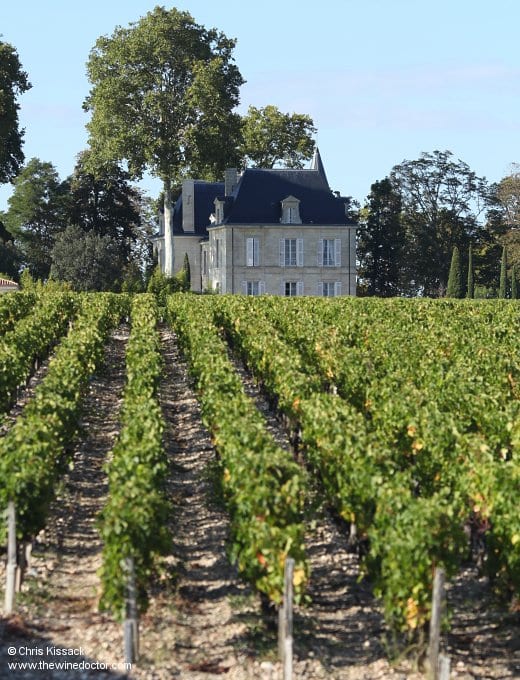
April and May were damp, and mildew threatened, although having gained a lot of practice spraying during 2007 most châteaux were quick to respond to this menace. But the flowering was affected, with coulure (failure of fertilisation to produce the fruit) and also millerandage (failure of fruit development, leaving lots of tiny berries in the bunch). Both further reduced yields. The development of the vines was retarded but a warm July, which many proprietors were keen to remind me of during the primeur tastings, helped them along. Perhaps this warmer month was a parting gift from La Niña, a cooling of the Pacific Equatorial current, which has the effect of bringing cooler weather to much of the world. This event, the opposite of the better known El Niño (a warming of the current) began in August 2007, but was fading by the summer of 2008, and probably had a strong influence on both the 2007 and 2008 Bordeaux vintages (and indeed much of the weather across northern Europe). The fruit began to change colour, but because of the erratic flowering this was rather spun out, and it was exacerbated by cool weather in August and early September. Extensive green harvesting was necessary to remove the fruit without a chance of ripening, further reducing yields, which are the lowest since 1991.

In was, however, September that again saved the saved the vintage. The warm weather arrived and ran right through into October, allowing the harvest to take place under very favourable conditions. The quality-conscious watched the grapes ripen on the vine, waiting for the right moment to pick. Atlantic breezes and sunshine dried the vineyards, and the subsequent dehydration of the grapes reduced the yields even more. Most vineyards brought in grapes in very good condition; its just that the volumes were dramatically reduced. Those that harvested later had, speaking generally, greater success; Lafite didn't start until October 1st, finishing on the 16th. Latour began on September 29th, finishing on October 7th. And it was not just first growth properties that practised such rigorous restraint; the latest harvest (although I am sure there were others comparable) I encountered was at Chateau Brown, where picking began on September 15th for the whites grapes, finishing with the Cabernet Sauvignon on October 29th. That's nearly November - not unusual for Sauternes, but certainly not the norm for the red grapes!

I will explore the different communes, and give more details on how the conditions affected the white varieties and the Sauternes vineyards, in subsequent updates. For the moment though, the soundbites for the 2008 vintage are:

Tasting the Wines

It's customary for me to give some overall view of the wines, but there is such disparity between communes and appellations this year that each really deserve their own write-up. Thus I will save the true detail for the communal reviews, and here I will only deal with generalities. First, let's deal with the elephant in the room; 2008 is no slouch. This is an excellent vintage, with at least some excellent wines from most appellations. The right bank has perhaps yielded more consistent success than the left bank, but that is not to say the Médoc is devoid of good wines. Indeed, a handful are thrilling. But on the right bank there are breathtaking wines, from Cheval-Blanc and Ausone, through Vieux Chateau Certan and Conseillante, through to less exalted names such as Beauregard and Clos Fourtet. The wines possess rich fruit, good acidity and, in the best examples, vibrant aromatics too.

Vieux Chateau Certan

As for the left bank there is great success here too...in places. But whereas the right bank wines have darker fruits, richness, depth and in some cases considerable power, on the left bank we have more vibrancy, more red fruit character, and firm acidities. This is not universal though; St Julien has the greatest success, showing lots of pure and sweet summer berry fruit backed up by crisp acidity and ripe tannins. Even a half-hearted taste of Léoville-Las-Cases, which is magnificent this year, makes plain the fact that there are excellent wines to be found on the left bank. As for Pauillac, there are more good wines, although with less convincing purity and freshness that in St Julien. In Margaux the story is more patchy, but Palmer is vibrantly brilliant, and the second wine Alter Ego de Palmer knocks most of the appellation into a cocked hat, so to speak. Save for a rather flashy Cos d'Estournel, St Estèphe was less exciting, as were the wines of the Médoc and Haut-Médoc. This is not a vintage to wantonly scoop up left bank petits vins without first tasting, in my opinion. The left bank success is much more selective than that.

So why is it that 2008 has been so much more successful than 2007, when the growing seasons seem so superficially the same? A similarity which is, perhaps, responsible for the diatribe against the vintage launched by French newspapers Le Monde and Le Figaro in November 2008....before any wines had even been made, never mind tasted. Their pronouncement was not only premature but very wrong, there are great wines in this vintage. I suspect there are numerous reasons why this is so. First, vitis vinifera is responsive to its environment, and the behaviour of the vines in any particular growing season is influenced by the previous year. So after last year's washout the vines were always going to yield less; add in the other factors that reduced yields - the green harvesting, the dehydration in September and October, and so on - and you have severely low yields, aiding quality. Secondly, although the growing season was on the whole damp, many proprietors reminded me of July, which was warm and sunny, helping the vines significantly. Thirdly, commitment and readiness from the vineyard managers; the readiness to spray against rot when required, and more importantly the commitment to delay picking, so that the fruit could benefit from the Indian summer.

I will go into more detail with my relevant write-ups, including more detail for Sauternes which always deserves separate and special consideration, as I will for the other left and right bank communes, in the next few days. (7/4/09)