
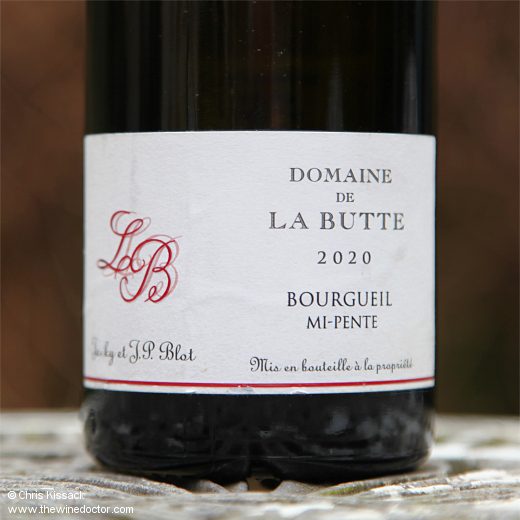
Domaine de la Butte Bourgueil Mi-Pente 2020
This week I explore the terroir of Bourgueil anew, through one of the region’s top red cuvées, Mi-Pente from the Blot family at Domaine de la Butte.
First though, a quick primer on the domaine. Domaine de la Butte is a fairly young creation, established by the late Jacky Blot. Despite its current renown, the slopes of La Butte seemed to remain anonymous through to the latter decades of the 20th century. Texts dating to the 1950s which put the soils and slopes of Bourgueil under the spotlight made no mention of La Butte at all, and it was only in the 1980s that this lieu dit began to garner some attention. Passing through the hands first of Gilbert Griffon and then Paul Salmon, the vineyard was purchased by Jacky Blot in 2002.
The domaine had a lot going for it. It had already been converted to organic viticulture by Francis Poirel, who had managed the domaine on behalf of Salmon. The terroir was desirable, being positioned high up the appellation’s limestone slopes. And deep beneath the vines Jacky found capacious cellars, hewn from that same rock, an expansive cavern large enough for multiple vats and as many barrels as he could dream of. Remarkably (although it is not unique in the Loire Valley) he found the cellars served by a shaft connecting the vineyard above to cellars below, so freshly harvested and sorted grapes could literally be dropped straight through roof from sorting table above, into subterranean vats below.
More than anything, though, it was the terroir that was key to Jacky’s eagerness to purchase the domaine. It was also key to how he carved up his first harvest in 2002, creating in the process the Mi-Pente cuvée (and a handful of others).
The defining terroir of Bourgueil and St Nicolas de Bourgueil is the ancient alluvial terrace which runs roughly east-west through both appellations at an altitude of 13 to 25 metres above the current river level. To my surprise, researching the origins of these gravelly terrace, I find they have been very poorly studied compared to the gravel deposits further upriver on the Loire, especially those on the section which runs from Briare through Orléans to Blois, as well as those along the Loir, Cher and Creuse (the latter a tributary of the Vienne).
The gravels between Briare and Blois have received attention from geologists because they tell the tale of the changing course of the Loire. Many millions of years ago the Loire followed a course from the Massif Central as far as Briare, before then continuing north to flow into what is today the Seine. Around 800,000 years ago it made an abrupt left turn, and the multiple gravel terraces found south of Orléans chart its shifting course through the hundreds of thousands of years that followed. Having initially flowed directly west, the ‘great bend’ slowly opened out, the river gradually arcing to the north, until it eventually settled on its current course through Orléans around 120,000 years ago.
Those Briare-Blois gravels are therefore no older than 800,000 years, while those along the Loir, Cher and Creuse are 1.1 to 1.4 million years old, this section of the Loire river system much older. By inference the Bourgueil gravels are of a similar age, perhaps 1 million years or older. This puts them on a par with the higher terraces of the Médoc in Bordeaux, Terrace 1 and Terrace 2, which also date to about this time (the mid-Pleistocene). Although the source is different of course; the Médoc gravels are sourced from the Pyrenees, the Bourgueil gravels have a more varied and complex origin, from throughout the lower river system.
While I think the gravels of Bourgueil give some excellent wines, it was not this terroir that drew Jacky Blot here. He was looking for limestone, and as we move northwards across the gravel terraces the land rises, and gravel gives way to limestone. Around Restigné the white chalk of the Lower Turonian appears, and along the entire slope there is a broad band of micaceous chalk from the Middle Turonian and then a thin band of yellow limestone (the famed tuffeau jaune) of the Upper Turonian. These multilayered Turonian chalks date from 89 to 93 million years of age (much older than the gravels!) and are highly prized for viticulture. Mid-slope here is the broad Middle Turonian, and it is here that the vines for Mi-Pente (meaning, of course, mid-slope) are planted.
Once picked and sorted, the grapes for Mi-Pente descend via that chute into the vats below, and then once the fermentation and maceration are completed they go into oak barrel for the élevage. Having tasted the various cuvées again and again over the last two decades Mi-Pente is consistently superior across multiple vintages. And in a warm year such as 2020, clearly favourable to the region’s reds, expectations should be high.
In the glass the 2020 Bourgueil Mi-Pente from Domaine de la Butte displays a deeply pigmented heart, almost opaque in truth, with a clearer raspberry-red rim. Currently still showing a primary style, it offers up a dense and smoky nose of warm grilled blackcurrants, toast, liquorice and tar, touched with delightful nuances of garrigue herbs and menthol. The palate sees the toasted currant and blackberry fruits come to the fore, here laced with cinnamon and scented Eastern spices from the oak, with a rich limestone grip underpinning it, accompanied by a touch of lightly drying tannin, with perhaps a little contribution from the wood in this regard. This all culminates in a sweetly spiced finish and good length. This is quite delicious now, with a lovely ripe grip, but its true worth will be seen in future years. One for the cellar; come back to this in five to fifteen years. The alcohol is 13.5% on the label. 94/100 (19/1/26)
Read more in:
- My detailed profile of Domaine de la Butte
- My reports on the 2020 Loire Valley vintage
- My guides to Cabernet Franc and Bourgueil
- My 2025 Bourgueil tasting report, Breton’s Brilliance
Find Domaine de la Butte Bourgueil Mi-Pente 2020 on Wine Searcher: 
Find all Domaine de la Butte wines on Wine Searcher: