
Breton’s Brilliance: Bourgueil & St Nicolas de Bourgueil, 2025
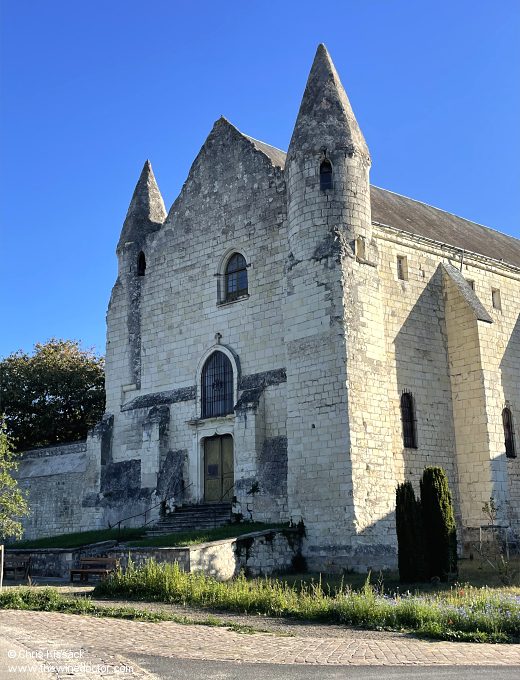
Weaving my way through Bourgueil town centre on a busy market day a few weeks ago my somewhat aimless perambulation eventually brought me to the doors of the imposing Abbaye Royale Saint-Pierre de Bourgueil (pictured below).
The abbey, which dominates the east side of the town, was founded during the final decade of the 10th century, and it would play a key role in Cabernet Franc’s eventual domination of the vineyards of St Nicolas de Bourgueil, Bourgueil and Chinon. This moment came more than six hundred years after the foundation stone was laid when, in 1631, Abbé Breton received a delivery of vines from Bordeaux.
These vines had been sent on the orders of Cardinal Richelieu (1585 – 1642), along with instructions to plant them around the abbey. The good abbot did as he was requested (a wise course of action when dealing with Richelieu), and in the years that followed he was a tireless advocate for the variety, which thus became known as the Plant de l’Abbé Breton, and eventually just Breton. I should point out there are competing theories for the origin of this name, but however it came to be known as such, the modern-day moniker for this variety is – as I think you already know – Cabernet Franc. With Abbé Breton’s backing the planting of this variety gathered pace, usurping previous favourites in the region. Four centuries later it completely dominates the region’s red-wine appellations.
While the competing theories for the name Breton also suggest Cabernet Franc’s arrival in the region was much earlier (in the 11th, 13th or 15th centuries, all long before Abbé Breton was born), many local vignerons look to the arrival of the vines in 1631 as the most significant moment. This was the point at which the Cabernet Franc touchpaper was lit, in my view making Bourgueil and its abbey the variety’s spiritual home in the Loire Valley.
Despite this, it has long seemed to me that Bourgueil (and St Nicolas de Bourgueil) have languished in the shadows cast by their neighbour, Chinon. Perhaps it is Chinon’s illustrious past, with all manner of notables – Henry Plantagenet, Aliénor d’Aquitaine, Joan of Arc and François Rabelais to name a handful – cropping up in its history. Or maybe Chinon is just a little easier to pronounce than Bourgueil (which is not as simple as it looks). Or, perhaps more likely than either of these theories, it is just that Chinon is much larger and therefore more present on both domestic and foreign markets. This has always been the case, but Chinon’s expansion in 2016 to admit another nine communes, adding many hundreds of hectares to the appellation, only reinforced its dominance.
With an expansive Chinon report in the pipeline (coming soon – and even larger than this one), it seemed only fair to me that Bourgueil and St Nicolas de Bourgueil also have their share of the limelight. The role Bourgueil played in the planting of Cabernet Franc in the region perhaps demands it, but more importantly so does the quality of the wines being made here today. As indeed they should, the Cabernet-friendly gravel terraces and clay-limestone slopes have no lesser potential than similar terroirs in Chinon, or St Emilion for that matter.
Below I report on close to 90 examples of Bourgueil and St Nicolas de Bourgueil (and a handful of other wines made by domaines based in these appellations), from names both familiar and new to me. First, though, I provide a run-down of recent vintages.
Please log in to continue reading: